Showing posts with label BRT. Show all posts

11 February, 2009

SENATE PASSES TRANSPORT STIMULUS BILL


The Photo Below is another image from Jacksonville, JTA and FDOT that they claim we don't have ready.


Concept By Robert Mann / Drawn Design by Ennis Davis, Thanks to MetroJacksonville.com

By a vote of 61 to 87, largely along party lines with some Republican cross-over votes, the Senate has passed it's version of the Transportation Stimulus Bill. It will be interesting to see how this shakes out in compromise committee. Let's hope something is left in New Starts, Amtrak, Fixed Guideway, Discretionary Funds, and State Rail Funds, all appear in abundance in the final program.

What us ready? Why we don't even have engineering or drawings done...

Grants to Amtrak
$800 m House Bill
$850 m Senate Bill

Grants to States for Rail
$300 m House Bill
$250 m Senate Bill

High-Speed Rail
0 House Bill
$2 b Senate Bill

Total Rail
$1.1 b House Bill
$3.1 b Senate Bill

Transit Formula Funds
$7.5 b House Bill
$8.4 b Senate Bill
Fixed Guideway Modernization
$2 b House Bill
0 Senate Bill

New Starts
$2.5 b House Bill
0 Senate Bill

Total Transit
$12 b House Bill
$8.4 b Senate Bill

Discretionary Grants
0 House Bill
$5.5 b Senate Bill

Remember Jacksonville, the Mayor and JTA have told you we don't have any plans... We're not shovel ready! To think we could have gotten these cars for asking.

Special thanks to The Transport Politic http://thetransportpolitic.wordpress.com/


25 January, 2009

THEORY - WHY LRT-STREETCAR OUT PERFORMS THE BUS OR BRT


WHEN, "AS GOOD AS RAIL", NO LONGER EXPLAIN THE LOADS...

OVER THE RAINBOW TO AN ANSWER.

THEORY:

First your going to have to understand this whole exercise is based on the numbers that rail nearly always beats out bus in "all things equal" performance. Nobody knows why. Countless millions of dollars have been lost in study after study as to, "Why people prefer rail?" Some simply close their eyes and ears to this, but most will clear the throat and mutter, yes, rail does seem to have a slight edge. Again and again, WHY? WHY? WHY?

It's weird that we have spent so much energy on such a basic human tendency. Believe me when I say I don't believe it's some magic bus stigma. I don't believe it's really the "Transit For The Poor" or "Who rode the short bus in school", etc. that we struggle with here. There is a silly old theory that "Rail does well because people know where it's going." PISH! Anyone that can read or hear can figure out how to use smart transit. Real time information and electronic destination signs SHOULD be more then enough to reproduce rail performance.

Would more gimmick transit like PCT BUSES (Potato Chip Truck - Thinks it's a Trolley), express and non-stop services or restroom equipped-reclining, top of the line, seat-Silver Eagle's, with full bar and tables do the trick? Busway's, dedicated lanes, HOV, guide wires, bus trains, even "slot car buses". Comfort, low floors, que jumping, signal priority or freaking flying wing buses and they'll still come up short on ridership. In view of the ridership gap, are the millions spent on BRT really worth the investment when a clear rail alternative is available? There is a ton of talent and energy being invested in reinventing the wheel. Sell it however you want, but I want to take you over the rainbow on this one.

Look hard at the image at the top of this article.

If you see The Grand Canyon with a Gateway Arch type bridge perhaps 4 feet wide, 5 miles across and 7,000 feet straight down from the peak, then we're all on the same page.

We are going to cross it. Do you hug the beam or walk? Neither.

We are starting on the South end of the canyon in North Central Arizona. ALL THINGS ARE EQUAL in this and we will assume that the grades are no problem for either vehicle. Oh, you see where this is going?

Now on the starting line you have a scaled down BRT super bus, 3.9 feet wide and 10 feet long with but two seats. It's been driving over that giant arch with a professional driver for years. Our driver of record could thread the needle with a bus at 90 MPH, and this toy is no challenge to him. BUT, is it a challenge to you?

There IS a catch to this study, just for incentive, if you don't ride, we're just going to shoot you, (mass transit, bad neighborhood, you'll understand). The "safe driver" is about to leave with our golf cart size bus and YES he will drive this bus over the arch and over the canyon. Will you WANT to jump aboard for the ride? What could we do to convince y0u? Perhaps if we added all those BRT toys? What if we added guide wires? What about? Could we?

FORGET IT BUBBA, I AIN'T GETTING ON YOUR SCALE MODEL BUS,

JUST SHOOT ME.

NEXT: Alright, now we reproduce the whole show, this time we have an identical vehicle to whatever you imagined your bus to be. The only change is THIS TIME IT'S ON RAILS. Stay on this side and we'll gladly have the our happy transit gangster shoot you.

ARE YA DEAD YET?

Not me, send a note to me in Saint George, Utah...

I'm gone on the mini-streetcar.

Did I have you thinking about it?

Did you notice a difference that two rails make? Imagine if you will, going over the circus giganticus Roller coaster with a Golf Cart? I don't think so.

The I-405 at 6:00 PM? A blow out on the I-40? A high speed collision on the I-95? Driver has a stroke? Heart attack?

Remember that in this, all-things-were-equal but the bus failed through NO FAULT OF IT'S OWN. The remotest chance of an accident on that narrow arch was enough to vote for rail. Humans vote with their instincts. No amount of dollars or engineering is going to prove that the bus was "As good as rail - only cheaper."

See you on the streetcar JACKSONVILLE, MIAMI, SARASOTA, FT. LAUDERDALE, TAMPA, CINCINNATI, COLUMBUS, COLORADO SPRINGS.


02 December, 2008

When BRT Brings On Bloodshed

Mass Transit Magazine has an article on the new BRT system planned in Cape Town, South Africa. It appears to be yet another case of the Transit Agency ignoring the will of the people in order to advance some ultra-highway agenda. For years Cape Town has buzzed along with a network of Jitney Buses in private hands, a mirror image of Santiago De Chile.

In Santiago the BRT system was rammed through right over the protests of the private Jitney companies. The new super-bus routes were designed as trunk lines and the Jitneys were expected to jump in line and carry the connections to their destination. That didn't happen. People used to getting door to door service were furious over the new bus system. The system itself quickly overloaded and became as gorged and slow as the Jitneys it was to replace. Proof enough that BRT DOES have a ceiling - and it's no where near rail.

The next step in Chile was rioting which included turning buses over and burning them for effect. Now to compound the mistake the Santiago Metro Subway System is being expanded as it offered the only viable alternative to BRT and was thus crushed in the process. Again, even rail has a ceiling, and when passengers are relegated to the position of a tuna-in-a-can, things will go over the top. The rioters didn't seem to blame the rail for the problem and saved their wrath for the BRT system itself.

One has to wonder if these projects had included the Jitneys and allowed them to be the operating arm of the new system, how things might shake out. Could the Jitney companies each be issued so many of the new buses? Could the Jitneys use the exclusive lanes? Why does BRT have to be exclusive of Taxi's? Rail? Subway?

If BRT is really the attractive alternative that it is billed to be, then why can't it hold it's own as a component of a much larger mix?

In Bogota, the highly praised system is a national joke, anyone that thinks otherwise has been listening to the prose written for you digestion by the BRT institutes. Sure Colombia would love to call it a great success, they would love to continue to pioneer this mode and sell it to you when the time comes. But when the truth gets out it's going to crash big time. No problem, the BRT camp will just point to some other "success".


Cape Town's Rapid Bus System Will Lead to Bloodshed
Peter Luhanga
Argus Weekend (South Africa)

SOUTH AFRICA - Taxi bosses have warned of a "taxi war" over the City of Cape Town's planned multi-billion-rand Bus Rapid Transit (BRT) system, which is set to change the face of public transport in the city.

While the city has stated its aim of completing phase one of the BRT by March 2010, three taxi associations operating in the greater Blaauwberg region released a joint statement last week saying the way city transport planners were implementing the system was "unacceptable".
The taxi owners - representing the Ysterplaat Taxi Association, Maitland Taxi Association and Du Noon Taxi Association (DTA) - said they had been invited to a meeting at the city civic centre offices on Tuesday where the BRT system was explained. But DTA spokesman Terrence Mhlangatshoba said they walked out of Tuesday's meeting as the BRT system undermined their business and did not take into account what they had invested over the years.
Itshaan Stanfield, appointed spokesman for the three taxi associations, said they would have no part of the BRT system.

He said the way the city was going about trying to gather support from the taxi industry for the BRT was dividing the taxi industry and would lead to violence.
"We know for a fact that this process will lead to bloodshed between permit holders and people without permits. The blame will be on the city, it will be held accountable.
"The city must stay away from us. We have come a long way with this business. They must rather invest their millions in building houses for millions of people who are living in shacks."
City director of transport Maddie Mazaza said the city had been engaging with the taxi industry "in detail and on different levels" and was "committed to pursuing this process of engagement".
Mazaza said all exchanges so far had been "frank and open".
She said the city was not aware of anyone walking out of meetings without excusing themselves and was confident a "real win-win" agreement between the city and taxi industry could be found, and engagement with the minibus taxi industry would be ongoing.

Phase one will cover the city's central business district, with a trunk route to Du Noon in the north and a link to Cape Town International Airport.
The BRT system is to be expanded to other parts of the city after 2010. - West Cape News


This battle has been fought in Santiago, and it's coming to Cape Town. One must now wonder how long until it hits our shores?

Jacksonville has had an ill advised highway based transit plan in place for about 10 years. The project includes $100 Million dollars which the City has in the bank for Mass Transit. Last night the Mayor announced that he wanted to take $100 Million of transit money and transfer it to new highway projects throughout the City. He is using the rabid port expansion as his excuse, yet 1/2 of all the many projects are no where near the port or remote warehousing.

So are we to have more highways and less Mass Transit? It sure looks like it, and what little we have will be tied up in a BRT scheme on the North side of Downtown. Something likely to eliminate local parallel routes.

This bears a close watch, shutting down our Mass Transit system, just as JTA has come to terms with some rail studies and re-planned it's North BRT line is insanity. As the news trickles in it appears to be the same $100 Million Transit set-aside that he is after. He has even pointed out the desire to cut JTA's funding and tie it to sales tax revenue. To do so will create an inability on
the part of JTA to do more then what we have seen from 30+ years of cash starved Amtrak.

The thousands of jobs the mayor is claiming will come from highway projects have not been borne out by facts. No where does highway development do anything more then create or add to sprawl. Sprawl? Yes, Jacksonville invented it - we are the largest City in the Western Hemisphere in size.

So what jobs? Those at the corner Big Lots? Mickey D's? How will those low income workers get to those new jobs without a stable bus system. The only high income jobs this will create are in road construction. With the Mayors father owning the largest concrete company on the coast this ought to be a cozy relationship.

Bloodshed? Try and pull the transit out of our urban core and watch what happens. I fear it won't be just Cape Town getting the headlines. No problem, the BRT camp will just point to some other "success", but it won't be Santiago, Cape Town, Bogota or Jacksonville.


23 November, 2008

PRISONERS OF THE WHITE LINES ON THE FREEWAY


Well it's not much but it is a first effort at "Cyber-Art", with nothing more then "Paint" and a free Photobucket Account. What do you think? Look like anyone you know? Maybe a whole city full of prisoners? Yes, for those old enough to remember, the line came from the song "Coyote", by Joni Mitchell. While the song itself was about a whole different set of urban problems, either in lyrics or reality, yet the end result is the same. Somehow we are all "Prisoners of the white lines on the freeway..."


To paraphrase a fellow 60's radical to all of you in Computer Land, "STEAL THIS IMAGE!"


11 November, 2008

BRT EVERYONE CAN LOVE!


FINALLY SOME COMMON SENSE

Bus Rapid Transit is on it's way, not the $26 Million Dollar a mile version either, rather a system called Light-Rail-Lite. Please understand that this whole project has been something short of a local war.


Initial route alignment had JTA building a "super-bus" freeway right along Interstate 95 (the main N-S route on the East Coast) from downtown to the Gateway Mall. At Gateway, the BRT line would meet regular city buses for the Northwest side of town. Northwest Jacksonville is by far the most transit dependent segment of the City. Yet NOBODY lives on I-95. So with all the money, concrete, steel and time involved, we were looking at one short leg of a 4 legged - BILLION DOLLAR BUS.

After thousands of articles, here and elsewhere, after explaining our need for rail as our primary trunk system, and BRT as our primary feeder, it would seem the message is finally sinking in. The system now proposed is a much less involved build. No 30 year wait to ride the buses either. Using surface streets - and better yet a main artery that is little used but connects the whole city, JTA has hit on the formula for BRT success. HOV lanes, Lem Turner Road, Shand's hospital and future commuter rail all out of the box on about the same date. Run Jacksonville RUN! Scott, Suraya, Please take a bow.

Here's the news:

JACKSONVILLE DAILY RECORD

11/11/2008
by Joe Wilhelm Jr.
Staff Writer


A vision for the future of Downtown transit including city buses feeding trolley routes to reduce congestion on city streets has moved another step closer to reality.
The Federal Transportation Administration (FTA) and Jacksonville Transportation Authority (JTA) are planning improvements to the local public system and Phase One of the Jacksonville Rapid Transit System has received approval from the U.S. Environmental Protection Agency. JTA will soon be requesting bids for the design of the improvements.
“It’s an important first step to get this rapid transit system started,” said Scott Clem, director of strategic planning for JTA. “It’s also a step toward having a multi-modal transportation system in Jacksonville and Northeast Florida.”
The JTA plans to have the final design for Phase One by the end of 2009 and complete construction by the end of 2010.
“Our goal is to have this phase and the Jacksonville Regional Transit Center (JRTC) opened at the same time,” said Clem.
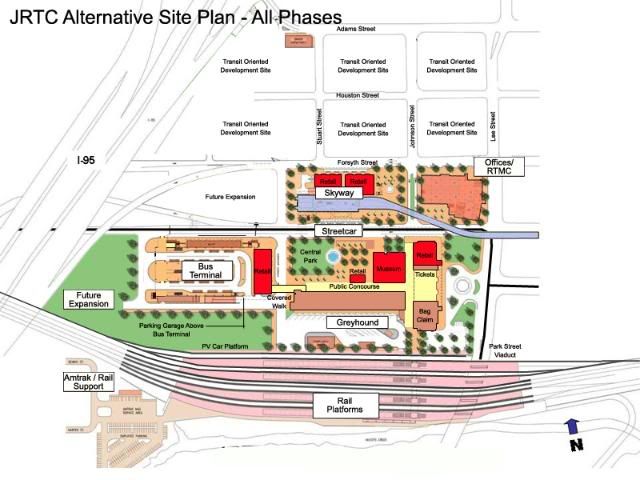
The JRTC is planned to be built across the street from the Osborn Center on the north side of the exisitng Skyway terminal. The center will include Greyhound and JTA bus terminals, Skyway access and an Amtrak terminal.
The $15.5 million Phase One project will include dedicated bus lanes along Broad and Jefferson streets, installation of transit signal priority equipment on bus routes and real-time bus schedule information supplied through GPS systems.
Transit signal priority systems utilize equipment on buses and traffic signals that will detect when a bus is at a stop near a traffic signal and, if the light is green, will prolong the green light to allow the bus to get through the intersection. The GPS equipment will provide transit customers with arrival and departure times for buses at each stop.
Phase One moved into the design phase after receiving approval from the U.S. Environmental Protection Agency after the project underwent an environmental assessment, which is required by the National Environmental Policy Act of 1969. Factors analyzed during the assessment include social, economic, environmental and transportation issues.
Each analyzed factor was then further broken down. The social and economic factors considered included neighborhood/community impacts, cultural resources, economic impacts, environmental justice and property impacts. Environmental factors included air quality, noise and vibration, hazardous material sites, water resources, parks and historical sites.
Traffic, parking, transit operations and ridership and construction impacts were the transportation factors analyzed.
After all factors were reviewed, a finding of no significant impact was submitted to the EPA, reviewed and approved.
Just like the trolleys rolling through Downtown, the Jacksonville Rapid Transit System is moving right along and the next phase of the project is underway.
As the design phase on the Downtown project begins, a public hearing will be held to discuss the North Corridor project. An environmental assessment is being conducted by JTA to determine the type of transportation improvements needed north of Downtown.
The 10.5-mile corridor stretches from Downtown along Boulevard Street to Gateway Mall and continues north along Norwood Avenue/Lem Turner Road, ending south of Armsdale Road near I-295.
The first public meeting to discuss the project was held Monday. Another public meeting will be held from 6-7:30 p.m. on Nov. 17 at Florida Community College at Jacksonville North Campus in the room C-126 auditorium. The public meetings have helped JTA find out what the public thinks about the planned improvements.
“We’ve had a mixed response to the rapid transit system project,” said Suraya Teeple, JTA transportation planning manager. “Some people are concerned that some of the connections won’t be made, but this is the first phase, so right now we are working on educating the public on what they can expect from the new system.”


08 November, 2008

ODE to BRT - Our Savior

JTA - "The Dream", FILE PHOTO

Ode to BRT, the story of what will happen if the largest City in the South gets to murder it's railroad plan for a system of BRT buses. Why the previous story posted without it's title is any ones guess but read on down, and you'll find the poem of the BRT system - our be all - in all - save all - bus network.

We are NOT against BRT - just don't try and build a bus into a train and don't expect a train to be a bus. It just won't happen - won't work.

So please enjoy this light-hearted look ahead into some future nightmare in Jacksonville.


ODE TO THE JACKSONVILLE BRT PLAN

"There's a Hooker being cozy with a Jacksonville cop."

"Stepping off this dirty bus first time I understood..."


Imagine if we scrap our rail plans for the "super bus" BRT system. The newspaper is already running "hit" pieces on rail failures, lack of profit and imagined expenses. The CD player just ran the old piece "Greyhound" by the Late Great Harry Chapin, (who by the way was killed on a freeway when his car was crushed by a large over the road vehicle). So with apology's to Harry, here's my take on BRT as the sole system in the 3RD largest City in the East.
"I find a seat
And we move out in the lights."


"Everybody's looking half alive."
It's midnight at the bus stop
And I drag myself in line.
Travellin' light, I got to go
But the bus won't be on time.
Everybody's looking half alive.
Later on the bus arrives.

Got my prepaid ticket
I find a seat
And we move out in the lights.
Come on Driver, where's the heat?
It's cold this Jacksonville night.
I keep telling to myself that I don't care.
It's now tomorrow, I'll soon be there.

Using this BRT, It's a dog of a way to get around.
Riding around on BRT.
It's a dog gone easy way to get you down.
Tired of watching this City go by
So I look across the aisle.
The window's frosted, I can't see
But the girl returns my smile.
She reminds me of someone waiting at my home.
So I doze. So it goes.

I'm wrinkled on my seat at the transfer stop.
There's a Hooker being cozy with a Jacksonville cop.
My coffee's tasting tired.
My eyes roll over dead.
They should have built the rail, and got the gas out of our heads.
Oh, to be at home in bed.

You got me driving.
I'm on your JTA bus and you're driving.
But there's nothing new about JTA.
Nothing new about feeling grey.
Nothing new about putting off
Or putting myself on.

Looking for tomorrow is the way the commuter survives
I should have realized by now that all my life's a ride.
It's time to find some happy times and make myself some friends
I know there ain't no rainbows waiting when this journey ends.

Stepping off this dirty bus first time I understood
There's got to be an alternative that's good
That's a thought for keeping if I could.
There's got to be an alternative that's good.


08 September, 2008

Doctors of Transportology in Jacksonville?

An adaptation of a 1948 story by L. Beebe


Every now and then this blog ventures into a discussion of some phase of the transportation business because (a) he is a transit dependent child and has lived in nothing but shebangs, bus benches , and hobo jungles, of one degree of stateliness or another for the past quarter century; (b) because almost everyone likes to read about streetcars, buses and trains; and (c) it is probably the most fascinating single business in the world from the inside, and transportation men probably know more about human beings by the time they are junior hostlers and dispatchers than the most learned psychologists in Vienna when they are at the top of the professoring business. Everything happens in transportation, and now and then a play- wright or a novelist who recognizes them as an unrestricted hunting ground and one with no season makes a fortune out of his discovery.

There isn't, however, much that one can write about transportation that makes the State and Municipal Agency's happy unless it is unmitigated goose-grease and undiscriminating flattery. An individual passenger manager can abide reading that his own conveyance is the quintessence of lux, is patronized solely by the old nobility, or in the case of rail, that its food service make Voisin in Paris look like a hamburger joint. But remark that anyone Else's passenger system is comparable to this degree of elegance, and he is sore as a leading lady whose name has been spelled wrong in the reviews of her opening. A few months ago I remarked that I , as I am now, in favor of mandatory jail sentences by Federal statute for transit managers who charge from a dollar up, or indeed anything extra, for a single transfer, restroom, coffee or extra bag, and since that time this blogger has spent most of his time in foxholes avoiding angry missionaries from the State and City who want to sell him on the proposition that charging for restrooms or coffee or transfers or baggage, a preposterous and tactless larceny on the face of it, is practically something to be listed as an improvement in the service.

Pish and nonsense. Transit companies have gotten away with so much murder during the past few years of easy money and immigration to cities that in many cases they have come to regard the passenger or commuter as a boob or zany, who is no better than a victim type and fit only for insult and pillage. The time may be at hand when they will think differently. Certainly any reasonable intelligence hopes so.


Probably the trouble with all too many Transportation Companies or Agencies is that they are managed and staffed by young men. It should be perfectly obvious that no man is fit for an executive position in any transit operation, let alone one which requires his coming in actual contact with the passengers, until he is fifty. By that time he has possibly acquired sense and probably manners. It may have been a crazy baboon with a credit manager's intelligence or it may have been a recent graduate from the UNF College of Transportation and Logistics, but it was certainly no Transportation Manager of mature judgment or wide experience who dreamed up such an insult to his passengers as charging them for our Skyway, or transfers or baggage. It is conceivable that some Agencies, crazed beyond the ordinary with rapacity, would like to charge extra for the reclining seats and run a separate account for the use of the restrooms (if any) and fuel, but these aren't generally considered reasonable by the standard American Transportation code of ethics, although they may be at any time.


The art of running a deluxe transportation service has almost disappeared in the United States, and it is because government ownership, knowing that no outrage against decency is beyond the capacity of an ambitious young man anxious to get ahead, turned their properties and especially their front desks over to the juveniles. These shiftless, undressed, and uncourtly little juniors, to whom a named passenger train with its French menu is a mystery and who do not even own, let alone wear, proper morning clothes, have taken over responsible positions once held by experts and veterans in whose generation of manners and graciousness no carrier could dream of a manager's job at a Railroad Street bus garage until he had served behind stairs for at least forty years in the more distinguished trains of Jacksonville's old Seaboard, Atlantic Coast Line, Florida East Coast, Southern, Trailways or Greyhound lines. When he could speak six languages flawlessly, could identify a hundred different Rhine wines by reference only to the aroma of the cork, and knew every traveling person of consequence in the United States and England by sight and that instanter, he was entrusted with a probationary job as a night assistant passenger conductor. Nowadays the graduate of a school of transportation management considers himself a failure if he isn't resident managing director the week he has learned that streetcars and potato chip trucks aren't the same vehicles. The manager of one of Florida's highest ranking transit properties, while he may be an excellent purchasing agent or even a personnel manager, is still in his early thirties, and it is the opinion of most of the ridership in his august property that he should be put away out of sight for another twenty-five years.

03 September, 2008

WHEN BUSES FAIL AT BUSINESS ATTRACTION

Scottish Electric Trolley Bus in Action
Diesel bus at a University Station, note the dirty glass panels

A lot can be said for the idea of placing a lite-BRT (Bus Rapid Transit) system at various points on our proposed Commuter Rail, Streetcars or even our Skyway. These limited busway's would flow in from the outer suburbs and bring in passengers that would feed into the trunk system. Wherever possible, the transfers should be designed as seamless and across the platform "easy".

National numbers for large developments along BRT systems is not good. In fact international numbers are not great either though they exceed those in the USA. These developments known as TOD (Transit Oriented Developments) focus on less parking, less-auto, and pedestrian friendly atmospheres, usually centered around a transit station. Some of the "ideals" are the Live-Work-Play type developments.

Claims have been made that in Jacksonville, as-if we were a unique island, we would obtain Billions of dollars in new developments along our BRT bus system. There are many reasons beyond the numbers that say this simply isn't true. Primary is the "flexibility" of the bus itself. This was the big sell, when the streetcar lines were closed down by GM-FIRESTONE-PHILLIPS-STANDARD OIL. They'd come into a city with millions of dollars to spend, throw our some "gifts" then wine and dine the political powers, explaining the city's of the future will be built on highways and oil, endless sprawl and freeways. Bus routes could and would change with the growth tide and to try and do that with streetcars would "bankrupt society", or so they claimed. The point of sale was F-L-E-X-I-B-L-E ! Today in a fuel short world, that very concept has came back to haunt all of us. No self respecting developer wants to sink limited millions into a massive development around a "flexible" transit mode. Here today and gone tomorrow? There simply are no guarantees.

Another argument that has raised it's head locally is being addressed in Brooklyn New York today. Buses for the most part have dirty diesel engines which spew a smelly mix of carbon particles and sulfur into the air. Where the bus stands, the walls are black with carbon. Recently a rash of local Jacksonville articles questioned the wisdom of the Regency Square Shopping Mall's bus center being a 100 yard dash through traffic, and tropical weather. It is located far across the parking lots near the Arlington Expressway. So playing dodge cars, and lightning bolts, dragging the stroller and 3 bags, any self respecting shopper is turned off by the situation. In the end JTA loses and so does the mall and the city. Let's look in on Brooklyn for a fix:


Ikea’s bus fix; Superstore’s shuttle no longer an ‘idle’ threat
By Sarah Portlock
The Brooklyn Paper

The Ikea bus-aster at Borough Hall and in Park Slope, has been resolved.

Earlier this summer, residents of Brooklyn Heights, Carroll Gardens and the Slope were enraged that Ikea shuttle buses were idling and blowing diesel exhaust into the air at their loading and unloading zones in those neighborhoods. The buses show up every 15 minutes from 10 am to 10 pm on Joralemon Street near Court Street and at the intersections of Ninth Street and Fourth Avenue and Smith Street.

Last week, officials with the big box superstore met with Community Boards 2 and 6 last week and announced that they had fixed the problem by hiring more dispatchers to regulate bus schedules.

Ikea spokesman Joseph Roth added that the mega-retailer is also doing its own monitoring.

And it’s working, community leaders said.

“It seems, for the most part, we have resolved our issue at Borough Hall,” said Community Board 2 District Manager Rob Perris, who was among the first to demand that Ikea fix the idling problem.

Residents near the Park Slope and Gowanus locations said they were concerned about traffic congestion and were confused about where exactly the buses stopped — but traffic there has also calmed, a visit revealed.

“They can’t do much better than that,” said Boerum Hill resident Bill Harris.
A public meeting will be held this fall to discuss any remaining issues with the store’s transportation offerings, said Community Board 6 District Manager Craig Hammerman.

BACK TO JACKSONVILLE'S BLOG

So what should the Jacksonville solution be to the question? Leave the TOD entirely to rail and streetcar? No. But fix the BRT in such a way that it will attract it's own share of investors along it's routes. The best assurance that the bus isn't going away, is overhead electric or trolley bus. While slightly more expensive then standard or hybrid buses due to the overhead, costs are still no where near the original estimates for the more expensive "Quickway" or exclusive bus freeways we originally proposed. The Quickway system was around 26 miles in length and would cost about 26 million a mile to build. A modern overhead trolley system could be built for about 1 million a mile, plus the price of the buses.

We also would reap the benefits of a clean electric system for the corridor bus routes. While some detractors will claim the power is generated by coal at JEA and thus isn't pollution free, there is certainly no rule to say this must remain the status quo. An example is found in Canada, where an electric transit system many times the size of ours is powered by a wind farm. Image alternatives, solar, wind, gas. Even at it's worst, with dirty coal (anthracite coal burns cleaner) the electric bus still removes the pollution from the walls of the Mall, the downtown buildings, and transit stations, to some distant power facility. I think that makes it very attractive to us all.

26 August, 2008

JACKSONVILLE REGIONAL RAPID TRANSIT - THE TRUTH BEHIND THE HYPE


JACKSONVILLE TRANSIT TRUTHS
Adapted from an article in the Marin Independent Journal
By Robert W. Mann

Some bare truth about the promises and complaints made about a Jacksonville Regional Transportation System. Considering a complete system as Light Rail-Streetcars, and Commuter Rail, which for the purposes of this article I'll lump together under LRT. Also a network of limited Light-Rail-Lite-BRT lines to feed into the LRT trunk and perhaps the Skyway, all of this complimented by a network of neighborhood transit buses that would tie it all into a complete network. So is this promise of a Jacksonville Regional Rapid Transit System ( or JRRT) really a transportation Valhalla? I'll be honest and you be the judge.

Will JRRT solve the traffic jams on the freeway?

The simple answer is no. There is no realistic solution to the perpetual rush-hour traffic jam. Even widening our freeways and highways will not do the trick. Suburban highway gridlock is a nationwide phenomenon caused by a land-use model based on single-family homes sprawled over a wide area. What JRRT can do is provide an auto-free alternative.

Would JRRT only help Jacksonville or downtown Jacksonville?

Yes and no. The biggest effect of the JRRT system will be to take Clay, St. Johns, Nassau County -residing workers to their jobs in Jacksonville. As long as Jacksonville, housing and cost of living are higher, its labor force needs to live somewhere. Many logically choose more affordable surrounding Counties. It's in Jacksonville taxpayers' interest to facilitate the commute for workers essential to the county's economic health and to do so in an environmentally sensitive manner.

Are there are other less costly solutions?

The reality is the retail clerks, office staff, restaurant workers and building trades employees who live in Surrounding Counties and help form the backbone of Jacksonville's economy can't telecommute. A separate BRT quick way-busway costs almost as much as rail and will, in the end, result in more buses and more roads without a marked upsurge in ridership, bottom line? Good transit needs to "Mix your Modes", offer choices, and network. BRT alone without rail will fail. Likewise rail without BRT or quality bus feeders also fails. Futuristic dreams such as our Jetsons-style monorail, for anything but local shuttle service, will be far more expensive than rail even in the unlikely event that their technical aspects are perfected. Remember, Buck Rogers technology costs big bucks. Except for corporate sponsored systems, anyone who claims their proposal will not cost taxpayers a cent is either a charlatan or hopelessly naive.

But isn't JRRT LRT ideas 19th century technology?

Untrue. The Europeans, Japanese or Chinese are all expanding both their commuter and long-distance rail lines to 21st century standards. Modern rail systems are regarded worldwide as an environmentally sensitive way to move large numbers of travelers. It's the single-passenger petroleum-propelled auto that represents the technology of the past.

Will anyone ride JRRT once its in operation?

That is a fair question with no definite answer. Will the trains run empty or will long-term spikes in gas prices boost patronage past JRRT's projections? Proponents of new rail systems tout ridership successes and opponents emphasize failures. If the numbers are substantial, the naysayers will disappear. If they tank, the Jacksonville will never hear the end of it. Of course, when the Matthews Bridge was proposed, some claimed that few would ever pay a toll to cross a highway bridge to no where.

06 August, 2008

HOW BAD DOES JTA SMELL?

By Robert Mann

In Jacksonville for years the cry of the masses is that our "buses stink," they are dirty, filthy, smell like body odor of the unwashed masses, tattered, inept, unreliable, uncomfortable and often downright rude. A broken welfare transit system, home for the homeless, drug dealers and hookers, is certainly no place for an up and coming employee or executive.

But how true is that image? Has the transit of the masses been so neglected so as to sink into an irretrievable ninth circle of Hell?

Consider our role models, both our parents and relations. An editorial in Mass Transit Magazine last year looked at vacation season and asked if any of us had ever been on a public transit vacation? The author then took the extension to the extreme in stating that even Hollywood Movies and Recordings, avoid public transit in general, and buses in particular.

I had to say, I do remember traveling on a Greyhound Super-Scenic Cruiser sometime back in the early 1960's. As I recall, the passengers seemed to all share an obvious economic depression, but the polished driver sang all the way south. Helping little old ladies aboard, and overweight beach bums with their blankets and packs. The old route ran down Florida's scenic highway A-1-A from Jacksonville and the Beaches, to St. Augustine, Marineland, Flagler Beach to Daytona Beach. Often in easy sight of the Atlantic Ocean surf, or the many colorful shops and hotels that dotted it's route. But the whole experience had the cloud of some depressing due for the company axe, a prediction in my young mind, which turned out to be quite accurate. Almost every hamlet had it's stop, and it seemed to be well patronized in it's once daily, down and back schedule. Then one day, it simply was no more. It was as if the tides had washed it away like so many grains of beach sand. Driving the route some years later, I was listening to Harry Chapin's song "Take the Greyhound, it's a dog of a way to get around..."

A-1-A is much wider in most places today. The hotels are more grand, the restaurants are national and international chains. Even the tiny airport or two south of Jacksonville, are now regional jet ports. While Marineland and it's hotel have faded, St. Augustine and the dozen or so State and National Parks this little trip passed through sure haven't. In fact, when I made that trip, Jacksonville had a population of about 202,000 persons. Today the City is the third largest populated place in any of the east coast states.

So was it really Hollywood? Recall if you will that the "Bob Newhart," show, started and ended with stunning images of Chicago's CTA trains. Then there was Doctor "Patch Adams," who took the bus to find himself in a mental hospital. "Trains, Planes and Automobiles," and movies such as "Airplane," had us rolling on the floor laughing at the overall shortcomings of the transportation industry. Anyone remember Mr. Ralph Kramden? Ralph Kramden, played by Jackie Gleason, on the famous 1950's TV comedy, "The Honeymooners," Ralph was a bus driver for the fictional Gotham Bus Company. Though he was never seen driving a bus (except in publicity photos), but was shown multiple times at the bus depot. Ralph was frustrated by his lack of success, (apparently being a bus driver even carried a stigma in the 1950's) and often developed schemes designed to earn him and his wife a quick fortune. Ralph was very quick-tempered, and frequently resorted to insults and hollow threats of violence.

So while the Hollywood jury is still out on the bus business, our own local JTA has had a year of bad press. Bus drivers tossing passengers off the bus, fights over fares, refusal to carry passengers, complete lack of "ANY TIME" information, non-existent route maps, and now a roving Gnome who is blogging a journal of doom, "30 days with JTA," that will now be expanded to 90 days after a near fist fight with a cursing, irate, driver. The driver stopped at an unmarked stop across the street from a marked location. Perhaps the sign was simply missing, or perhaps for traffic reasons it was never placed. However JTA information told our stalwart passenger to flag down the bus. He did as he was told, and stepped aboard only to catch a full broadsides of foul language and demands that he get off the bus, walk the two miles to the next stop, or, the police would be called to eject him. As his journal has caused a constructive discourse with JTA management, he was immediately back on the cell phone to JTA information and soon talking with the supervisor.

Needless to say it got even more ugly when the driver still yelling, told him, "Oh I'm sure your talking to my boss, you can tell him to XXXX too!"

Is it an obvious case of "The Jacksonville Transportation Authority Stinks," with service boardering on the tenth circle of hell? Not at all. JTA is in transformation from a large southern city system, to an international city metro. Certainly there are bumps along the way, but managment is doing exactly what it should be doing with this case, this journal, this rider and information. It is meeting en-masse, and not just for damage control, but reaching for real solutions. Listening to what the public is saying. Sweeping changes are coming to the bus portion of JTA, and I'm confident they will be quickly followed by monorail (The Jacksonville Skyway), light rail and commuter rail, additions and improvements. Things happen for a reason, and no matter how beautiful the new Gillig BRT model buses, if the driver's attitude chases away the would-be patrons, then the bus "stinks".

Our solution is not simply that new vehicle smell on the same old machine, but a complete re-thinking of the industry. Out of the Box, and even perhaps out of the old bounds. There is that route down A-1-A just waiting for some lucky service to pick it up and market those beach side resorts. This is Florida's First Coast, home of the nations oldest city. Today all of that falls within the bounds of the Jacksonville Metro Area and the potential reach of JTA or a joint venture of JTA and another franchise, such as Trailways or a charter carrier. We are talking fare free in Jacksonville, preboarding tickets or passes, fun buses, day trips, and maybe even singing drivers. All along the booming coast we have construction, new jobs and massive port expansion. Home to more fortune 500 companies then any other two Florida Cities combined, we have a new, urban and financially powerful workforce. There is national exposure in our Arena and Arts, and our NFL Jaguars or the home of the PGA at Sawgrass, have changed our posture. No longer can we afford to operate the old bus system of the past and JTA knows it. We still have miles upon mile of untouched roadway, and untouched beach sand... I say it's time that Jacksonville and JTA build some castles in the sand. Any of you old enough to remember the Chapin Greyhound song, will recall, he ended it in reflection of his bus trip... "A thought for keeping if I could, It's got to be the going not the getting there that's good."

29 July, 2008

MASS TRANSIT MIX - A HUGE LESSON FOR JACKSONVILLE

WHAT WOULD A STREETCAR AND SKYWAY DO FOR JTA BUSES?

Trends Blur Line Between Bus and Train
Elisa Crouch and Ken Leiser
St. Louis Post-Dispatch

MISSOURI - For years, many St. Louis transit riders fell into one of two camps.
After it opened in 1993, MetroLink appealed largely to middle-income riders who used light rail to get to college campuses along the tracks, to office buildings in downtown St. Louis, and to special events at Busch Stadium, the Trans World (now Edward Jones) Dome and the Kiel (now Scottrade) Center. Most had cars in the driveway.

Bus riders were generally working-class, and many of them had fewer options when it came to getting around. The bus was more a necessity than a choice.

But the latest research put together by the Metro transit agency shows some erosion in those class divisions.

Part of the reason is the way today's MetroLink is fed by the bus system.

MetroLink operates as more of a hub-and-spoke network these days, where buses feed the trains - and vice versa. That means many traditional bus riders use the trains for parts of their trips. There also are more bus transfer centers, including those at Hampton Avenue and Gravois Road, Broadway and Taylor Avenue, and Ballas Road and Highway 40.

Growth of the MetroLink system and new express bus service has extended the reach of transit as well, making it available to more people.

Another reason, of course, is that gas prices have shot up to nearly $4 a gallon. So the group of people who see transit as a necessity - or a bargain - has grown a bit.

Half of today's bus riders say they have a car, truck or motorcycle in their household, according to preliminary findings of this year's onboard customer survey. In 1993, about 70 percent of bus riders said they either didn't have a car available to them or didn't drive.

In this year's survey, 3 percent of bus riders reported household incomes of $100,000 or more. By way of comparison, 8 percent of MetroLink riders were part of that income bracket.

Most bus riders have Internet access (61 percent), own a cell phone (70 percent) and use text messaging (58 percent), according to the survey.

Thirty percent of bus riders have been riding less than two years. Those newer bus riders, according to the survey, tend to have slightly higher incomes than established riders.

"We've seen a lot of the kind of stereotypes of these rider groups kind of disappear as time has gone on," said J. Todd Hennessy, manager of market research at Metro.

"It's a more diverse system," said Jessica Mefford-Miller, the agency's director of research and development.

Tom Shrout of Citizens for Modern Transit said that he had heard the knock that MetroLink was at odds with the bus system, but that he had never subscribed to it. "The bus system was in free fall until MetroLink opened," he said. "The ridership on MetroLink helped stabilize the bus system."

Shrout says a transit system that appeals to more people stands to be more robust than one that does not. He points to development popping up along the Forest Park-to-Shrewsbury MetroLink line as evidence of that.

16 July, 2008

BRT STILL GROWLING DOWN THE ROAD ASLEEP AT THE WHEEL


A LINE BY LINE CRITIQUE OF AN ARTICLE ON
BUS RAPID TRANSIT
IN THE CITY OF JACKSONVILLE AS PUBLISHED IN
THE FLORIDA TIMES-UNION

JTA's fast bus program still in the planning stage

The Federal Transit Administration will provide some funding.
JacBy LARRY HANNAN, The Times-Union
and commentary by "The Jacksonville Transit Blogger"


Richard Ervin believes the bus system in Jacksonville could run better than it does now.

This is true, and almost any citizen of the city that has ever used our transit system would agree.

While waiting for a ride at the Florida Community College at Jacksonville Station, Ervin said people can't always rely on the buses operating on time.

Rely on a system that is held captive to the wild fluctuations in Florida's traffic and eternal construction zones. We all know someone who is getting up at 4 o:clock AM in order to make a simple bus trip to a 8 - 5 office job.

There are often delays in traffic, and they can't always be relied upon to get to work on time, he said.

In response to complaints from people like Ervin, the Jacksonville Transportation Authority is starting an effort to improve the public bus system in downtown and suburbs . The effort involves putting more buses downtown, with new bus routes that would be more efficient than the existing routes.

Remember the promises that the Skyway would replace the bus downtown? Thou shalt NOT build BRT under thy Skyway! While the hearings would have one believe that the new rapid bus will become the "be all" and "save all" of Jacksonville Transportation, I couldn't disagree more on the point of the plan itself. Running new highways for buses and the sudden flood of buses predicted is due to fail for many of the same reasons the Skyway has lapsed into premature rigermortis. High start-up costs, soaring diesel fuel pricing, and lack of training. For over 100 years Jacksonville has had some form of "bus" that ambles along the roads every 40 minutes, with 5-10 passengers aboard. Just because we brand it, and run some new buses every 5 minutes doesn't mean all of those passengers will suddenly show up and fill our seats. They must be trained and that will start with the CURRENT system cutting the headway's from 40 minutes, to 20, then to 10, then to 5. At that point passenger loads and demand will drive the construction of betterment's such as BRT. With few exceptions, Jacksonville is getting the cart before the horse.

JTA will hold two public hearings at Jacksonville City Hall on Thursday to discuss this effort. The agency is billing the new effort as Bus Rapid Transit.

The agency isn't billing this as Bus Rapid Transit, the Federal Government is. BRT is a planned system of building dedicated busways which try very hard to look just like Light Rail Transit. Rather then train tracks, there are mini-Freeways. Mr. Ervin, is right, the system could operate better then it currently does. But a bus system needn't cost a Billion dollars with nothing more to show for it then a few new buses and a few miles of mini-freeway.

Transportation officials will discuss their plans to improve the bus system at these hearings and seek comments.

Another dog and pony show in order to fulfill the requirements of federal funding applications. This is NOT some suddenly benevolent JTA program reaching out to touch your heart and mind for the good of the City and our fellow citizens.

JTA does not yet have specific routes, costs or a timetable to institute Bus Rapid Transit. The plan calls for a restructured bus route system focused on key downtown streets, dedicated bus lanes during peak hours of operation and traffic signal priority.

This describes the Light-Rail-Lite model of Bus Rapid Transit. Certainly this makes more economical sense then the massive Quickway or "Mini-Freeway" model. The worst part of our own local plan is the relocation of the downtown routes North-South or East-West all onto just 2 to 4 streets. Oddly the new "superbus" would roll along right underneath our seldom used Skyway.

Traffic signal priority would be achieved by having devices on the buses that keep the traffic lights green when a bus is approaching that light. This would be done when a bus is running behind schedule, said JTA spokesman Mike Miller.

In other words, any driver that rolls up to a stoplight, is not likely to stop his bus. The idea seems great for bus riders and many of the public will think how quickly it will move the traffic, but they'd be wrong. If the lights are on a timed system, and a great deal of Jacksonville IS, then some yahoo in a bus would throw off the sequence for the rest of the day.

JTA is preparing to institute Bus Rapid Transit in conjunction with the Federal Transit Administration, which will kick in some money for the new system.

Under the Federal "New Starts" and other programs "BRT" is labeled as a system or product just as streetcars or subways are. By jumping through every hoop, the City can indeed obtain funding to lock us into a BRT system on some of the trunk lines.

The current bus system has 48 routes that are centered in downtown Jacksonville. Most of the routes connect at the FCCJ Station.

Apparently our newspaper doesn't know the FCCJ station has a name, "ROSA PARKS TRANSIT CENTER"

JTA is planning to build a new regional transportation center along Bay and Forsyth streets that will become the hub of the new public bus system.

Building this new Transportation Center next to the current Jacksonville Terminal, which is being used as a much-too-small convention center, borders on madness. The City of Jacksonville needs to address it's convention shortcomings and get the facility empty so buses from JTA, Greyhound, Trailways, and trains from AMTRAK could all mix with the Skyway. There is even a partial tunnel system that could tie it all together.

After looking at the downtown area, JTA plans to focus on improving bus service in other parts of the city in future phases of the project, Miller said.

We can hope that the system adjusts it's efforts to direct this new money toward Commuter Rail, rather then BRT. The trouble here is that 3 out of 4 of the proposed busways follow right alongside the railroads. Only Arlington has a stand-alone shot at success. Meanwhile just adjust the other 3 trunk lines a few degrees and the badly duplicate system suddenly becomes a balanced ballet of buses-trains-and monorail. For example the North route planned for I-95, where nobody lives, could swing slightly Northwest and open a whole new Transit dependent neighborhood to faster, safer, better service. Rather then I-95 Gateway as a route, we end up with even more BRT using Moncrief, Norwood and Lem Turner, tying into rail Shands or Union Terminal.

The agency sees Bus Rapid Transit as part of a future regional transportation system that includes the existing Skyway, commuter rail and possibly boats that can transport people throughout Southwest Florida.

Someone was asleep at the wheel here, we live in "NorthEAST Florida". Also note that in spite of the claims to be deep n a streetcar or Light Rail Study, the reporter completely missed that point. But then again, he might believe he's in Naples.It's all good though, someone give him the phone so he can ask JTA, I'm sure there is a plan... Somewhere.

Bus Rapid Transit has been criticized by rail proponents who want to see JTA focus on building a commuter rail system. JTA officials claim the solution to Jacksonville transportation problems include both rail and buses.

In this JTA is correct. It WILL require layers of mass transit, overlaid into a tapestry of layers. Not just downtown, but in Town Center, Beaches, Regency, Orange Park and other locales. But it is impossible to make a fine garment if every stitch follows the same path.

10 July, 2008

THE STATE OF JACKSONVILLE BUS RAPID TRANSIT

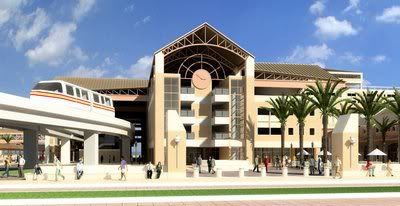
Miami-Dade South Busway BRT system


For 30 years, I have played the attack dog for lame transit schemes that have rolled out of city hall in Jacksonville. The latest of these attacks have been directed at JTA's BRT system. Perhaps it's time to explain my stand on BUS RAPID TRANSIT and how it would and wouldn't work in Jacksonville.

First understand, no one can quite explain what Bus Rapid Transit, or BRT, really is. To make it elementary, let's just say it is a cafe or smorgasbord of bus transit toys, laid out to pick and choose from. Depending on the extent of investment and the number of additions and betterment's, a regular bus provider can become a magic BRT magnet.

BRT comes in two forms, the very expensive, first proposed for Jacksonville, rivals Light Rail in Costs, with few extra benefits and at least an equal number of faults. This system is known as "QUICKWAY". Usually it involves completely grade separated bus ways, without a single cross street, pedestrian cross walk, or railroad crossing. In effect a freeway for buses. Stations are grand affairs, some with shopping and other services built in. Buses run fast and frequent. Other features might include railroad like signals for traffic control, real time digital information signs, ground level boarding, GPS bus locating service. In short, it's a great concept for a medium to high density route with very frequent "headways" (times between buses). A decent example of the QUICKWAY system is the Miami-Dade Kendall Busway, where a perfectly good railroad was torn out, graded flat and paved over.

The second form of BRT is what JTA claims, it is now pursuing. Known as LIGHT-RAIL-LITE-BRT, It would include only some of the above. In fact the buses might operate in an HOV or commuter lane in the local freeway or arterial road. There might be a few pull-offs, some digital signs, traffic light priority, even que jumping bus lanes, for the ever long lines at the traffic signals. In short it is a discount way to still build a system of BRT without the hundreds of Millions involved in building bus only freeways or "Quickways." Los Angeles, is chock full of examples of the LIGHT-RAIL-LITE-BRT model.

Your JACKSONVILLE TRANSIT BLOGGER is neither for nor against either type of system. As they would apply to a City with few other options, South Florida for example, BRT often makes the most sense. However, whenever highway lobbyist push for replacement of existing railways for a two or three lane quickway, my hair stands on end.

Why scrap a perfectly good railroad for a new concept, that even in it's most expensive form is still being sold as "Like rail only cheaper."

Facts are facts and frankly, while select rail projects, Light Rail and Modern or Heritage Streetcars can be found that cost $30 - $50 Million a mile, this in and of itself shouldn't qualify BRT as superior.

BRT doesn't have a track record in this country of attracting developers, the reasons stated by Mr. Mike Miller of JTA, in the BRT meetings. "If a route turns out that it doesn't work, we can just move it..." THAT is EXACTLY why nobody is going to plunk down $200 Million dollars on a new downtown high rise, because it's close to a BRT line. Here today, gone tomorrow.

A few other reasons why BRT in Quickway form is useless in most of Jacksonville. It will cost more then a simple Light Rail System. Starting with Heritage vehicles, streetcar lines have been recently built for as low as $3 Million dollars a mile, with many deluxe projects coming in at $10 or $15 Million a mile. Streetcars are not oil dependent, electric current, a simple 600 volt DC system can be provided by tidal action in the river, by wave action at the beach, by wind generators at the jetties, by any form of fuel, including solar power. The entire system in Edmonton, Canada, is wind powered in a branded marketing campaign called "RIDE THE WIND..."

So rail doesn't pollute, or at least doesn't need to. Rail can be placed in the street, curb, sidewalk, on private land, down an old unused freight branchline, up a Greenway, in a median, on a bridge or some combination of all of the above.

But it's not the end of the world for BRT advocates in Jacksonville. We citizens deserve the best of the best in Transit, and the World is our shopping mart. BRT in a semi-Quickway to the beaches could even be designed for someday conversion to Light Rail. The new Matthews Bridge could share BRT and SKYWAY or LRT as it brings mass transit into Arlington.

A properly laid out core of rail trunk lines could replace the current BRT plans for Southwest Jacksonville, (commuter trains), Southbank and Southeast Jacksonville, (commuter trains - Skyway - Streetcars) , North Jacksonville is a natural for an easy combo of Commuter Rail (The old "S" line-Greenway, Rapid Streetcars Gateway Mall - Downtown) . Note that we didn't wipe out the BRT plans for Arlington, nor did we take them out of the other areas. We just move them to the ends of the rail lines. For example, step off the train at Airport Station and a BRT bus meets you across the platform to whisk you to the Airport or River City Marketplace. Step off in Yukon, and the NAS bus takes you to work on the base. At Union Station other Light-Rail-Lite-BRT systems take you west to US 90 or I-10, Normandy.

I don't see the future of JTA as a ONE SIZE FITS ALL transit system. It won't work and never has. By layering non-competitive-complimentary layers over the city, we offer Choice, Speed, Comfort and Safety.

Now don't get me started on Comfort, do a blog search for the "SILVER EAGLE MODEL 15 Coach" Add bathroom and Starbucks bar and we'd have to beat the passengers off the longer run s. Let's work together to built our broken stepchild JTA system into a World Leader. Mr. Mayor? Mr. Blaylock? Pick up the phone.


TAKE A FREE TOUR OF THE JACKSONVILLE SKYWAY

The arguments rage to this date, "Should have never been built," "waste of taxpayer money," "Doesn't go anywhere," "Nobody rides it..." etc. Bottom line is we have it, and it is finally showing signs of life. Simple extensions to the Stadium, San Marco, and the area of Blue Cross in North Riverside would turn this little train around. Addition of Park and Ride garages and multimodal transit terminals at the end points would bring on the crowds. The video must have been shot on a Sunday Morning, as downtown is certainly as packed with life as any other major City on weekdays. Jacksonville is a city of Bikes, joggers, walkers, buses and cars, one almost wonders how the photographer managed to find this quiet moment.


Support the Skyway? Join the Monorail Society Today!

Subscribe to monorailsociety
Powered by groups.yahoo.com

WELCOME ABOARD

Sign by Danasoft - For Backgrounds and Layouts