Showing posts with label GADOT. Show all posts

11 April, 2009

Alabama Uses the "F" Word


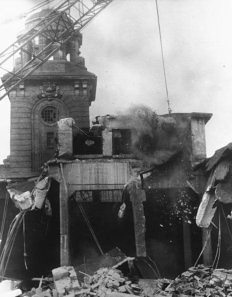
In the early 20th century, Birmingham was served by seven railroads. Six of these joined together to form the Birmingham Terminal Company. The company hired Atlanta architect P. Thornton Marye to design the station. Its construction took two years and cost $2 million. Although the station's Byzantine style created some controversy, its opening in April 1909 was a major event for the city. A balloon race and a parade, led by Grand Marshal E. J. McCrossin, were held to celebrate. The Birmingham Terminal Station was the primary passenger station for Birmingham from 1909 until rail travel sharply declined in the 1950s. It filled two blocks of 26th Street North (now Carraway Boulevard) above the 5th Avenue North underpass. Originally the main train stop for out-of-town visitors, as automobile and air travel came in to prominence the building was neglected, it was finally torn down in 1969.


Architect Frank Milburne designed this Spanish Mission style station soon after 1900. It stood on West Trade St. and the railroad tracks, about where the Bus Station presently sits. Milburne fashioned a series of stations in this style. Indeed, Salisbury still has and has restored its Spanish Mission style railroad station. Legend holds that President Woodrow Wilson once asked whether the Charlotte Station was fireproof. When told that it was, Wilson supposedly said, "What a pity." The building was demolished in 1962.


Union Station in Atlanta was the smaller of two principal train stations in downtown, Terminal Station being the other. Opening in 1930, Union Station served the Georgia Railroad, Atlantic Coast Line (previously the Atlanta, Birmingham and Coast Railroad), and Louisville and Nashville (previously the Nashville, Chattanooga and St. Louis Railway). It replaced earlier stations on the same site.
After the tenant railroads of Union Station had discontinued all their passenger trains -- the last such train operated the day before Amtrak came into existence -- the station was razed in 1972. Remnants of the platform may be seen behind the Atlanta Journal Constitution building although construction of Underground Atlanta and MARTA largely obliterated the site.


Terminal Station, designed by architect P. Thornton Marye was built in 1905. It stood at the northwest corner of Spring Street and Mitchell Street. After 65 years of service as a passenger railroad station, it closed in 1970 and was demolished in 1972.
The Richard B. Russell Federal Building, which opened in 1980, now stands on this spot.


Amtrak has offered Florida a pre-High Speed Rail plan of 5 trains each way per day, per route. Taken to the fullest possible extent, this would equate to 25 trains each way per day in Jacksonville's terminal, in other words 50 trains and that is without any Commuter Rail development.

It's time we held our own railroad summit meetings and pull every community from Norfolk, to Charlotte, Atlanta , Birmingham and New Orleans into a Jacksonville Hub promotion. Atlanta is making noise like they'd love to be the new rail center of the Southeast, but keep in mind Atlanta destroyed and complete buried any trace of both Union Station and Terminal Station. Birmingham wants in too but has the drawbacks that most of the current New York - Southeast traffic by passes them by as it moves up and down the East Coast. Charlotte and North Carolina have become leaders in their own regions by funding and then pulling Amtrak across the State to build a Carolina Corridor. Again, station and numbers still favor an East Coast city. So it all comes back to Jacksonville, the pin in the Southeastern hinge of rail transportation.

Even the planners on the side of other cities are savvy enough to know the "F Word" aka: FLORIDA must be included for them to have any chance of success. If we continue to fiddle in both Tallahassee and Jacksonville, they might just discover a way to cut us out of the majority of these new rail projects. We need a RAIL SUMMIT JACKSONVILLE, with confident city promotional figures to tour our great Jacksonville Terminal, and start planning how they can connect with this hub. Meanwhile over in Birmingham, planning for Atlanta, New Orleans and Houston, they still toss the bone to Jacksonville as every railroad line into the state passes through our Terminal.

From the Birmingham Business Journal:

The Birmingham City Council is getting behind efforts to bring high speed rail to Alabama.

Three weeks after the state reversed its position and released $120,000 to pay delinquent membership dues to the Southern High-Speed Rail Commission, Birmingham’s City Council will debate allocating matching funds for federal intercity passenger planning and construction programs. A resolution supporting the Southern High-Speed Rail Commission’s efforts to create a line between Atlanta and New Orleans is scheduled to be introduced at the April 14 council meeting. A Southeastern high-speed rail line could mean billions worth of construction projects with regional leaders negotiating with the federal government to provide as much as 80 percent of the funds.

The council’s Transportation and Communications Committee voted unanimously to send the resolution to the full committee. Councilor Carol Duncan chairs the committee and said the timing is right to back efforts to upgrade city, regional and national transportation infrastructure.

“We’re really moving and it is getting exciting,” Duncan said. “Funding should be put in place. We’re getting ourselves in place so it can happen in Alabama.”

Alabama’s Southern High-Speed Rail Commission chapter needs $1.3 million to complete feasibility studies, according to state commission representative Richard Finley. He said just the Atlanta-Birmingham line could be a $400 million project.

Duncan said the state and region are working to ensure the funds needed for Alabama to have a seat at the high-speed rail table are available.

Finley, chairman of the Southern High-Speed Rail Commission, will host the group composed of representatives from Alabama, Louisiana and Mississippi in Birmingham on April 23. The commission will discuss a plan of action for seeking federal funding to transform Crescent Corridor into a high-speed rail line.

Birmingham Mayor Larry Langford has called his own summit of 15 Mid-South mayors to unite behind a line that could link Atlanta and Houston. Langford mailed invitations for his April 30 summit on April 3. The mayors of Atlanta, Houston, Tuscaloosa, Meridian, Miss., Anniston, Baton Rouge, New Orleans, Biloxi, Gulfport, Miss., Mobile are among those Langford invited.

He hopes to forge a partnership with his peers to broker a major regional economic development project. With the federal government allotting $8 billion for high speed rail projects, Langford said a united effort is needed.

“We must join forces and agree to cooperate if the mutual interests of our communities are to be met and that we are to receive our fair share of the funds devoted to what I am calling the ‘Mid-South High Speed Rail Corridor,” Langford’s invitation said.

Meridian, Miss. John Robert Smith applauded Langford’s vision and efforts to help the region speak with one voice as it seeks its slice of the federal high-speed rail pie.

“The corridors that link Georgia, Louisiana, Mississippi, Florida, Texas and Alabama are critical for the future development of the Southeast,” Smith said. “Mayors are the strongest and best advocates for rail in this country.”


You see Mr. and Ms. Jacksonville politician, ours still stands and it just awaits your call to become the hub of the Southeast. Just remember when looking for railroads and funding, the "F" word is Florida, and Florida Railroad is spelled J-A-C-K-S-O-N-V-I-L-L-E.

10 September, 2008

JTA - WHAT ABOUT CALLAHAN ?


So we have these massive 30 and 40 passenger diesel buses, growling up and down the roadways of Jacksonville, the backbone of a future inter modal and inter county Transit network. The planners are already hard a work putting pens to paper and hitting the keyboards to crunch the numbers. There are still unanswered questions. If Baldwin ends up on commuter rail, what about Fargo? If Yulee is a terminus, then what about Callahan? Some interesting thoughts on making the whole metro transit inclusive comes from a small city and a big think-tank in Central Oregon.

Flexible Transit? Big lessons from little Bend, Oregon
by Sreya Sarkar Monday,

In September 2006, after six years of deliberation and planning and with much fanfare, Bend began its fixed-route bus service, Bend Area Transit (BAT). Seven bus lines within the Bend city limits charge adults and youth $1 and seniors 50 cents to ride. The city also continued to offer the general public the previously existing dial-a-ride bus service with door-to-door transit.The population explosion in the Deschutes County communities seemed to demand this new fixed-route service. Yet, after just a year of service, when Bend residents were asked in a regional survey if they would like to see BAT expand its services, they offered a mixed response: They would like to see it expand but would not like to pay more taxes to maintain it.

Over the past year, a committee of public and private leaders representing the three Central Oregon Counties (Deschutes, Jefferson and Crook) have worked to create a regional framework to address a more efficient, effective and equitable use of alternative transportation services. The committee, called the Central Oregon Mobility Consortium, has been formally established under the Central Oregon Intergovernmental Council (COIC) and has generated private funding to conduct the region’s first comprehensive survey of alternative transportation services.The survey results clearly show that overwhelming support exists for transit services based on real market demand. The transit model promoted by the Mobility Consortium is very different from that followed by traditional public transit agencies which typically provide one or two distinct services. The Consortium feels that the traditional fixed-route public transit model may fit the needs of some big cities, but definitely not those of the scattered and low population density communities of Central Oregon.The Consortium’s plan, therefore, is to pool together the region’s public and private transportation resources (including municipal buses, school buses, shuttles, vans and even taxicabs) and match the modes of transportation with customers’ needs. Critical to this approach of providing flexible services and allowing customers to choose the type of service that best suits them in terms of price, convenience and time is the development and operation of a “one stop” information, reservation and dispatch center. This idea is unique in that it brings in the private sector to share the risk in developing and delivering services.Cascade Policy Institute recently asked David Foote, the consultant for the Mobility Consortium, if the Consortium has a specific plan for the low-income population in Central Oregon. His response was that there is no separate plan for the low-income population because the Consortium does not believe in segregating low-, middle- and high-income populations. He said services would suit the needs of different populations, including the low-income, the physically challenged and the elderly.However, the Consortium feels that traditional public transit is “subsidy” based. Therefore, very little incentive exists for the transit agency to be customer-focused. In many cases this results in low-income or transit dependent riders subsidizing more affluent riders. When asked about the feasibility of using privately operated automobiles (or jitneys) that could serve as flexible quasi-public transportation for low-income populations in Central Oregon, Foote thought it is an idea that needs to be “investigated.” He is of the opinion that if jitneys offer inexpensive and flexible transportation service to people who need it, there is no reason why they should not be considered as a viable transportation option.There are legal bans (or at least heavy regulations) stifling jitney services in most American cities. When and where the traditional fixed-route public transit model does not work, such legal bans should be lifted. There are a number of ways jitney-like services can be reasonably regulated without forcing jitney businesses to cease to exist altogether. A good way would be starting a system of user charges for jitney operators, including a requirement for financial responsibility for all vehicles instead of a high operating bond which unduly penalizes jitneys.Since Central Oregon has a skeletal and expensive public transit service that only serves people within the Bend city limit, a more comprehensive regional transportation system is urgently needed. It could include private jitney services, as well as special shuttle services for the physically challenged. The Mobility Consortium realizes that federal and state regulations sometimes create undue barriers to the better utilization of resources. The result is increased costs for providing public transportation services and low-ridership. That is the reason why it is willing to fight the legal battle against such regulations. Its main aim is to provide Central Oregonians with transportation choices and let them determine the service that best meets their requirements, based on the value of the service.Public transit is ultimately for the use and convenience of the public and not of the transit providers. The fact that Central Oregonians are convinced that the market can take care of public demands better than the traditional public transit agency is a starting point for considering including more private enterprises in the field of public transit.Sreya Sarkar is Director of the Wheels to Wealth Project at Cascade Policy Institute, a think tank based in Portland, Oregon.

11 August, 2008

VALDOSTA TRANSIT Coming Soon!

WILL THIS MEAN A NEW AGENCY TO WORK WITH FOR JOINT PROJECTS ? YOU BET IT WILL, ONE MORE VOICE NEVER HURTS.
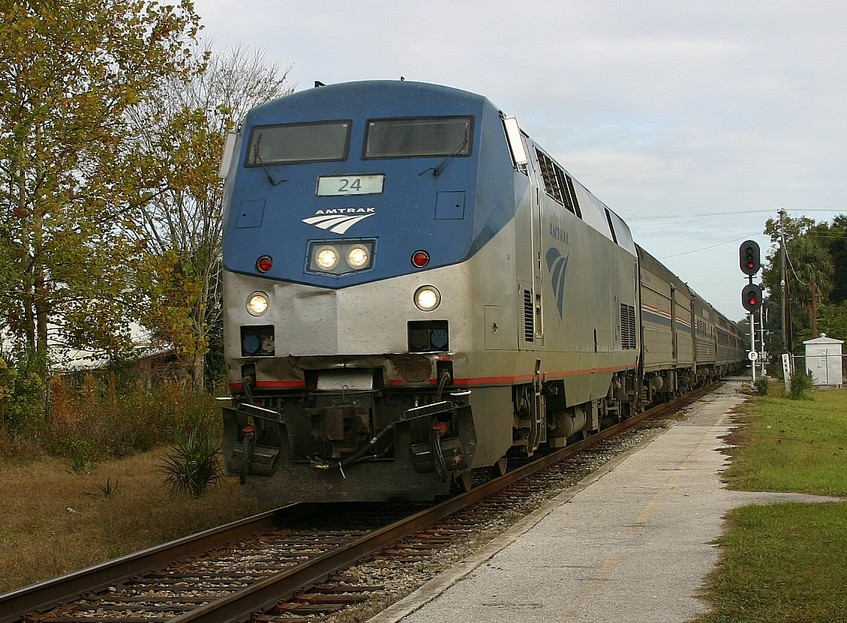
Above: Amtrak train in North Florida, doing a modern "Royal Palm" imitation. Below: Vintage Royal Palm Ad showing Valdosta and Jacksonville, Macon, Atlanta, Chattanooga and Cincinnati.

Valdosta, Ga., Gets Ready to Ride With Transit System

Kari L. Sands
The Valdosta Daily Times
GEORGIA - After much planning and several meetings, the city of Valdosta's transit system plan is well under way to develop a more efficient public transportation system to address the needs of Georgia's 10th largest city.

Though a great amount of planning has been done, the city of Valdosta still has several steps to take during the development of the city's transit system, including types and size of buses, location of pick-up points, and funding.

However, the city hopes to see buses rolling in as early as 18 months as federal funds have already been applied for, according to Metropolitan Planning Organization (MPO) Coordinator, Corey Hull.

"The next step is to hire a consultant to perform the actual implementation study or report. The MPO is in the process to do this. The study or report will be detailed to show routes, the number of buses, personnel, maintenance and other pertinent information," said Hull.

Over 18 months ago a feasibility study was conducted, and it was clear from the consultant point of view that a transit system would be beneficial to the urbanized area, according to City Engineer Von Shipman. The MPO is taking the lead on the city of Valdosta's transit system project since it will involve the use of federal funds to cover a portion of the cost.

"The current effort to implement a public transit service in Valdosta has been in active for about five years. In 2006, the Valdosta-Lowndes Metropolitan Planning Organization conducted a study to determine the feasibility of implementing transit services in the Valdosta Urbanized Area," said Hull. "This study found that the introduction of transit service would have a fairly high probability of success based on ridership potential and public desire for transit services for access to work, shopping and medical trips. During the hiring of a consultant to aid in the development of the transit plan, we will be seeking public participation on final route and stop locations, marketing strategies and operations plans."
Valdosta Mayor John Fretti is also optimistic about the timeline for the transit system's implementation.

"The federal government has allocated funds for the last couple of years to assist in the capital asset purchases of buses, a terminal and maintenance facility. Through the MPO, we are in final negotiations with a company to implement this system and have a functioning fixed base bus system in around 24 months," said Fretti.

Fortunately, the designation of Valdosta as a metropolitan city has made the MPO eligible for federal funds for both implementation and operations, although it is certain that ridership fees and local subsidies will be needed, according to City Manager Larry Hanson.

"To secure federal funding for implementation of the system, a implementation plan must now be developed which will include the routes, times of operation, the number and frequency of the pick-up points, and the participation of interested parties," Hanson said. "The MPO has conducted and completed interviews with professional firms and is presently negotiating with the firm selected as the most qualified."
Shipman also said that it should be understood that funds generated by those who use the system will not make up the shortfall received from the federal government.

"This will require local governments to come up with the balance of the funds needed. A final decision on this matter can only be made after the implementation report is completed and funds are budgeted," said Shipman.

Transit ridership is up around the country by 28 percent, according to Fretti. "With fuel prices so high, there may not be a better time to provide transit for our citizens to use for work and recreational commuting. Our time has come."

"We believe the transit system will help the entire area by reducing traffic and pollution, improving access to jobs and services, and supporting the needs of a growing city, county, University and Technical college. It is a major part of an overall transportation plan to reduce the emphasis on vehicles and single trips and encourage the cooperation of all governments and all involved parties to improve our overall quality of life," said Hanson.

The MPO has worked with the city of Valdosta, Lowndes County and other transportation planning partners to work to implement public transit services in and around the Valdosta Urbanized Area. The information received from the public and contained in the recently adopted Transportation Master Plan will be used as public transit service is implemented in Valdosta. The official timetable for the transit plan is still in the planning stages, but buses could start rolling as early as 18 months or the process could take as long as two years.


Blogger Comment: INCREDIBLE OPPORTUNITY to extend a hand over the State Line into Georgia and pick up a friend, to push for Regional Rail, Commuter Rail and the return of the famous Royal Palm-Royal Poinciana-Ponce De Leon Trains between Jacksonville and Atlanta, via Valdosta. Any good transit agency in a states 10Th largest City is bound to get some attention, toss in Florida and Jacksonville and we could push this idea over the top. Macon? Atlanta? All Aboard!

To see more of The Valdosta Daily Times, or to subscribe to the newspaper, go to http://www.valdostadailytimes.com/

TAKE A FREE TOUR OF THE JACKSONVILLE SKYWAY

The arguments rage to this date, "Should have never been built," "waste of taxpayer money," "Doesn't go anywhere," "Nobody rides it..." etc. Bottom line is we have it, and it is finally showing signs of life. Simple extensions to the Stadium, San Marco, and the area of Blue Cross in North Riverside would turn this little train around. Addition of Park and Ride garages and multimodal transit terminals at the end points would bring on the crowds. The video must have been shot on a Sunday Morning, as downtown is certainly as packed with life as any other major City on weekdays. Jacksonville is a city of Bikes, joggers, walkers, buses and cars, one almost wonders how the photographer managed to find this quiet moment.


Support the Skyway? Join the Monorail Society Today!

Subscribe to monorailsociety
Powered by groups.yahoo.com

WELCOME ABOARD

Sign by Danasoft - For Backgrounds and Layouts