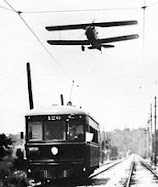
IS THE DMU DEAD?
 Dallas - Fort Worth uses the rebuilt RDC's.
I wasn't impressed by either the looks or the feel of the Colorado Railcar. Some may recall that I took a "test drive" at 80 mph and the thing sounded like it was leaving parts scattered along the tracks as we flew past. Doors rattled and banged, plastic everywhere not unlike an airliner but with obvious beat-up look and these were new. Perhaps the bugs just haven't been worked out yet. The original Budd RDC car, had some bugs when they were first delivered along with "trailer" cars. While not as powerful as the DMU, the Budd car operators quickly found that in pulling the trailer (basically a ultra-light but other wise standard railroad passenger coach) the RDC's transmission fell apart. But the Budd RDC has stood the test of time and those 1950's era stainless steel beauties are still clicking off the miles in commuter services throughout the country and beyond. Several firms are offering a rebuilt RDC at a fraction of the cost of the DMU, with the added benefit of getting almost double the diesel fuel mileage. Florida needs to use caution when it makes the purchases of these DMU vehicles, I tend to like the well tested path of the old faithful RDC.
Here's Why:
Another ugly possibility is that Colorado Railcar is on shaky ground. The lead Rader family member running the company got the ax not too long ago. Seems like this "sign" has happened three or four times already? The DMU is not getting any orders, and especially after TriMet's Portland, Oregon order is now three-four months overdue. The Vermont deal collapsed and Florida is sitting on Orlando - Jacksonville - Tampa commuter rail projects paralyzed by legislative inaction, so no orders are coming from here either. I wonder how many more transit agencies will cut a deal with them?
Railway Age magazine had this to say:
Less than a decade ago, when all but the last few passenger services operated with aging Budd Rail Diesel Car (RDC) equipment were phased out, the day of the diesel multiple-unit, or DMU, appeared to be about over on North American railroads. But hardly had the diesel railcar been declared dead when it came back to life in a flurry of proposals for new passenger rail starts with DMU equipment, together with supplier proposals for a variety of new designs for the North American market. Lying behind this new interest were the same potential cost advantages and operational flexibility over conventional locomotive-hauled equipment-particularly in applications for which the required passenger capacity is relatively low-that had made such a success of the RDC almost a half century earlier.
This was manifested first in a modest revival of rehabilitated RDCs in new-starts at Syracuse, N.Y., and Cape May, N.J., during 1994 and 1996. A far more significant example came on line at the beginning of 1997, when Trinity Railway Express began operating regional passenger service over a 10-mile route between Dallas Union Station and South Irving with a fleet of 13 Alstom Canada-remanufactured RDCs. Well satisfied with their operating performance, flexibility, and reliability, and anticipating a growing role for RDCs as full Dallas-Fort Worth operation grows and other planned services develop, TRE is now looking for another six RDCs for eventual rehabilitation.
The revival of interest in the DMU, however, is owed in large part to a variety of new designs, most of them based upon successful recent European equipment. Siemens Transportation, for example, is marketing three options, all based upon successful German designs. For short-haul "diesel light rail" services, Siemens is marketing the Regio Sprinter, an articulated diesel-hydraulic design, while the larger VT-642 diesel-electric railcar is being offered for commuter and short intercity markets. Neither of these vehicles complies with FRA Tier 1 crash worthiness standards, and can be used only in services separated from other railroad operations. The third Siemens option, however, is an FRA-compliant version of the VT-605, a diesel-electric vehicle available in tilting or non-tilting versions and capable of 125 mph maximum speed for extended commuter or intercity services.
Adtranz is offering an FRA-compliant version of the Flexliner DMU for both commuter and intercity services, and a diesel LRT design based upon the firm's GTW vehicle developed in Switzerland. Bombardier and Alstom are jointly marketing a modified version of Alstom's 125-mph XTER diesel-hydraulic trains built for the French National Railways. Bombardier is also marketing the Talent, a European articulated diesel light rail vehicle design
Adtranz is offering an FRA-compliant version of the Flexliner DMU for both commuter and intercity services, and a diesel LRT design based upon the firm's GTW vehicle developed in Switzerland. Bombardier and Alstom are jointly marketing a modified version of Alstom's 125-mph XTER diesel-hydraulic trains built for the French National Railways. Bombardier is also marketing the Talent, a European articulated diesel light rail vehicle design
Progressive Railroading has announced:
Colorado Railcar Manufacturing L.L.C. recently named Larry Salci president and chief executive officer. He succeeds company founder Tom Rader, who will remain the company’s sole shareholder, but focus on other business interests, such as his role as GrandLuxe Rail Journey’s president.Salci has 37 years’ experience in the transportation industry, including stints as president of The Budd Transit Group, Bombardier Corp., and Morrison Knudsen Transit Group and its successor company American Passenger Rail Car Co. He most recently was president and CEO of St. Louis Metro. Salci previously served as general manager and CEO of the Southeastern Michigan Transportation Authority.
The final piece of the puzzle in our state might be the Bio-Diesel fuel. Miami has converted the Tri-Rail locomotives to Bio-Diesel, a mix of homegrown cooking and other oils. But they just announced the DMU's can't be converted or their warranties will expire.
We can only hope the former Budd Executive will spin the company around and get it back on track. The competition is tough, the new Flexliner is a thing of beauty and the Siemens vehicle is no slouch either. We're hoping the American Made - Colorado Company will survive, but as we say in Florida; "when your up to your neck in alligators, it's difficult to remember the original objective was to drain the swamp."
 transit


 Posts
Posts