Showing posts with label faux trolley. Show all posts

31 May, 2008

What is and What isn't a Trolley?


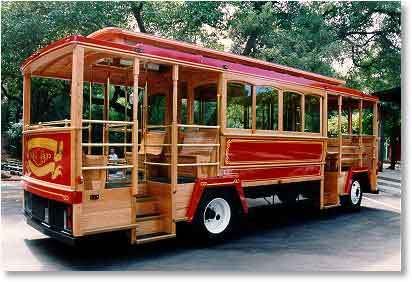
Photo 1: THIS IS NOT A TROLLEY
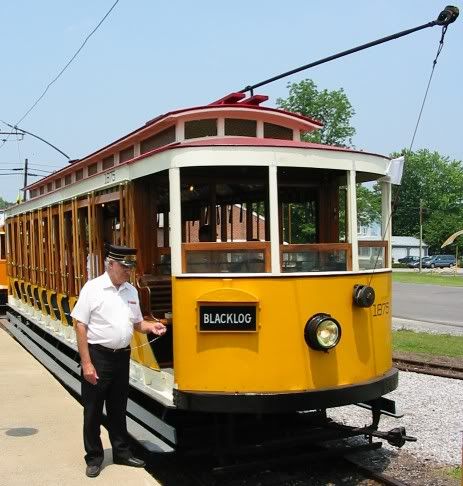
Photo 2: THIS IS A TROLLEY

What is...and isn't...a trolley?
This (Revision) from the Sacramento Bee Newspaper - Oct 2007


On the ongoing plans to build a streetcar line between Sacramento and West Sacramento prompted quite a few comments. One thing I notice is that, for many people, it isn't at all what a streetcar, or a trolley, is.

The term "streetcar" refers to fixed-rail transit that is run on city streets, rather than on separated grades like a railroad. The term was originally used to describe horse-drawn cars operating on rails, but can also cover cable cars, steam dummies (small steam locomotives intended to pull cars on city streets) and electric trolleys. Because horse cars, cable cars and steam dummies were all supplanted by electric trolley cars, the terms "streetcar" and "trolley" are pretty much identical.

The term "trolley" comes from the pole used to connect an elevated high-voltage power line to an electric vehicle. One of the earliest prototype electric streetcars had a four-wheel device that hung from the overhead wire, connected via a cable to the car, referred to as a "troller," is probably the origin of the term. Trolley poles came in various forms, using either a wheel or a shoe at the end of the pole to ensure good connection to the wire.Trolley vehicles normally run between 24 to 50 feet: about the size of a LARGE modern bus, but generally wider. Speeds vary, but for the most part trolleys run at 20-40 miles per hour.That being said, what ISN'T a trolley?

What about Jacksonville's new Riverside Trolley? The problem is, this ISN'T A TROLLEY. It is intended to look like a certan type of trolley, if you kind of squint, but it fails for several reasons. For starters, it's still a smoky, noisy bus. Second, it runs on wheels instead of rails, and therefore doesn't run as smoothly. Third, because it has no fixed path, its schedule and route can change at the whim of the operating company, thus it gives little security to land developers who want to encourage transit-oriented growth that the transit won't vanish in the next fiscal wind.

Finally, this isn't a trolley because "quaintness" is not a required feature of a streetcar. Modern streetcars (and even some historic ones) aren't necessarily long on charm, wood paneling or quaint design (even though many of them are.) They're a vehicle built for a purpose, and the purpose isn't to look cute (even though many of them do): they exist to move people.


Many people assume that LRVs (light rail vehicles) were the modern version of trolleys/streetcars. While it could be said they evolved from the Trolley roots, they are wrong. LRVs are intended to run primarily on private right-of-way rather than city streets, are typically 60-80 feet long and intended to run as multi-unit vehicles, are capable of higher speeds (up to 50-70 mph) and are intended for inter-city and suburban service. They are the historical replacement for the interurban, which is a type of transportation virtually unknown in modern society. Interurbans operated like LRVs do now: they run on streets in cities, but their real strength is in open country and private ROW where their larger size and faster speeds aid commuters. But a city trolley isn't usually intended to do that.


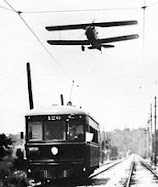
The classic example people think of when you refer to trolleys is the Pacific Electric (aka the "Red Car") of Los Angeles and Orange County,(See the movie "Who Framed Roger Rabbit" for the sad-comic-true story) but that was an interurban system. Streetcar service in Los Angeles was covered by the Los Angeles Railway (aka the "Yellow Car"), a physically separate system (originally a cable car system, they operated on 3'6" cable car gauge instead of standard 4'8/5" gauge) owned by the same person (Henry Huntington.) Why would Huntington, a financial wizard on a par with his uncle Collis P., operate two "redundant" electric railroad systems in the same area? Because he realized that they served two distinct and separate roles! LARY streetcars moved people around in downtown Los Angeles and adjacent neighborhoods: PE interurbans moved people around throughout the greater Los Angeles area, in between cities.
In some parts of the country, the line between Trolley and Interurban blurred. Often the Trolley served as something of a rural or regional Interurban. In the Southeast, lines such as the massive Jacksonville Traction Companys, Camp Johnston (NAS JAX) and Ortega, routes even called for heavier more Interurban like Trolley cars. In fact Jacksonville had a fleet of restroom equipped, bar and lounge section, "Observation-Lounge" Trolleys. Also a common practice in the American South was to use grade separation on the Trolley lines themselves, often in the downtown area's. These routes were laid with treated hardwood cross-ties and then covered in lush landscape and grasses. Jacksonville's Main Street, Palmetto Avenue and Pearl Street lines are just three example of this construction that was billed as "The most beautiful Trolley Line in the World."

23 December, 2007

More Faux Trolleys = More Faux Riders


More Faux Trolleys = More Faux Ridership at JTA
Somehow, Jacksonville is under the illusion that a "Trolley" is anything shaped like a shoe box and runs on streets, be they rubber tires, or pogo sticks, as long as they have no real suspension system, are fare free, and have hard wooden seats. Guess none of the JTA guys ever rode in the real leather seats of the old Interurbans I grew up with, or the Velvet seats of others? Nope, cane or wicker were once in vogue too, but even they had some give to the nether regions. The formula for success seems to be something like this:

1. We think our Citizens are not transit savvy and clueless, so they'll never know the difference.

2. Cheap "reptile farms" have fake trolleys and they are "REAL" tourist attractions, so why can't Jacksonville climb to reptile farm status?

3. Not having to pay for much longer lasting Electric buses, Skyway extensions or classic shuttle buses really saves us money. Buy the Yugo, and tell the citizenry it's a Rolls Royce. Don't tell them about it's short service life.

4. Never mind the vehicle, now we'll spend like drunken sailors to build route infrastructure, shelters, stations, landscape, and all the fittings, for what really amounts to a semi-dedicated route with a "Shoe box on a potato chip truck frame."

The Florida Times-Union wrote that: JTA spokesman Mike Miller said similar plans are taking shape for trolleys in Springfield and San Marco. The trolley would not disrupt the regular bus service, but would boost public transportation options during the day. Miller said buses running along Riverside Avenue make stops roughly every half-hour compared with the eight minutes between the proposed trolley stops. JTA has eight trolleys in its fleet, but plans are to add three more next year. Miller said the 30-foot-long vehicles, which already have a downtown presence, are more mobile than standard buses and seat 25 to 28 passengers. "People like it," Miller said. "It's retro-looking. People think of it like the old street cars."

So are FAUX TROLLEYS really "Trolley Cars?" Strictly speaking, No. The American Public Transportation Association has the following to say about the potential of us creating a tourism or commuter mecca from our fakes. Today many cities use rubber tired vehicles which are decorated to look somewhat like trolleys, but these vehicles are not real trolleys nor streetcars and are not the subject of this website. Some people may feel they can obtain the benefits of a heritage trolley line by using these inexpensive faux trolleys, but the economic, developmental, and visitor attracting benefits are not generated by these bus trolleys. Authentic rail based systems are required to achieve the benefits.

But guess what JTA? I don't agree with the APTA either! I think there is an avenue that hasn't been explored here or elsewhere that might have a very positive impact on shuttle transit. It just might even develop a little tourism following and maybe some Hollywood magic. Why not explore the world of the vintage bus or the Faux Vintage bus. The Mayors aide recently asked me, what's the difference? Why would someone want to ride a Faux vintage bus but not a faux vintage trolley? Simple really. A faux trolley isn't a rail vehicle, no amount of "dolly dressing," on the shoe box is going to make it a trolley. To any of the some 4-5 Million dedicated railroad buff's in the World, (EVERY ONE of them a potential Jacksonville visitor) our faux trolleys would make them lose their lunch. As I've said before, seeing a sign along the super-slab somewhere in Kingsland, Georgia, to "SEE the JACKSONVILLE JAGUARS up close and in person... get your photo taken with the team" all at Billy-Bob's Chevron Station. Being a dedicated fan, you head down the exit to spot the cardboard cut-outs of the whole team across the front of the gas station. Hardly the Jaguars you wished for isn't it?

Now turn it around. "RIDE THE ROSA PARKS BUS!", "Ride the vintage buses", "See the historic buses of Jacksonville..." Yes, I said Rosa Parks, there is a completely reconstructed duplicate of the original, with added AC and automatic transmission, painted and looking for all the world like that historic vehicle, available with support for $10,000 dollars. Hum? The Faux trolleys are more like $250,000 each! Now take it up a notch, did you know the same companies that supply the Theme Parks with all those cool historic transportation vehicles will do the same for us? Did you know we can buy, OFF THE SHELF, authentic 1920's vintage buses built to our order. Why are they so different? Well, no matter how you cut the date, the duplication, modeling, or rebuilding, it is still a bus... A vintage bus. NOTHING FAKE about that. I've done an informal poll downtown, and found that almost everyone I meet had MUCH rather ride in a classic 1920's bus or auto, rather then a fake shoebox trolley on rubber tires...

What other American City or World City for that matter, could boast a Buck Rogers Monorail overhead, Excellent Transit Buses on the ground and REAL 1920's and 1950's vintage shuttle buses in the downtown? If our Rail study and some of our BRT hits the road, add in a Streetcar and we would be the "WORLDS TRANSIT DISNEYLAND". To the great masses of people that might not seem like much, but I can tell you there are millions of us. Not you? Tell me you avoided all transit options down on "Main Street USA" when YOU visited the mouse... "Yeah, I thought so." Come on in JTA, I'd love to get this moving. Why don't we lead the pack for a change? "One Token for the Jacksonville Omnibus please..." I'm waiting in line already.


TAKE A FREE TOUR OF THE JACKSONVILLE SKYWAY

The arguments rage to this date, "Should have never been built," "waste of taxpayer money," "Doesn't go anywhere," "Nobody rides it..." etc. Bottom line is we have it, and it is finally showing signs of life. Simple extensions to the Stadium, San Marco, and the area of Blue Cross in North Riverside would turn this little train around. Addition of Park and Ride garages and multimodal transit terminals at the end points would bring on the crowds. The video must have been shot on a Sunday Morning, as downtown is certainly as packed with life as any other major City on weekdays. Jacksonville is a city of Bikes, joggers, walkers, buses and cars, one almost wonders how the photographer managed to find this quiet moment.


Support the Skyway? Join the Monorail Society Today!

Subscribe to monorailsociety
Powered by groups.yahoo.com

WELCOME ABOARD

Sign by Danasoft - For Backgrounds and Layouts