Showing posts with label Jacksonville Streetcars. Show all posts

12 December, 2009

Welcome Ray LaHood


NEW READER WELCOMED

Jacksonville Transit wishes to welcome our newest reader, Mr. Ray LaHood, United States Secretary of Transportation. Hopefully the Secretary will see some of the hip shooting posts that deal with sensitive subjects like Florida's disastrous HSR plan, from the view point of a pro-rail, pro-mass transit, pseudo retired consultant. He'll also read of Amtrak's apocalyptic Florida rail system, and interstate connections,or lack of the same, as opposed to our historic travel patterns. Jacksonville, and it's heavy need for Port Rail, LRT, Streetcars, Commuter Rail, Skyway Extension, and even connecting BRT, Bus, and new concept Express Bus services, are all here too. "New Concept Bus?" Yes, he'll read it here because this is the only place it exists, so far.

The harsh critiques of Jacksonville's so called Transportation Center are spilled out across the screen throughout the blog, with much, much, more to come.
So Mr. Secretary, check your diplomacy at the door, sit back, and enjoy some pointed sharp shooting blogging, who knows, perhaps you'll comment sometime?

10 June, 2009

JTA'S BRT TRUNK LINE NIGHTMARE COMES TRUE IN MIAMI

So Jacksonville, has bought the Bus Rapid Transit sales pitch, hook, line, and sinker. For over a year I have been raving on about BRT being nothing more then a cafe of advanced "bus think". The parade of supposed success story's keeps changing:

Pittsburgh
Cleveland
Boston
Santiago De Chile
Curitiba Brasil
Los Angeles El Monte busway
Bogota...etc...

Who are these people? Gentle Reader, these are the same highway boys that scrapped the nations streetcars and interurban's in favor of buses. Go figure, the rail industry has 7 large companies and dozens of small shortline businesses, but most private passenger traffic died in 1971 as Amtrak took over. The industry has ZERO real interest in running our government trains on their tracks unless there is a huge incentive in plant expansion.

Otherwise there are some 70 odd cities with at least a mile or two of streetcar or interurban tracks in North America. Most of these operations are less the 20 years old. While thousands of communities cashiered the streetcars in favor of supposedly "flexible bus transit."

States including Florida, once had laws on the book that every able bodied male MUST serve a week or so each year working on roads. Those same roads were largely paid for with railroad tax money. Once the roadways reached the point of saturation, most Americans shifted their loyalty to automobiles. So when the evil streetcar holocaust snatched the big trolleys from nearly every town on the continent, nobody seemed to care. So how loaded are the dice for the rail proponents such as this blog? Glad you asked:

State and Federal Highways, aka: roads and bridges, are in endless expansion within finite space. Tax Payers that support highways should look for the same return on investment that Airlines, buses or Amtrak gets. But we all know THAT won't happen.

In Jacksonville the same highway boys rolled out a 26 mile "Bus Rapid Transit" plan that in reality was a BILLION DOLLAR road project. The mantra went up from JTA that "highway=cheap", "rail=bad". So this blog, along with metrojacksonville.com, jaxoutloud.com, urbanjacksonville.com, started exposing this true boondoggle for what it's really worth. "Just like rail only cheaper..." Only someone forgot to look up the word CHEAPER in the dictionary:

CHEAPER
brassy: tastelessly showy; "a flash car"; "a flashy ring"; "garish colors"; "a gaudy costume"; "loud sport shirts"; "a meretricious yet stylish book"; "tawdry ornaments"
bum: of very poor quality; flimsy; embarrassingly stingy
The term derives from the Latin miser, meaning "poor" or "wretched," comparable to the modern word "miserable"Low and/or reduced in price; Of poor quality; Of little worth


So what are the folks at JTA and Miami-Dade REALLY selling us? Let's try that slogan again and insert the meaning of the word into our sentence:

"BRT - Just like rail only wretched, of poor quality and little worth."
"BRT - Just like rail only flimsy, gaudy and embarrassingly stingy."

Ever wonder where the billions of development promised by BRT really happen. Everyone knows the meaning of "cheaper" and none of them are going to plunk down $100 million on a new office tower without fixed, permanent transit.

So are we surprised that Miami-Dade is taking a "perfect example" of BRT built on a former railroad from Miami to Kendall and a converting it to toll road? No! A BRT system that was to show all of Florida just how much better BRT is then rail. So now with the railroad long gone, and the busway empty of either buses or passengers we see our State going even farther backwards.

So our lessons for the day:

BRT should NEVER be built where rail is already in place.
BRT does not live up to its claim to be "As good as rail."
BRT does tend to live down to the word cheap.
Commuter Rail or Light Rail would have been more attractive in the first place
Once the rail is gone, we may never see it again in any given corridor.
Once the BRT is gone, all we have to show for our $ Billions are a few more highway lane miles and a collection of newer buses.

Those example BRT models? Let's see if this is just a Florida ghost or a true fleecing of the flock.

  • Cleveland - The Euclid corridor claims millions in development and nearly every cent is socialized federal, state and local offices and the BRT has fallen short in every survey, Light Rail may soon replace the mega bucks spent on this "system."
  • 1978 – Pittsburgh's South Busway, projected to carry 35,000 weekday rider-trips, actually attracted only 20,000 rider-trips initially, and that level has now dropped to about 14,500, less than pre-busway ridership in the affected corridor. Meanwhile, a parallel LRT upgrade has attracted approximately fifty percent more passengers.[Source: Port Authority Transit data]
  • Boston - The highly vaunted "Silver Line BRT" will not be expanded in fact it's roadway was the most expensive piece of highway work in history, rail will take it from here on.
  • Santiago De Chile - IF you manage to get on a bus, be ready to duck flying bricks (you can feel the hate for this BRT in the air) and of course they're now building a Subway.
  • Curitiba Brasil - These folks claimed the worlds most successful BRT operation, they even got the bus traffic to move at 12 mph. Now they are quickly building a rail system.
  • 1973 – The El Monte Busway in suburban Los Angeles, installed on a former interurban railway alignment in the median of I-10, has been moderately successful, peaking with a ridership of about 30,000 per day. However, influential planners, highway engineers, and political leaders, perceiving unused capacity between the buses, in the 1980s opened the facility up to use by car pools. With the buses now delayed by "HOV" automobile traffic, ridership has dropped to about 20,000, a reduction of 33 percent. Meanwhile, a commuter rail line constructed by California down the middle of the "BRT" alignment, implemented to speed person-movement in the corridor, has been quite successful - consistently gaining ridership. [Source: LACMTA data]
  • Bogota - Ever imagine 350 North Americans packed into a single bus? Bogota with 5 rail lines going to waste, is holding tight to BRT in the hopes they can still sell it to stupid Americans. Just imagine what they could do with a series of 8 car push-pull commuter trains, but if your not into riots, military police or sardines, better steer clear of this system. It's so good in fact that it's ILLEGAL for a US/EEUU citizen to ride it!

"BRT" - You Can Build it ... But Will They Come?
Light Rail Progress – Updated December 2002

Proponents of "BRT" (so-called "Bus Rapid Transit"), including the US Federal Transit Administration, assume that, service characteristics (like access time, total travel time, and cost) being equal, the ability of "BRT" service to attract riders is equivalent to that of LRT (light rail transit). Accordingly, the FTA mandates that in ridership forecasting models – such as those commonly used in Major investment Studies for federally funded new starts – bus and rail modes must be treated as virtually indistinguishable to passengers. in fact, speculative ridership models sometimes assign higher trip projections to a "BRT" system alternative, on the basis of input assumptions of supposed bus "flexibility", such as neighborhood access, "seamless", transfer-free trips, express services leapfrogging around local services, etc.

But do these theoretical projections jibe with reality? The empirical evidence would appear to suggest otherwise.
Altogether, analysis has shown that, for new starts installed in corridors serving the core areas of US cities, "BRT" busways have attracted only one-third of the rider-trips estimated for them by FTA-approved modelling. LRT has attracted 122 percent. The palpable effect of this is that, on most new LRT systems, parking lots are jammed, and riders are crowding on trains; in contrast, typical new "BRT" systems may experience modest increases in ridership, but certainly not the avalanche of passengers seen on LRT.

Denver's new LRT extension was overwhelmed with passengers, a Denver Business Journal reporter assured readers that "Packed light-rail cars, overflowing parking lots and passengers left behind on station platforms aren't unique to the Regional Transportation District's new Southwest light-rail line." On the contrary, "They are scenes repeated around the country as people flock to new rail transit lines in numbers far beyond initial projections."[Source: Denver Business Journal 26 January 2001]

Now this from the Miami Herald, "Oh the Humanity," looks like someone figured out how to build another turnpike with FTA mass transit funds.


South Miami-Dade Busway may give way to cars

Officials plan to vote on a controversial plan to convert South Miami-Dade's Busway into a highway with toll express lanes.

A proposed plan would convert the South Miami-Dade Busway into -- among other alternatives -- a four-lane highway with express toll lanes where private vehicles would share the road with buses.

BY ALFONSO CHARDY
achardy@MiamiHerald.com
For years, motorists in South Miami-Dade have longed to drive on the two-lane bus road on the west side of the chronically congested South Dixie Highway.
Now they might get their wish if county commissioners and other local elected officials approve a proposed plan to convert the Busway into -- among other alternatives -- a four-lane highway with express toll lanes where private vehicles would share the road with buses. The revenue would then be used to fund the cash-strapped county transit agency.
The July 23 vote by commissioners and mayors who are members of the Miami-Dade Metropolitan Planning Organization would enable the Miami-Dade Expressway Authority to obtain a detailed study on ways to convert the Busway.
It would bring dramatic change to the Dadeland-to-Florida City roadway, which was built to encourage motorists to take buses that travel more quickly because they benefit from green-light priority at intersections.
But the strategy didn't work out well because Miami-Dade Transit was never able to operate many buses on the roadway. Currently, between 10 to 27 buses per hour during rush periods serving some 20,000 passengers per day use the Busway. At times the north-south roadway is practically empty.
Transit advocates now fear that modifying the Busway to allow private vehicles would further discourage commuters from using public transportation and reward solo drivers.
DIFFERING VIEWS
Katy Sorenson, a county commissioner and MPO member, provided a hint of the looming controversy when at last month's MPO meeting she urged fellow board members not to take actions that would steer people away from public transit.
''When the issue was brought up a year ago, I had some reservations, because undermining transit is the last thing I would want to do,'' she said. ``This would not necessarily undermine transit and it could provide a funding mechanism for transit. But I want to make sure that in this effort, transit is priority one and secondarily congestion relief.''
Commissioner Carlos Gimenez, also an MPO member, suggested he was more interested in relieving congestion even if that means allowing private vehicles on a bus-exclusive roadway.
''I would support moving forward,'' Gimenez said, alluding to the coming vote on the conversion study. ``If it competes with Miami-Dade Transit, so be it.''
The majority of members at the May 28 meeting seemed to support the conversion study, but not all 22 members were present.
OPTIONS
Three possible conversion alternatives were outlined to MPO members in May by an MPO staffer who said the options would be analyzed more in-depth in the Busway study.
Alternatives described by Larry Foutz, the MPO's transportation systems manager, included:
• Leaving the Busway as is, but allowing private vehicles to use it by paying a toll that would be deducted electronically via SunPass accounts.
• Adding one or two lanes, plus flyover bridges at certain or all intersections to ensure faster travel times for buses and toll-paying private vehicles.
• Building a four-lane elevated highway, moving traffic at expressway speeds along a totally rebuilt Busway from Mowry Drive in Homestead to the Dadeland South Metrorail station in Kendall.
Making no changes to the roadway and adding toll-paying traffic would cost almost nothing, Foutz said, but the option would only allow no more than 5,000 vehicles per day to use the facility and would likely slow the buses.
The other alternatives would add more vehicles to the roadway and range in cost from $228 million to $1.8 billion.
The most expensive, what Foutz called the ''Taj Mahal'' of the options, would be the elevated expressway-style alternative.
Under any option, Foutz said, toll rates would be relatively high because officials want to keep demand as low as possible to maintain fast travel times.
TOLL RATES
Tolls, in anticipated 2030 dollars, would range from $11.25 to $12.75 for travel from one end of the Busway to the other.
Depending on the toll rate and number of toll-paying vehicles, revenue would range between $11 million and $37 million per year.
The Busway was built along an old Florida East Coast railroad corridor that the Florida Department of Transportation acquired in 1988. Subsequently, the right-of-way ownership was transferred to Miami-Dade County.


06 January, 2009

THE FOLLY OF FAUX TROLLEY - sad saga of Cincinnati and Jacksonville

COME ALONG AND RIDE WHILE CINCINNATI AND JACKSONVILLE DRIVE OVER A BUDGET CUTTING CLIFF !
A face only a mother could love - this will really pack 'em in Ohio... NOT!
For years OHIO has produced the most visitors to Florida. It's a little known fact, and I'm sure the number probably rises, falls behind, and rises again, with the economy of time. Cincinnati, not unlike Jacksonville in many ways, is a river port, industrial, and regional market center. Last time I saw a large collection of Cincinnati residents they were in Jacksonville, getting their faces smashed into our football field. I missed this years revenge.

Cincinnati, like Jacksonville has a bright idea. Let's study and build a REAL streetcar system. Development money follows streetcars more then Commuter Rail, BRT, Buses or any other mass transit. But Cincinnati is thinking, maybe a faux trolley which we Jaxson's call PCT TROLLEYS (for: Potato-Chip-Truck-Trolleys).

Why such an insulting name? Well, the final effort of the historic streetcar systems to fight off General Motors was called a PCC Streetcar (for: Presidents Conference Car - designed by a conference of street railway leaders from around the globe in the late 1930's). Our Jacksonville response to Cincinnati would be, "Have you EVER seen or ridden on one of these things?" So lets take it to the Cincinnati article and see what THEY are saying.


Streetcar opponents propose trolley
By Barry M. Horstman • bhorstman@enquirer.com • January 5, 2009

Opponents of Cincinnati’s $185 million proposal to run permanent-track streetcars from downtown to Uptown are urging city leaders to consider a rubber-wheeled trolley system that they contend could provide the same service for a fraction of the cost.

The alternative $9 million trolley plan, to be financed largely with private money, also could begin operating sooner and without the disruption of tearing up streets to lay tracks that would either eliminate parking or traffic lanes along the route, according to former Cincinnati City Councilman Charlie Winburn.

“It’s faster, a lot cheaper, and if it doen’t work out, you can walk away from it without having torn up your streets,” Winburn said. “I don’t see any downside.”


JAX TRANSIT BLOG: People are not fooled by these faux trolleys. They do nothing to promote future streetcar ridership and are seen for what they are, buses with lipstick. We have them in Jacksonville where they serve as downtown shuttles. Frankly we should have saved our money and bought electric buses for this task, at least they wouldn't smell.

However, City Councilman Chris Bortz and other streetcar proponents do.

San Francisco's 100 year old streetcar, Cincinnati? Jacksonville? Please tell me how much you'll save over this same time period with Faux Trolleys.

The proposed four-mile streetcar plan working its way through City Hall could spur hundreds of millions of dollars in economic development along the line and would be more attractive to commuters for whom public transit is a choice, not a necessity, Bortz said.

“You can dress it up however you want, but a bus is still a bus,” Bortz said. “A rubber-wheeled bus is never going to produce the kind of economic activity a streetcar system would.”


JACKSONVILLE TRANSIT BLOG: This is very true, buses of any kind only account for about 7% of all Transit Oriented Development, and a closer examination shows most of that is socialized, state and federal offices.

Winburn’s idea, patterned after a successful downtown trolley in Cleveland – where, in only two years, daily ridership has grown from about 700 to almost 5,500 – comes as the council awaits a report this month from City Manager Milton Dohoney Jr. on potential public and private funds to finance the streetcar proposal.

Even if the city can fully fund the streetcar plan, Winburn argues that the much lower price tag of his trolley proposal makes it a clear preference.

“With the economy as uncertain as it is, this isn’t the time to be investing nearly $200 million in a system that, no matter what the projections say, no one is really certain is going to work,” Winburn said.

A coalition including the NAACP and Citizens Opposed to Additional Spending and Taxes (COAST) has started circulating petitions to place a charter amendment on the November ballot that would prohibit the city from funding the streetcar plan unless voters specifically approved the expense.


JACKSONVILLE TRANSIT BLOG: What about history? How does streetcar stack up against your PCT Bus?

After World War II, the Cincinnati Street Railway modernized its system with new rail cars and infrastructure, as directed by the city. The next City Council reversed the policy by ordering removal of all rail service. The financial losses from the abandonment of nearly new rail facilities forced frequent fare increases on the riders, until it became the first major city to have a 55-cent fare. The ridership decreased 88 percent during 40 yr.

After rail service was eliminated in Oklahoma City and its environs, transit use fell 97 percent on a per capita basis. In St. Louis, with all-bus service, only 13 percent of the riding habit remains. St. Louis has now contracted to restore rail transit on a Metrolink from the airport through downtown to East St. Louis to recover some of the transit market share.

FROM THE APTA Website: Why choose a rail-based system over a rubber-tired system?

A rail-based system provides numerous advantages that help outweigh its higher capital cost:
A sense of government commitment and permanence that reassures potential riders, neighbors, and businesses that service will continue.
People overwhelmingly prefer riding rail vehicles to buses, so rail solutions attract more passengers (see
Transportation Research Record 1221 for a detailed treatment of rail vs. bus ridership).
For the above reasons, rail systems typically inspire business development.
Heritage trolley systems provide a sense of historical authenticity that blends very well with an urban environment, especially older, redeveloping neighborhoods.
Heritage trolleys with proper maintenance last essentially indefinitely (New Orleans operates cars built in the mid-1920s in daily, heavy service) while buses seldom have a life of more than 20 years.
MEANWHILE BACK IN CINCINNATI:

Bortz, though, stressed the importance of weighing the system’s long-term economic impact, not simply its construction cost.

“If spending $150 million produces $1 billion in economic activity, that’s a better investment than spending $10 million and getting nothing out of it,” Bortz said.

The permanence of the streetcar’s tracks, Bortz added, would inspire greater confidence among potential investors along the route than a system of rubber-wheeled trolleys that could easily be abandoned or moved.

JACKSONVILLE TRANSIT BLOG: Economics of streetcar -vs- fake PCT trolley buses? Take a look for yourself:


Winburn bills his plan as a relatively inexpensive, low-risk trial of the overarching concept of developing a streetcar line from downtown through Over-the-Rhine to the Uptown area around the University of Cincinnati and nearby hospitals.

Under his proposal, local business leaders would be asked to raise $13 million in private money to buy and operate 12 trolleys for a two-year trial period.

The trolleys – with a nostalgic design featuring wooden rails, brass bells and a distinctive dark green color – could be running by December, while the best-case scenario for the streetcar plan envisions a starting date in early 2011.

“This would give us some real-world experience on whether there’s truly a market for this,” Winburn said.

“If people are riding the trolleys and we’re starting to see investment along the route, great – we’ve saved almost $200 million and didn’t have to destroy our streets to do it. If it’s not working, at least we haven’t wasted a lot of money, didn’t inconvenience businesses with a long construction project and aren’t stuck with tracks we don’t need.”

City Councilman Chris Monzel occupies a middle ground in the debate.

Strongly against the current streetcar proposal, Monzel is yet to be sold on the trolley plan.


JACKSONVILLE TRANSIT BLOG: Are your PCT Trolleys really a solid plan? The Tampa Electric Company operated 100 rail cars in that city until the Tampa Utility Board refused to allow the transit property in the rate base, forcing it out of business. National City Lines, which also operated 37 buses in Tampa, took over the entire operation after the rail system’s demise. Despite rapid population growth, ridership has fallen 60 percent with an all-bus system. Per capita ridership has fallen 81 percent.

“Even if you’re primarily using private funds, that’s still a lot of money to benefit only a couple of neighborhoods,” Monzel said. “I’d like to bring a lot more neighborhoods into the mix. But once you do that, you might say, wait a minute, don’t we already have that with buses?”

JACKSONVILLE TRANSIT BLOG: So what if you DID have buses doing the same job? What would the difference be? Take a look my friends:

Cincinnati and Jacksonville need to realize that the people are not stupid and won't be fooled into investing in your rubber tire trolleys. Note these words from the American Public Transportation Association website:


Does a trolley have rubber tires?
Strictly speaking, No. Trolley cars or streetcars have steel wheels and run on rails, which are often laid directly in street paving.

Today many cities use rubber tired vehicles which are decorated to look somewhat like trolleys, but these vehicles are not real trolleys nor streetcars and are not the subject of this website. Some people may feel they can obtain the benefits of a heritage trolley line by using these inexpensive faux trolleys, but the economic, developmental, and visitor attracting benefits are not generated by these bus trolleys. Authentic rail based systems are required to achieve the benefits.

Whatever happens in Cincinnati, this blog supports CINCINNATI STREETCAR. Oh and Ohio, at least until the streetcars are rolling again in Jacksonville, could you please hold off on sending us anymore of your citizens?


24 December, 2008

SCREW CHRISTMAS TRANSIT IN JACKSONVILLE


The Republican Mayor of Jacksonville, John Peyton, has recently announced his own stimulus package. The details are horrifying. We have $100 million dollars in a special account for Mass Transit Improvements, plus a dedicated half cent tax that goes directly to the Jacksonville Transit Authority (JTA).

To make matters worse, just as President Elect Obama comes along and asks for "ready to go plans for Transit", our own JTA has just finished stage one and two of Streetcar, Commuter Rail, and BRT studies. They also have a plan to reopen the downtown train station as a transportation center, and city money was already earmarked for that project as well.

Along comes mayor Peyton, the Concrete and Oil magnet, with a plan to raid all mass transit funds for new highways around the port. Further the funds for Transportation Center have vanished into a smoke screen of "3,000 new construction jobs".

Yeah, right Mr. Mayor, and after the roads open? Then what?

There will be no land run on Highway Adjacent Development that the Port Of Gold wouldn't create on it's own. With rail being the weak spot of our port (for the most part locked into one railroad company), and that same mainline has been identified as the backbone of commuter rail. Everyone See's a win-win situation for a sweeping purchase-lease back agreement and upgrade.

Over in City Council, the idea is being floated around to tear down the $200 million dollar monorail and replace it with streetcars! This idea is just short of crazy as the two systems could compliment each other and the City would gain from a multi-modal approach. But there's no funding to do any of those projects, no matter how good or crazy.

If the Council rubber stamps the mayors suicidal transit plan, Jacksonville might just as well roll it's name back to Cowford. It's been a long, long time since Jacksonville had a true multi-modal mass transit system, and it was taken down by National City Lines and their oil, asphalt and rubber tire friends. Today it's concrete and oil that enriches the Peyton family's pockets and he seems content to pull us back to 1932.


'Twas the night before Christmas
And all through the town,
Not a person was moving
No bus could be found.

The transit dreamers,
Were snug in their beds,
While visions of streetcars
Danced through their heads.


Our stations are empty
They sleep through the night.
No headrests and pillows
So restful and white.

The Skyway had been
of their very own choosing,
So tempting and good
There was just no refusing.

The evening they'd spent
Seemed wrong for this Season.
Since Peyton killed Transit
Without purpose or reason.


On Commuter Rail,
So spacious and bright,
All might have sang,
Christmas carols that night.

"'Tis a most happy Christmas,
"They’d sing with delight,"
'Travel at its best --
What a wonderful night."

And when it came time
That Christmas was there,
We had nothing to show,
And few who would care.

As to Town Center they sped
On through the storm,
A city without transit,
And Freeways the norm.


No thanks for our train,
So streamlined and fine,
No streetcars, no buses,
Just Peyton sublime!

"This is," we had said,
"The one way to go --
The Double Track Route
For comfort, we know."

Then without heeding the call,
As he turned out our lights,
"It's a Peyton Christmas...
For all a GOOD night."

Merry Christmas Jacksonville

09 December, 2008

HIGHWAY HIJINK'S AND MUSHY MAYORAL MATH

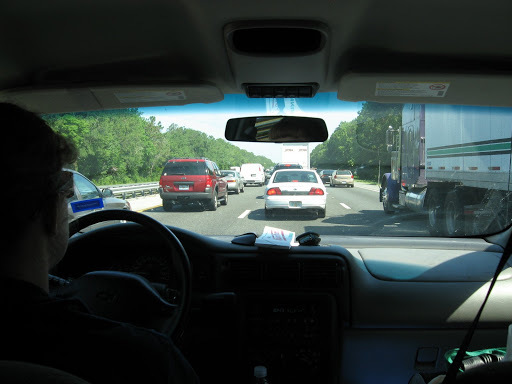
Just another Jacksonville rush hour

At a meeting of US Mayors, some very interesting items came up for consideration by the Public Transportation World. Stimulus is the catch word of the hour and everyone is looking for a piece of this golden fleece as the nation try's to spend itself rich.

Here in Jacksonville, our Mayor, John Peyton, just shocked the City last week with a call for a new $100 Million dollars of local spending to jump start the economy. Where pray-tell will the Mayor find $100 Million dollars laying around - useless? Why the funding for the Transit arm of our Transportation Authority of course. Currently the JTA enjoys a 1/2 cent on the dollar appropriation from the City. The Mayor wants to take that money away, money that was promised to the Transit Needy and Transit Savvy citizens of Jacksonville when we agreed to remove the tolls from our many bridges. So now Transit will have no toll money and no City money except that Peyton's big idea is to link the Transit funding with monthly sales tax revenue. In other words, 35+ years of Amtrak disasters look like success to this guy, after all, he now wants the same funding program for JTA.

I wonder if his daddy hadn't made a fortune in Gate Concrete and Gate Petroleum and bought him a mayoral ticket, how he would feel? He claims his $100 Million in new highways will create thousands of jobs and cause JaxPort (also know as The Port of Gold) to blossom even faster. Fat chance, (non transit type's should know that a single interchange can cost $150 Million). So where are these jobs going to come from? Not one mayor in any of the cities at the meeting had a clue. Tuscon, Arizona calculates that a $30 Million dollar road program in that City will cause 1,050 jobs. Certainly some sort of new version of the tired old "Trickle Down Economics" of Tricky Dicky and The Late Great Ronald Reagan.

If Jacksonville uses Tuscon's numbers as an example, the Mayors great rescue will amount to 3,500 new jobs in a metro of 1.4 Million people. BIG DEAL. One has to wonder how many of these jobs will be screeding concrete at Gate Products? Even if 500 of those jobs were professional trades and construction related, what happens when the money runs out? Of course we could just sell another bus. So are the other 3,000 jobs going to be burger flippers at the corner Gate Gas Station? You bet they will.

Oh but Mr. Mayor, you forgot that those folks won't make enough money to buy an automobile to get to work in this, the most sprawled, and largest City in land area in the Western Hemisphere. So they'll just take the bus right? OOP'S tossed those out for another guard rail on I-10, just another of our soon to be 4 interstate highways built with Gate Concrete.


Let's look at the mayors conference, from the Arizona Star:


$110 million for a new streetcar system that is scheduled to receive $87 million from the Regional Transportation Authority and requires only $75 million in new funding to complete.
Tucson Mayor Bob Walkup said the projects were included on the list submitted to the Conference of Mayors because that's what they wanted.


"They said 'Give us your list of things that are ready to go,'" he said.


Some of those on Tucson's list, however, are not on its five-year construction plan.


And Walkup said that if the feds picked up the tab for something like the streetcar project, "we'd probably have to pay them back."


Monday's report is in response to statements last month by President-elect Barack Obama saying he wants to create or save 2.5 million jobs by 2011.


Miami Mayor Manny Diaz, who chairs the conference, said that dovetails with the needs of cities that have infrastructure projects facing them.


"We need to invest where we can get the biggest return," Diaz said at a press conference in Washington. "We are not here for a bailout."


But if Tucson's job-creation figures are any indicator, the claim that projects from the 427 cities surveyed would create 850,000 jobs may be questionable.


Consider the item seeking $30 million for pavement rehabilitation and preservation, which Tucson says will mean 1,050 jobs.


Walkup said that does not mean 1,050 people filling potholes.


So where does the number come from?


"Nobody could explain it to me adequately," the mayor said. The best answer he got, Walkup said, was the idea that money spent on the projects would "trickle through our community."
"This is going to improve dry cleaners and people that are in the service industry by virtue of the fact that capital money is spreading," he said.


So Mayor Diaz of Miami says we need to invest where we'll get the most return. Great idea. Let's look at The Port Of Gold - JaxPort. Certainly nobody would suggest a Port that will triple in size in as many years should go wanting. But to rob the city of an already sketchy Bus System, and kill hopes for Rapid Transit in the process? That is just rabidly short-sighted. For all of these new Port highways, has one moments thought been given to a neutral railroad access or terminal company? Shhhh! We wouldn't want to tick off the resident brass hats in the CSX tower downtown.

But aren't Tuscon, Miami, Fort Lauderdale and Sarasota all planning streetcars. Yes they are but the Florida Cities won't let the cat out of the bag. Why? Maybe it's because Jacksonville has already raided the Ports from Seattle to Key West to Bangor, and positioned itself to become the second or third largest port in the nation in a few years. God knows we wouldn't want any of that success to spill over to Mass Transit.

What success you say? Well, Tuscon is planning a complete modern streetcar system for a mere $110 Million Dollars - COMPLETE. I'm sitting here with two studies on my desk that say Jacksonville could self fund and have Commuter Rail with rebuilt RDC cars up and running next year for about $50 Million or half of the Mayors highway hijinks's.

Would the Streetcars make money? Of course they will, they'll make as much as City Library System, The City Parks and all those roads the mayor is so fond of. But it's the fallout from streetcars that is so attractive to everyone but Jacksonville's leaders. Tampa, for example built a historic tourist type streetcar only a mile or so in length and has seen $1.5 Billion in economic development follow along it's route. Isolated case? I think not. St. Louis Metro-Link Light Rail, $4.5 Billion in new development, Portland, Oregon, has reaped a cool $6.5 Billion.

This isn't hamburgers Mr. Mayor, this is real development, condos, retail, light industrial and corporate headquarters that follow the rails wherever they lead.

Oh, I almost forgot, we have THE PORT. Who needs a $6.5 Billion dollar legacy project when our children's children look at those big chain link fences and say, "Teacher told me to thank Mayor Peyton for dat daddy." Of course the kids will have to have a way to get to the port and Peyton won't be getting any credit for that little oversight.

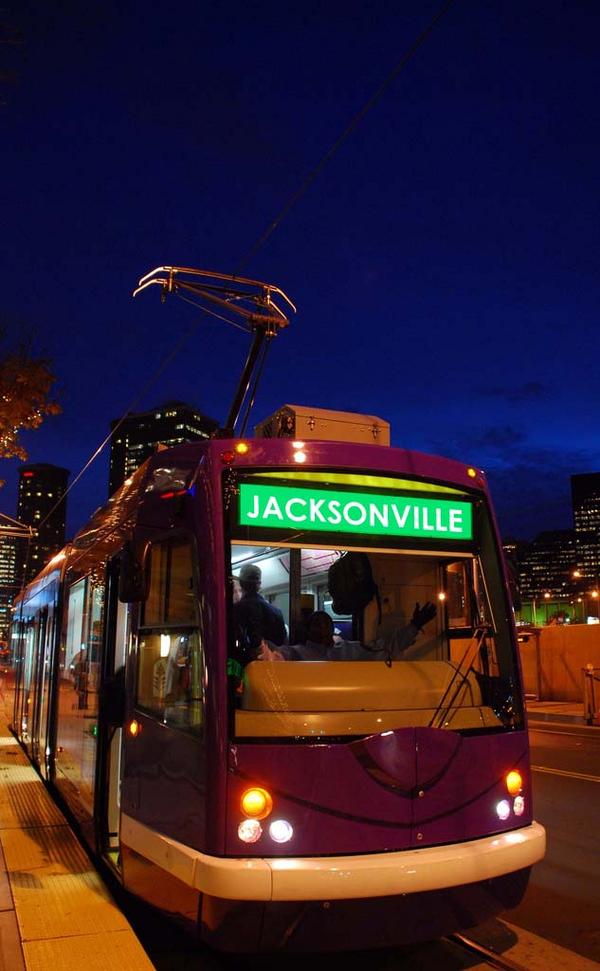
So here we sit on a pile of cash, able to self fund rail if we so desire. Keeping our brain trust in our neither region's has crippled the council, defamed the mayor, and sent the press off on wild tales about losing money on rail. They say a photo is worth 1,000 words so let me insert one for our consideration:

Meanwhile having blown the whistle on this self serving foolishness, I find myself deep in an old and familiar drama:


--Do not arouse the wrath....

-- Toto at my feet --

--CAMERA PANS right with him as he runs to a veil that hangs near the throne steps

-- PEYTON'S VOICE ...of the Great and Powerful PEYTON! I said -- come back tomorrow!

-- Bob speaks as he looks to the right

-- CAMERA PULLS back to Toto - starts to pull back Peyton's veil

--Bob, "If you were really great and powerful, you'd keep your promises, talk to you constituents and educate yourself!"

--PEYTON'S VOICE Do you presume to criticize the....

-- Toto pulls back the veil to reveal the Mayor at the controls of the throne apparatus

-- his back to the camera PEYTON'S VOICE ...Great PEYTON?

--You ungrateful 800 Pound Monster of Mobility!

-- The press folds and reacts with fear

-- PEYTON'S VOICE Think yourselves lucky that I'm...giving you audience tomorrow, instead of....

-- The Mayor at the controls -- his back to camera -- he speaks into the microphone

-- he turns, looks and sees that the veil is gone

-- reacts and turns back to the controls

-- PEYTON'S VOICE ...twenty years from now.

--Oh -- oh oh! The Great PEYTON has spoken! Oh -- Oh PEYTON'S VOICE Oh - I - Pay no.......attention to that man behind the curtain. Go - before I lose my temper! The Great and Powerful ---Peyton has... uh....yes....spoken.

This scene is repeated over and over all across America, as the grass roots Mass Transit Advocates try and educate the public. As for Jacksonville and the Oil and Concrete Mayor?

No disrespect intended Mr. Mayor, but you won't piss on my leg and tell me it's raining!


25 October, 2008

HOW TO LOVE BRT

Phoenix, AZ


Cleveland, OH.


Mexico City, Mex.

HOW TO LOVE BRT...

It’s a bad thing if BRT in Jacksonville doesn't materialize. I couldn’t state this any more strongly. We need as much transit as we can get; our buses are currently ineffective in all but rush hours. Just because I prefer rail over BRT doesn’t mean I’m against BRT, I just prefer rail to BRT. In all of my rants I have tried to point out that I think it’s a bit telling that we never seem to get that cheap BRT that we are promised by the anti-rail crowd. That doesn’t mean I would prefer these bus projects canceled.

If we could get more bus service in any form, that would be a net good thing. I would ride a JTA bus to work every day when I worked at Trailways, and it was great. It came to Monument Road at Atlantic a few blocks from my house, and droped me off right in front of my office, at the bus station. In order to provide service like that, the bus has to stop a couple dozen times between my house and my office. That’s what buses do really well: providing local service. Rail can’t do that level of local service very well. It’s a good thing we aren’t asking it to.


Saying buses are cheaper than rail in the long run is a misleading argument. We’ve discussed this ad nauseam here, here, here and here. The two sentence version: Buses are suited for one sort of transit, rail for another. BRT is trying to get buses to do the type of service rail is best suited for, which never seems to really work. The most common anti-rail argument is that investment in rail is regrettable because we can get BRT to do the same thing for less money.But the very crux of the argument is dishonest, because no one has ever seen this BRT that can do what rail does. We’ve seen BRT that can’t do what rail does, Boston’s Silver Line and LA’s Orange Line. And we have seen BRT that costs almost as much as rail (see the Silver Line), or more then rail (see the Euclid Corridor). But we’ve never seen BRT that can do what rail does.


Euclid Corridor BRT Opens


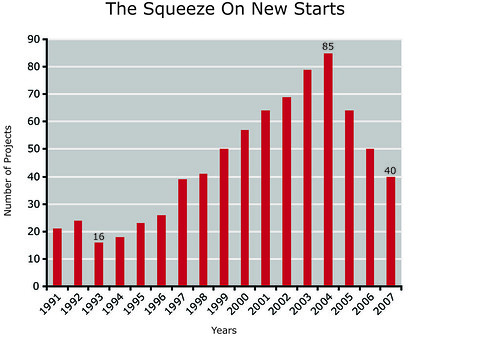
The Euclid Corridor BRT opens this weekend in Cleveland making it the third true BRT line to launch in recent years (Orange Line and Eugene EMX). Expectations will be high, err low. Projected 2025 ridership stated in the Plain Dealer is 15,000. That's a far cry from the previous projections of 39,000 cited by the FTA (Echo's of our own Skyway's 50,000 daily rider estimates). Given the amount of destinations and jobs on the line I doubt it will take long to get to 15,000.They basically reconstructed the street and are running the same buses as the Eugene system, (buses which weigh more and cost almost as much as modern streetcars). It's also another case of a project in the FTA process opening over 10 years after conception. I thought BRT was supposed to be cheaper and quicker to implement? Though if it started today, the project wouldn't even be funded under Ma Peters. It got a Medium Low in Cost-Effectiveness and a promised cost of $21 million per mile. Which ended up being $29 million per mile. I thought the reason for BRT projects was because they are more cost-effective. Basically what this proves is that the FTA doesn't want to spend money on projects that give transit its own Right-Of-Way. No not painting lanes on the street, but a true separation from other traffic that makes it more effective. Today, its required to get a medium in Cost Effectiveness.


So why does JTA just keep hammering on the same BRT routes and plans? Simple, they are already in the Federal pipeline. Those projects that do not currently have a rating of "medium" in cost-effectiveness would automatically be precluded from funding recommendation by the FTA, notwithstanding the merits of other criteria applicable to those projects. This is part of the cutdown in projects that has been going on lately. It's recently dropped from 85 projects in the pipe before the 2005 "medium" enforcement to 2007. Not counting small starts, this year only has 31 projects in the New Starts report.Lest you think that projects are rightly being cut, it should be noted that Denver's Southeast Corridor, Charlotte's South Corridor, the Los Angeles Orange Line, and the Minneapolis Hiawatha Line all had a Medium Low ratings. Those projects have all passed their projections yet would not have been funded under the current process. Anyone else tired of cost-effectiveness being used as a blunt object to bludgeon the alternatives that will truly get people into transit, including rail AND true BRT? Let's see how this line goes. I still wish it would have been rail and electrified, but it's an improvement in the corridor, one that the FTA would not approve of these days.


The BRT subject in Cleveland during the planning and building of the Euclid Corridor BRT line, Rightly or wrongly, has been fairly controversial with locals - you can see what I mean by looking at the comment section on any Plain Dealer newspaper article written about the EC project. Some of the criticism comes from a misunderstanding of who funded the project and where the money came from. Other criticism comes from the idea that building the EC meant that we squandered resources that could have been used for a better transit project. It is true that EC replaced an existing bus line on Euclid Ave. It is also true that the old bus line was horribly crowded, slow, and inefficient. A primary selling point of the EC is that it connects the city's two biggest employment centers: downtown and University Circle. Of course, they already have the Red Line (heavy rail) that connects those two neighborhoods (although the stations could be relocated to better serve that end; and one of them is currently planned to be rebuilt).The alignment of the BRT line is one of the biggest disappointments. The alignment that was built continues down Euclid Ave. into East Cleveland, which few locals will argue is the city's roughest, most rundown, and unsalvageable parts of the area. It is also an area that is already served by the Red Line. Not unlike Jacksonville's BRT plans that run under the Skyway or along side railroad tracks. It would have been exciting to see an alignment that turned south and east at University Circle and provided transit service to neighborhoods like Cleveland Heights and University Heights. It would have also certainly been more exciting to have a new electric rail line (whether light or heavy) down Euclid Ave. and into neighborhoods that currently lack good transit service to University Circle and downtown. Ridership expectations may not necessarily be high, as the PD claims, but the stakes certainly are high. Critics are ready to pounce on the project and officially label it as a failure and waste of valuable resources.


Cleveland’s Mr. Calabrese, is the push behind the Euclid BRT, he parrots the JTA line on BRT just being a stepping stone to rail. "Bus rapid transit lines can be designated and more buses can be tacked on if the service starts to grow. If the volume grows to a point, then some of these vehicles can be linked together. And then tracks can be laid".


Suddenly a bus system has become a fully fledged light rail system. If the volume grows some of "THESE VEHICLES" can be linked together? Buses? Really? Where has this happened? Where have they just slipped rails under the bus and got instant light rail? Can you image this happening on the Arlington Expressway or I-95 North BRT alignments? Someone please tell me which lane the trains will be in. The fact is, the BRT proponets are being dishonest with the public. They know the only thing even close to this is when the Cuirtiba, Brazil, BRT system failed to meet demand (after being the model for both Cleveland and Jacksonville) forcing the City of Curitiba to build a new Metro Rail System.


I don’t think light rail is cheap, I think light rail, especially vintage streetcars, or modern streetcars (in that order) is cheaper than the alternatives. Even more so in Cities like Jacksonville where many lightly used railroad branchlines or abandoned rights of way can be accessed for transit. Roads are very expensive. Adding the outter beltway, just the Federal contribution is $69.2 Million. Adding the new interchange at I-10 and I-95 is another $148 Million. Completing a widening redesign to accommodate FDOT’s budget on a 2-mi segment of Interstate 275 just west of downtown Tampa in the Westshore Business District. Construction of the first phase of this project will cost $277.5 million, begin in 2007 and wrap up in 2012. Ultimate construction cost will exceed $500 million. Each of those cost considerably more money per mile than light rail does, just the new viaduct and 520 bridge in Seattle, will each cost more than a billion dollars per mile. None of these will move as many people as light rail would. Light Rail is cheaper to operate per passenger miles than buses are, which is why you want riders going long distances to do so on rail. Exclusive lane BRT around here is not going to work if the current routes pass review. Even if BRT and the expanded interstate highway fails, congestion and fuel will continue to eat into bus funding, making buses ever more expensive to operate per passenger mile. This is why buses are better suited for local access than rail, and rail is better suited for longer distances than buses are. Investment in light rail will pay off spectacularly, because we’ll be able to put buses that are used for long-haul service back to where they are effective, into shorter local service. Once riders get on rail, they become much cheaper per over the distance, we save money, and can improve service. Light rail isn’t cheap if you have no buses, and buses aren’t cheap if they are asked to do what rail should be doing.


I am very much pro-bus, which is why I took the bus to work everyday when I could drive, thank you very much. However, I do have a problem with the Mike Miller, JTA, et al. argument that, every thing being equal, buses can do what light rail can do cheaper. It’s a dishonest argument, and the first bit of proof that BRT is not cheap is provided by the fact that we don’t seem to be able to get any cheap BRT.


The only people I can imagine who would be happy that Jacksonville Commuter Rail, Streetcar or, a Skyway expansion, might not arrive are the anti-everything set, who claim to be in support of BRT, but, of course, if it comes time to vote on funding, they'll be more then happy to vote no. They might be happy because they can continue to make the the argument that BRT will be cheaper than rail, and instead of having an example to compare light rail to, they can continue to compare high dollar subways to BRT systems in far away places like Lima, Peru and Bogotá, Colombia. They know full well that BRT can’t do what light rail can, and they can remain against any form of transit mix that actually works.
Special Thanks:
The Overhead Wire
City of Cleveland
Cleveland Plain Dealer
JTA
Mr. Mike Miller
Mr. Rob Pitingolo
The Toledo Blade
APTA
Seattle Transit Blog
Light Rail Now
FTA


04 October, 2008

JACKSONVILLE STREETCAR IS POSSIBLE!


Two fantastic "HOW TO" articles appear today in the Jacksonville Transit Blog. The first is from Michigan, and the "Overhead Wire" news. This gives us a step by step way to build or rebuild our streetcar system using public private partnerships. The only missing element is the old rule that utility companies can't also own the streetcar network. In todays world, this law is long outdated and even though it is/or once was federal, it needs to be dumped. We need all the electric transit we can get. So think JACKSONVILLE TRACTION and think, we CAN!


Friday, October 3, 2008

Street Railway Resurrection
Michigan lawmakers are
looking at a bill that would allow street railway companies to form in the state and use recently passed tax increment financing laws and other mechanisms to fund new lines. I don't imagine the line is completely private, but its an interesting step away from the public transit agency model. It seems similar to Portland Streetcar Inc, but I haven't looked deep enough yet to see the similarities. There are some interesting provisions though:
As envisioned in one set of bill drafts, for which state Rep. Bert Johnson, D-Detroit, is the lead sponsor, the street railway company could build, own and operate the system. The company could acquire property, including through gift, purchase or condemnation, and could borrow money and issue bonds.It's a fascinating idea and the point is to have it replicated all over the state, from Grand Rapids, to Ann Arbor, to Detroit.


Allen also said a goal is “to come up with a replicable plan, which means that we can work it in Detroit, or Grand Rapids. We’re open to input from anyone. If this tool can work in a variety of communities in the state, that is one of our objectives.”

THE OVERHEAD WIRE

26 September, 2008

Transit Wisdom? ...and Toledo Too?

Neil Reid, director of the University of Toledo Urban Affairs Center, warned transit officials to consider the American comfort level with buses.


Along for the ride? Wisdom from Ohio...

While bus ridership in both Toledo and Cleveland has grown in recent months, diesel costs have ballooned. And those fuel bills threaten the revenue and viability of busing systems across the country. “Many systems around the state, instead of adding service when demand is at an all-time high, are probably going to be cutting service,” Mr. Calabrese said.“My diesel bill went from $5 million in 2003, to $12 million last year, to $21 million this year, and it should be about $24 million next year.”In Toledo, TARTA will cut its bus service by 7 percent on Aug. 24, a decision that has caused outcries from local riders.Aside from rising fuel prices affecting expansion possibilities, Neil Reid, director of the University of Toledo Urban Affairs Center, warned transit officials to consider the American comfort level with buses.“Most people in Toledo, people say under 50, probably have never ridden a bus before or only on sporadic occasion,” he said. “People probably just don’t consider that an option.”The issues may cut deeper than simple unfamiliarity.Busing systems in many cities have been painted as ferries for the poor. Alan Plattus, director of the Yale Urban Design Center in New Haven, Conn., said dismantling a classist attitude — as has been done in many European countries — may be as important to the success of buses in America as the routes they follow.“The bus system has gotten to be a class system,” he said. “Middle class people who might use the bus instead of taking a car trip don’t do it.”For many urban planners, busing systems also have become the figurative poor man’s light rail, a shot below the mark for cities focusing on asphalt instead of track and relying on tenuous data promising real estate development around buses.John Norquist, president of the Congress for the New Urbanism in Chicago, agreed developers are more likely to be attracted to areas along rail stations or lines where the city has signaled its intention to make large, nearly indelible investments.“Light rail is good because it’s permanent,” he said. “People say with buses they’re good because they’re flexible, but they could disappear at any moment.”Light rail — the term applied to streetcar systems such as trolleys — is nothing new.The Richmond Union Passenger Railway came online as the first large electric street railway system in 1888, displacing horse drawn buggies. Many cities, including Toledo, decommissioned their streetcar systems in the 1950s as the country began its migration to the suburbs and the automobile industry flourished.Finding the right pathJames Seney, former executive director of the Ohio Rail Development Commission, said old streetcar lines in Toledo fit the layout of the community and may be a guide for rail revampment.“What makes urban rail work is when you create transit routes that have clusters of neighborhoods on them,” said Mr. Seney, the former mayor of Sylvania. “You should design [routes] based on your existing neighborhoods and tie that into the growth of downtown businesses, rather than trying to capture a larger area.”Though Mr. Seney said new tracks would be needed if Toledo decided to move forward with a rail plan, he admitted “the old guys logistically were correct.” The push toward rail is being seen in other U.S. cities.About 100 years after its invention, light rail experienced a heavy resurgence. Most of the United States’ busiest light rail systems today were built or intensely renovated in the last two decades, including lines in Los Angeles; Portland, Ore.; St. Louis; Denver, and Dallas. Even smaller cities such as Little Rock, Tacoma, and Galveston, Texas, have invested in light rail systems since the turn of the century.The Massachusetts Bay Transportation Authority in Boston shuttles over a quarter million people per day on its green and red lines, making it by far the largest light-rail operation in the country.

25 September, 2008

JACKSONVILLE IS STREETCAR SERIOUS NOW


Amazing new photo that surfaced in "Roots Web" of Jacksonville Traction 113 on the Kings Avenue Line. We were so far ahead of our time, using in the street tracks only in downtown and medians or private tracks elsewhere. Then we jumped the gun and shot ourselves in the foot, converting the whole thing in a giant dirty General Motors-Firestone-Standard Oil-Phillips Petro buy out. With fuel prices soaring, and highway funds on zero, congestion is not going away, it's time to think streetcars again. The following is a reprint of a Florida Times-Union Story.


Photo credit Metojacksonville.com
Streetcars: A lot of potential


By The Times-Union
Retired transportation consultant Bob Mann is either a visionary or hopelessly stuck in the past, depending on your view of his proposal that would return streetcars to downtown Jacksonville.

But on one thing, everybody agrees: He's tenacious.

Mann has been advocating streetcars - light trains on tracks, powered by overhead electricity and sharing the road with cars - for about three decades.

And, amid increased traffic congestion and spiraling gasoline prices, he's making some headway. In fact, the Jacksonville Transportation Authority is doing a study on the feasibility of making Mann's proposed track part of the city's transit system.

There is much to like about Mann's proposal:

Cost. Because it would use existing tracks, the system presumably would be relatively inexpensive.

Potential ridership. Not only would the uniqueness attract some riders, it would serve a heavily traveled route that includes Five Points, the convention center, the Landing, football stadium and library.

Tourism. Vacationers might pull off Interstate 95 for a ride. While here, maybe they would patronize some local businesses.

Economic development. In other cities, housing and businesses tend to spring up along streetcar lines.

For example, USA Today reports, Portland's streetcar system "attracted about 100 projects with $2.3 billion in less than five years, all within two blocks of the line. They include 7,248 housing units and 4.6 million square feet of office and retail."

The proposed line here would go through some areas, near downtown, that clearly need an infusion of economic development.

And, if they are made aware of the Portland experience, maybe developers would help pay the costs.

What does the future hold? Something. Mann just isn't sure quite what.
He sees three options:
- museum. Put the streetcars in a building and invite people to look at them. That could increase public support for funding.

- For a little more money, a short track might be built to carry people to and from the museum. This might spur more donations.

- With sufficient funds, build the system and use it.

There may be a trend to streetcars. Dozens of cities either have or are planning them, Mann says.

What about Jacksonville?

Proceed with caution. Every dollar spent on streetcars is a dollar less for buses or other forms of transit*(see blogger note).

But this seems to have potential.
* Blogger Note: Phil Fretz of the TU did a great job in grasping the meat of the streetcar race in Jacksonville. On this one point he may have stumbled a bit, as with each streetcar deployed, it relieves several buses. Those buses can then be sent into new areas or to close headway's (make service more frequent). Thus every dollar for streetcar is NOT a dollar lost on other transit.
Our motto should be, implement streetcars downtown, but build to Light Rail standards on the key downtown loop. The slightly more expensive LRT tracks would be used by the streetcars and in the future, if the time comes to expand to the Beaches, the downtown core is already built to handle the bigger cars too.

10 September, 2008

SAVANNAH STREETCAR HAS JACKSONVILLE ROOTS

Savannah, Georgia, is showing the way for Jacksonville and plans to open as early as November.
The Streetcar in the Center of our original Jacksonville Traction Emblem spent it's last years working the transit lines in Savannah. One of the lucky few to survive the fate of chicken coops, sheds and "Florida rooms".

River Streetcar: November at earliest
LAUREN NARDELLA

Saturday, August 23, 2008 at 12:30 am

The rails along River Street won't be put to good use for another few months.
The highly anticipated River Streetcar is presently in Altoona, Pa., for electrical and mechanical gear to be put in place.

It's expected to be delivered to Savannah in six to eight weeks, said Sean Brandon, the city's mobility and parking director.

After it undergoes testing, it could be operational as early as November.

"It's been a journey," Brandon said at a streetcar information session Friday. "This is ... one of the most difficult projects we've had to undertake."

The streetcar is from the 1930s and has been completely refurbished as a modern, hybrid vehicle.

"It's a Prius on steroids," said Gary Landrio, assistant vice president of Tran Systems, a transportation consulting company in Warren, Pa.

"(The River Streetcar) is one of the most cutting-edge things from a green standpoint that's being done anywhere in North America," he said. "There's no vehicle like this."

When the streetcar is operational, it will run from noon to 8 p.m. to allow for extra space on River Street for business deliveries in the mornings.

It will hold 50 to 80 people, and round-trip fares will be 50 cents. The free dot shuttle will connect to a streetcar stop at City Hall.

Disability access
Part of the delay in the streetcar's completion stemmed from the addition of two wheelchair lifts.

The technology for the lifts needed to be hidden in order for the streetcar to still look like it's from 1935 - which took up a lot of time, Landrio said.

A significant amount of people with disabilities visit Savannah, according to Brandon. The streetcars will be fully ADA accessible.

"Now somebody with mobility challenges can ride the length of River Street and can get on and off to visit what they want to," Brandon said.

Cynthia Egan, owner of Arts & Crafts Emporium on River Street, is pleased the streetcar will be able to accommodate wheelchairs.

"I think it will bring a lot more tourists that normally couldn't come down here," she said. "It really fills a void."

Moving the rails
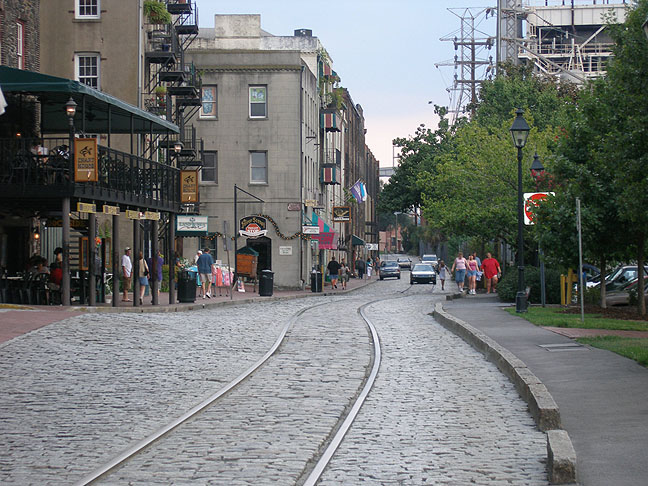
The streetcar will use the existing rails along River Street.

But there's a possibility the rails might need to be moved along the stretch from Spanky's restaurant to the Olde Harbour Inn, Brandon said.

The rails shift in that spot, and moving them two to two-and-a-half feet north may make it easier for motor vehicle traffic to move along River Street at the same time as the streetcar.

While a decision won't be made on moving the rails until the streetcar is tested, the city plans to move forward with the assumption that the work will need to be done.

"The goal is to get this in as soon as possible," Brandon said.

The general consensus is that it would be best to move the rails in December (excluding the week of Christmas), January or February to cause the least amount of disruption to businesses.

If everything else works out on schedule for the streetcar, it would operate from the west end of the route up to the construction area.

More delays possible
Another possible hurdle on the way to the streetcar becoming fully operational is the Federal Transit Administration.

The city submitted a safety plan to the administration in July and received a 40-page response Thursday.

The FTA works with a local office in Atlanta, which works with the state Department of Transportation, according to Brandon.

He said they don't have much experience with passenger rail, except for the Metropolitan Atlanta Rapid Transit Authority.

"I hope they don't try to treat us like MARTA," he said, adding that the safety standards should be different and should take into consideration the routes and speeds of the vehicles.

The FTA would need to approve the safety plan before the streetcar could run in Savannah.

The streetcar may eventually have a counterpart on River Street.

Another has been purchased by the city, but it won't be refurbished until the first car and the rails are complete and fully operational.
BLOGGER QUESTION: So Jacksonville, the city that would have been FIRST with a heritage streetcar system. But for Jake Godbold and unfounded fears that it would chase away the UMTA gift of a "free Skyway". Are we now going to drag ourselves last in line?


TAKE A FREE TOUR OF THE JACKSONVILLE SKYWAY

The arguments rage to this date, "Should have never been built," "waste of taxpayer money," "Doesn't go anywhere," "Nobody rides it..." etc. Bottom line is we have it, and it is finally showing signs of life. Simple extensions to the Stadium, San Marco, and the area of Blue Cross in North Riverside would turn this little train around. Addition of Park and Ride garages and multimodal transit terminals at the end points would bring on the crowds. The video must have been shot on a Sunday Morning, as downtown is certainly as packed with life as any other major City on weekdays. Jacksonville is a city of Bikes, joggers, walkers, buses and cars, one almost wonders how the photographer managed to find this quiet moment.


Support the Skyway? Join the Monorail Society Today!

Subscribe to monorailsociety
Powered by groups.yahoo.com

WELCOME ABOARD

Sign by Danasoft - For Backgrounds and Layouts