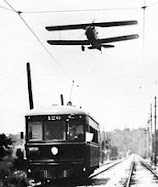
INCOMING!
KANSAS CITY ANTI-RAIL LOBBY ATTACKS LIGHT RAIL AND THE JAX BLOGGER FIRES BACKThe so-called Citizens Transportation Committee is at war in Kansas City trying (with help from City Hall) to kill a citizens ballot vote that put Light Rail into a plan that only included KC Transits BRT plans. The BRT went flaming into the garage, then the City Council overturned the peoples vote! OUTRAGE! Court cases threatened and suddenly Light Rail is back on track only now there is a "new" group of very vocal citizens against light rail. Interesting? You bet. Suspect? Oh right out of the General Motors handbook of 1932...
So just for fun let's play a game here. Jacksonville and JTA could take this same approach, they could come back from a "Streetcar" and "Commuter Rail" study with horrible tales from the Kansas City group. What if this were JTA or the Jacksonville Citizens asking these questions, how would you and I answer them?
FROM AN IMAGINARY CTC ("Citizens Transit Committee") - JTA REPORT... (WE DEMAND ANSWERS TO THIS)
1. The inclusion of all elements of transit into the discussion of a city’s transportation plans.
2. The early inclusion of all segments of the population in transportation discussions.
3. The use of standardized methods of route comparison.
Beginning January 1, 2008, the CTC presented a series of questions to the Light Rail Task Force. Each question was supported by additional comments and reference sources when available, but only the questions are included here.
Question # 1 - January 1, 2008 Why does the Task Force continue to work with erroneous construction cost figures? You are using $50 million per mile for light rail and $40 million per mile for streetcars. Evidence shows that your $50 million per mile figure for light rail is very low and your $40 million per mile for streetcar is very high.
The CTC seems a bit confused. We NEVER said Light Rail would cost us $50 million a mile in Jacksonville (or elsewhere for that matter). Certainly it COULD if we built it in a subway or on a Skyway like structure, but not as we plan it. In fact the contractors think Modern Streetcar Track can be built down the center of streets such as Water Street for as little as $5-10 Million a mile and that includes the overhead wire system and cars. Light Rail would cost more due to larger vehicles and more weight, but even for private right-of-way and all double track it shouldn't surpass $30 Million a mile.
Question # 2 - January 2, 2008 Why does the Task Force completely ignore operating costs? Operating costs are a continuous expense to taxpayers. Citizens should have this information available before they enter the voting booth to decide the fate of light rail.
Fair enough, we currently pay about $17.00 per Skyway passenger, and our bus system carries only 5% of the working city at some cost to taxpayers. Modern Streetcars on the other hand operate in the area of $1.00 - 2.00 per passenger in subsidy. Heritage Streetcars, that is historic or replica historic cars often do much better. In post Katrina New Orleans, the Streetcars are in the black and massive expansion is in the works. Operating and Maintenance (O&M) costs are lower for streetcars then for buses.
Question # 3 - January 3, 2008 When will the Task Force discuss light rail crime? Crime is a real problem both in terms of quality of life on the trains and in actual dollars.
Frankly we are very concerned about this, the Rosa Parks Center, the driver less and conductor less Skyway leaves patrons to their own devices most of the day. Bus driver and passenger crime happens with some regularity at JTA bus stops. A Streetcar system, would have double the defense. We would have station shelters, which while far smaller then the Skyway could have central camera surveillance 24/7 and we would run Streetcars with Motormen and on occasion, roaming Conductors for added security. That equals about double the man power available to a JTA bus patron and Camera=Police presence.
Question # 4 - January 4, 2008 Why does the Task Force continue to discuss “Fast Streetcars” when no such device exists? Since the early 30s, all streetcars have operated at a top speed of around 45 mph. This includes historic, traditional, and modern streetcars. In urban environments, all hard rail transit vehicles that operate at ground level operate at speeds of 17 to 20 mph. Only when operating below the traffic as a subway or above traffic as an elevated are transit vehicles able to escape the speed restrictions caused by mixing with automobiles and pedestrians.
We have mentioned this before in the local press. The old JCCI study that labeled streetcars as slow, clunky, little more then tourist toys was completely wrong. (For NASCAR-LIKE evidence of what street railway equipment is capeable of doing see the side-bar article on "Those old and Slow Trolleys"). Frankly the motors that power any Streetcar or Light Rail Vehicle can be made to run at speeds none of us would be comfortable with. Did you know the 300 MPH trains in France are the same basic technology as streetcars? Where it gets interesting is where do you want our streetcars to hit 50 or 60 MPH?
Main Street? Water? Park? San Marco? Hardly. We can still outrun the cars on I-95 by using some private right-of-way such as that of the old F&J (Maxwell House) branch that connects downtown with Gateway Mall and doesn't go down a single street. So if your driving on North Main and the lights flash, the gates go down, all you'll hear is a faint "Woo" type Interurban Horn, and a classic streetcar will whoosh past at 45 MPH. Fast enough.
Question # 5 - January 7, 2008 When will the Task Force discuss construction disruption times as it impacts local business? All small businesses are concerned with anything that interferes with customer access to their business.
Unlike Highways and Busway's for BRT, streetcar construction usually is done in segments of 3 or 4 city blocks at a time and about 30 days from cut to finish per segment. Thus no business should be without easy access for more then 1 - 2 months.
Question # 6 - January 8, 2008 After the Task Force establishes a final route, when will local business owners at the station sites be advised that eminent domain may be required for their property?
No streetcar station should be so big as to require anyone's property. The needed right-of-way and station sites are already in place all along the streets and railroad grades of Jacksonville.
Question # 7 - January 9, 2008 When will the Task Force examine your recommended routes to insure they serve those most in need and provide the greatest benefit to the most people?.
The first goals will be to create a downtown double loop that allows cars to move to all of the hot spots in Jacksonville Development. Courthouse site, La Villa, Prime Osbourne/Transportation Center, Water Street, Landing, Omni, Hyatt, Cathedral and Stadium districts. Add to that the need to reach out and touch the neighborhoods such as the Riverside, 5 - Points, San Marco, Springfield communities. See the chart above for a Conservative estimate of the growth that our new - OLD streetcar system would promote in downtown.

 INCOMING!


 Posts
Posts