06 August, 2008

HOW BAD DOES JTA SMELL?

By Robert Mann

In Jacksonville for years the cry of the masses is that our "buses stink," they are dirty, filthy, smell like body odor of the unwashed masses, tattered, inept, unreliable, uncomfortable and often downright rude. A broken welfare transit system, home for the homeless, drug dealers and hookers, is certainly no place for an up and coming employee or executive.

But how true is that image? Has the transit of the masses been so neglected so as to sink into an irretrievable ninth circle of Hell?

Consider our role models, both our parents and relations. An editorial in Mass Transit Magazine last year looked at vacation season and asked if any of us had ever been on a public transit vacation? The author then took the extension to the extreme in stating that even Hollywood Movies and Recordings, avoid public transit in general, and buses in particular.

I had to say, I do remember traveling on a Greyhound Super-Scenic Cruiser sometime back in the early 1960's. As I recall, the passengers seemed to all share an obvious economic depression, but the polished driver sang all the way south. Helping little old ladies aboard, and overweight beach bums with their blankets and packs. The old route ran down Florida's scenic highway A-1-A from Jacksonville and the Beaches, to St. Augustine, Marineland, Flagler Beach to Daytona Beach. Often in easy sight of the Atlantic Ocean surf, or the many colorful shops and hotels that dotted it's route. But the whole experience had the cloud of some depressing due for the company axe, a prediction in my young mind, which turned out to be quite accurate. Almost every hamlet had it's stop, and it seemed to be well patronized in it's once daily, down and back schedule. Then one day, it simply was no more. It was as if the tides had washed it away like so many grains of beach sand. Driving the route some years later, I was listening to Harry Chapin's song "Take the Greyhound, it's a dog of a way to get around..."

A-1-A is much wider in most places today. The hotels are more grand, the restaurants are national and international chains. Even the tiny airport or two south of Jacksonville, are now regional jet ports. While Marineland and it's hotel have faded, St. Augustine and the dozen or so State and National Parks this little trip passed through sure haven't. In fact, when I made that trip, Jacksonville had a population of about 202,000 persons. Today the City is the third largest populated place in any of the east coast states.

So was it really Hollywood? Recall if you will that the "Bob Newhart," show, started and ended with stunning images of Chicago's CTA trains. Then there was Doctor "Patch Adams," who took the bus to find himself in a mental hospital. "Trains, Planes and Automobiles," and movies such as "Airplane," had us rolling on the floor laughing at the overall shortcomings of the transportation industry. Anyone remember Mr. Ralph Kramden? Ralph Kramden, played by Jackie Gleason, on the famous 1950's TV comedy, "The Honeymooners," Ralph was a bus driver for the fictional Gotham Bus Company. Though he was never seen driving a bus (except in publicity photos), but was shown multiple times at the bus depot. Ralph was frustrated by his lack of success, (apparently being a bus driver even carried a stigma in the 1950's) and often developed schemes designed to earn him and his wife a quick fortune. Ralph was very quick-tempered, and frequently resorted to insults and hollow threats of violence.

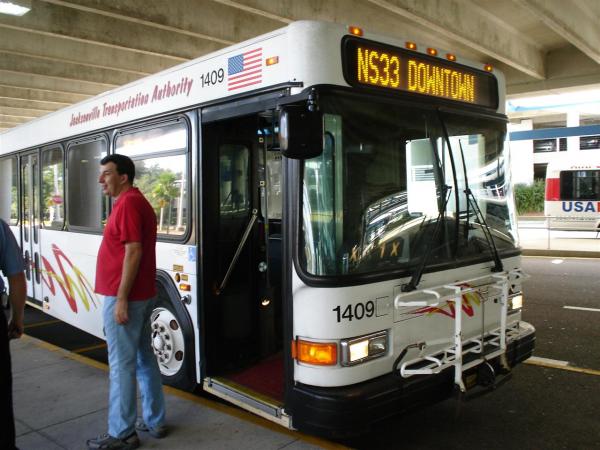
So while the Hollywood jury is still out on the bus business, our own local JTA has had a year of bad press. Bus drivers tossing passengers off the bus, fights over fares, refusal to carry passengers, complete lack of "ANY TIME" information, non-existent route maps, and now a roving Gnome who is blogging a journal of doom, "30 days with JTA," that will now be expanded to 90 days after a near fist fight with a cursing, irate, driver. The driver stopped at an unmarked stop across the street from a marked location. Perhaps the sign was simply missing, or perhaps for traffic reasons it was never placed. However JTA information told our stalwart passenger to flag down the bus. He did as he was told, and stepped aboard only to catch a full broadsides of foul language and demands that he get off the bus, walk the two miles to the next stop, or, the police would be called to eject him. As his journal has caused a constructive discourse with JTA management, he was immediately back on the cell phone to JTA information and soon talking with the supervisor.

Needless to say it got even more ugly when the driver still yelling, told him, "Oh I'm sure your talking to my boss, you can tell him to XXXX too!"

Is it an obvious case of "The Jacksonville Transportation Authority Stinks," with service boardering on the tenth circle of hell? Not at all. JTA is in transformation from a large southern city system, to an international city metro. Certainly there are bumps along the way, but managment is doing exactly what it should be doing with this case, this journal, this rider and information. It is meeting en-masse, and not just for damage control, but reaching for real solutions. Listening to what the public is saying. Sweeping changes are coming to the bus portion of JTA, and I'm confident they will be quickly followed by monorail (The Jacksonville Skyway), light rail and commuter rail, additions and improvements. Things happen for a reason, and no matter how beautiful the new Gillig BRT model buses, if the driver's attitude chases away the would-be patrons, then the bus "stinks".

Our solution is not simply that new vehicle smell on the same old machine, but a complete re-thinking of the industry. Out of the Box, and even perhaps out of the old bounds. There is that route down A-1-A just waiting for some lucky service to pick it up and market those beach side resorts. This is Florida's First Coast, home of the nations oldest city. Today all of that falls within the bounds of the Jacksonville Metro Area and the potential reach of JTA or a joint venture of JTA and another franchise, such as Trailways or a charter carrier. We are talking fare free in Jacksonville, preboarding tickets or passes, fun buses, day trips, and maybe even singing drivers. All along the booming coast we have construction, new jobs and massive port expansion. Home to more fortune 500 companies then any other two Florida Cities combined, we have a new, urban and financially powerful workforce. There is national exposure in our Arena and Arts, and our NFL Jaguars or the home of the PGA at Sawgrass, have changed our posture. No longer can we afford to operate the old bus system of the past and JTA knows it. We still have miles upon mile of untouched roadway, and untouched beach sand... I say it's time that Jacksonville and JTA build some castles in the sand. Any of you old enough to remember the Chapin Greyhound song, will recall, he ended it in reflection of his bus trip... "A thought for keeping if I could, It's got to be the going not the getting there that's good."

DON'T CONFUSE US WITH FACTS IN JACKSONVILLE!

Watch Out Jacksonville, Here it comes again... Why we MUST leave the roads...
Wouldn't Edgewood at Roosevelt look sweet with Commuter Rail?
Imagine the advantages to adding Modern Streetcars to our Monorail System Downtown...
In spite of a unified outcry from the community leadership, our politicians are still throwing up the red signals. No amount of logic seems to matter, but as if it did, I'll print some more!
Wednesday, August 6, 2008

People want transit, politicians lag behind
More evidence that people want to end the dominance of the auto....

A recent poll found that given a hypothetical $100 to invest in transportation, Americans said they would spend $62 on trains and rail, buses, bike paths, and sidewalks, and only $38 on roads. (Source: Harris Interactive poll [+/- 3 pts]). In other words, Americans want to spend 63% of transportation dollars on bicycling, walking and public transportation, nearly tripling the 22% now spent. Philadelphia Bicycle News

More From The Center for Transportation Excellence

85% of all transportation costs in the U.S. are related to private automobiles.

A $10 million investment in public transportation results in a $30 million gain in sales for local businesses (3 times the public sector investment in transit capital).

A recent study by the University of North Texas found that the new DART (LIGHT RAIL)system in the Dallas region has already generated over $800 million in development, and that the full system is projected to generate $3.7 billion in economic activity upon build out.

A recent survey by Jones Lang LaSalle in its Property Futures publication found that 77 per cent of New Economy companies rated access to mass transit as an extremely important factor in selecting corporate locations.

A regular rush-hour driver wastes an average of 99 gallons of gasoline a year due to traffic. The average cost of the time lost in rush hour traffic is $1,160 per person.

A study on U.S. government spending and its impact on worker productivity estimated that a 10-year $100 billion increase in public transport spending would boost worker output by $521 billion, compared with $237 billion for the same spending on highways.

AAA members who rely almost exclusively on automobiles for their daily transportation needs, would still opt to spend more money on public transit than on new roads, according to a recent survey.

Almost half of all Fortune 500 companies, representing over $2 trillion in annual revenue, are headquartered in America’s transit-intensive (RAIL SERVED) metropolitan areas.

America’s families spend more than 19 cents out of every dollar earned on transportation, an expense second only to housing and greater than food and health care combined.

American families spend 18% of their household budgets on transportation, making it the second largest household expenditure after housing.


Americans living in transit-intensive areas save $22 billion each year by using public transportation.

An assessment of the economic benefits of the services provided by the Memphis Area Transit Authority (MATA) (HERITAGE STREETCARS) found a benefit-to-cost ratio of more than 13 to 1 when both direct and indirect benefits were considered.

An estimated 14 million Americans ride public transportation each weekday and an additional 25 million use it on a less frequent but regular basis.

Around Washington D.C. 40% of new building space in the 1980s, worth $3 billion, was built within walking distance of a Metro (RAIL) stop.

Between 1997 and 1999, an estimated 4,500 housing units and some 9 million square feet of commercial-office floorspace were added within walking distance of the Tasman West LRT corridor.

Building more roads isn't always the answer to this growing problem. Each of the cities in the TTI study would require an average of 37 more lane miles to keep pace with just one year of increased traffic demand.

Business output is positively affected by transit investment. A sustained program of transit capital investment will generate an increase of $2 million in business output. After 20 years, these benefits increase to $31 million.

Drivers in one-third of U.S. cities spend more than 40 hours a year (an entire work week) in traffic that is not moving.

Every dollar that U.S. taxpayers invest in public transportation generates $6 or more in economic returns.

Federal transportation grants for State and local governments totaled $4.4 billion for transit or 14% of all transportation grants in 2000. Federal transportation grants to State and local governments amounted to $26 billion or 80% of the total in 2000.

Four in five Americans believe that increased investment in public transportation strengthens the economy, creates jobs, reduces traffic congestion and air pollution, and saves energy.

If one in 10 Americans regularly used transit, U.S. reliance on foreign oil could decline by more than 40%, or nearly the amount of oil imported from Saudi Arabia each year.

In 1999, public transportation vehicles used 856 million gallons of fossil fuels and 5.2 billion kilowatt hours of electricity - which is less than 1% of all energy consumed in the U.S.

In 2000, Americans took 9.4 billion trips using public transportation, an increase of 3.5% from the previous year - the equivalent of more than one million new trips each day.

In 2000, Americans took 9.4 billion trips using public transportation, an increase of 3.5% from the previous year - the equivalent of more than one million new trips each day. During the same year, ridership grew twice as fast as the U.S. population and outpaced growth in other travel modes.

In 2000, America's public transportation systems employed 350,000 workers to operate, maintain and manage all modes of transit. A full 50% of this workforce serve as operators or conductors.

In 2000, total federal spending on transit was $5.3 billion or 11% of all transportation spending.

In Los Angeles, .80 of every $1.00 spent on public transport gets recirculated in the region, translating into $3.80 in goods and services. Conversely, .85 of every $1.00 spent on gas leaves the region.

In suburban Philadelphia, the total increase in residential real estate value in neighborhoods with train service is estimated to be over $1.45 billion.

In the last five years, transit use has increased faster than any other mode of transportation.

New urban expressways cost up to $100 million per mile while rail and bike facilities cost on average $15 million and $.1 million, respectively.

Of the nation's top 50 metropolitan areas, all but (JACKSONVILLE) were planning a New Start project, adding to a existing system or have a new system under construction.

On average, a typical state/local government could realize a 4%-16% gain in revenues due to the increases in income and employment generated by investments in transit.

Public transportation customers are diverse: People age 65 or older represent 7% of riders; 18 years and younger , 10%; women, 52%; White, 45%; African-American, 31%; Hispanic, 18%; and Asian and Native American, 6%.

Public transportation is a $32 billion industry that employs more than 350,000 people.

Public transportation ridership has increased 22% in the last six years.

Since 1980, three subway systems, 68 light rail systems and 1240 bus systems have been added to U.S. communities.

The adjusted cost of congestion in the 75 areas studied by the Texas Transportation Institute has tripled in the past twenty years to $68 billion in 2000.

The amount of fuel wasted in traffic annually in the 75 major urban areas studied in TTI's Urban Mobility Study would fill 114 supertankers.

The annual cost of driving a single-occupant vehicle is between $4,826 (for a small car) and $9,685 (for a large car), depending upon mileage. The annual average cost for public transportation for one adult ranges from $200 to $2,000, depending upon services used.

The average annual income of rail commuters is more than $50,000 and most own two cars.

The National Safety Council estimates that riding the bus is over 170 times safer than automobile travel.

The poorest quintile of American households spend 36% of their budgets on transportation, while the richest fifth spend only 14%.

The value per square foot of commercial space near Metrorail stations in Northern Virginia has jumped more than 600 percent since the first station opened in 1977.

Three-quarters of Americans support the use of public funds for the expansion and improvement of public transportation.

BLOGGER NOTE: In Jacksonville, these are no longer Bus vs Rail vs Skyway arguments, with fuel prices in the stratosphere, this is now a matter of common sense and urban survival.

Thanks to; Center for Transportation Excellence

Philadelphia Bicycle News

Metro Jacksonville for Photo Help

04 August, 2008

AN ELECTRIC LESSON FOR JACKSONVILLE


DENVER AND THE WEST
DENVER RTD

By Jeffrey Leib Denver Post Staff Writer
BLOGGER NOTE: Please be aware that this article is intended for Jacksonville Residents that "know where Denver is..." (*see note at bottom of article)

Blitzed by an overwhelming demand for electric-powered FasTracks commuter rail, RTD directors unanimously voted Tuesday night to reject diesel power in favor of electric for trains to Denver International Airport and Arvada/Wheat Ridge.

A parade of government officials, civic association heads and neighborhood residents approached the Regional Transportation District microphone to promote electric trains as cleaner environmentally and more likely to support development near rail stations.

Electric rail between Union Station and DIA will save travelers at least five minutes on the trip when compared with diesel, cause "less pollution and less noise" and connect more efficiently at the airport terminal, Denver Mayor John Hickenlooper told RTD directors before the vote.

On the roughly 24-mile-long DIA line, with its number of stations, an electric train gets the travel-time savings because it accelerates more quickly than a diesel counterpart, according to RTD's analysis.

Arvada Mayor Ken Fellman warned transit agency directors that "I will face a backlash" from constituents if RTD switched to diesel power for Gold Line trains after electrified rail was promised to Arvada residents in the 2004 FasTracks vote.

Voters approved the $4.7 billion transit expansion that year, but since then, the cost of FasTracks has escalated to $6.2 billion, in part because of an unusually steep rise in the cost of construction materials.

The increase led RTD officials to examine cost-savings measures and an early study showed the agency could save up to $100 million in constructing the Gold Line and DIA train with the switch to diesel by eliminating the expense of overhead electrification.

More recently, RTD updated that analysis, showing that electric rail will actually be cheaper to construct and operate on a long-term basis, since diesel- fuel costs are expected to outpace the expense of electric power. This is especially true if private companies and investors get involved in building and operating the rail lines.

Keith Howard, president of Sunnyside United Neighbors Inc., spoke in favor of electric rail for all four FasTracks commuter rail lines and he welcomed the vote to support electric for two of them, the Gold Line and the airport train.

"It's prudent to take the long view," Howard said. "The board was wise to make a decision in the framework of decades."

RTD still must decide which technology to use on FasTracks commuter rail lines to Boulder/Longmont and north Adams County.

The 2004 FasTracks plan that voters considered assumed both lines would be diesel-powered, but RTD directors said they will wait for results of ongoing environmental studies of both lines before voting on the train technology.
(*NOTE: No insult intended. Just for fun you might recall the NFL coach of the Denver Broncos before their first big meeting in Jacksonville with our Jaguars. The Denver coach made the infamous quote, "Hell, I don't even know where Jacksonville is..." After the Jaguars not only beat Denver but slaughtered their team, one of the Jaguar players grabbed a microphone and asked the Denver Coach on national TV, "Do you know where we are now coach?")

NC TRIANGLE PULLING AHEAD OF JACKSONVILLE?

TRIANGLE TRANSIT AUTHORITY IMAGE OF DMU UNIT AND STARTER LINE


Commuter Rail System Coming to the Triangle?
NORTH CAROLINA PULLING AHEAD

Raleigh, N.C. — Could existing rail lines ease Triangle traffic problems? That’s the focus of a new study by the company that owns a lot of right-of-way in the state.Plans for a light rail system stopped when federal funding fell through. Many said it was too expensive. Now, one group wants to know if a commuter rail system could run on current tracks.When it seemed like any chance of a local rail system was off track, the North Carolina Railroad Co. decided to take a another look.“I think there is a strong consensus that commuter rail will come. It’s just a matter of when and how,” said Scott Saylor, NCRR president.The company is paying for the study to see if existing lines could be used in a commuter rail system. The study will examine the cost of converting tracks to be shared by commuter and freight trains.“It will tell us how much infrastructure would need to be added and how frequently the trains could run along with the freight trains,” Saylor said.The company is looking into the possibility of running four commuter trains in the morning and another four in the afternoon. The study will look at 174 miles of commuter lines – one section from Goldsboro to Burlington and another section in the Piedmont. It will examine stops 5 to 7 miles apart and possibly one at the airport.“I think it would be great,” said Raleigh City Councilman Philip Isley. “We clearly need something like that, the problems we've had with the TTA and its limited destinations.”The original Triangle Transit Authority light rail proposal included building two new tracks. The TTA plans to follow this new process closely.“In talking with the North Carolina Railroad, we've made it clear that we want to participate at a level that will allow us to understand the results when they are produced,” said TTA General Manager David King.The North Carolina Railroad Company is looking for consulting engineers to conduct the study. The company hopes to have results by the middle of next year and plans to present the final numbers to local government, businesses and transportation groups.

31 July, 2008

CURITIBA'S BRT MELTDOWN!

Photos: Curitiba Brazil, LIGHT RAIL to the rescue
Photos: Curitiba Highly praised BRT
The Road to Curitiba
By ARTHUR LUBOW
Published: May 20, 2007

Today, Curitiba remains a pilgrimage destination for urbanists fascinated by its bus system, garbage-recycling program and network of parks. It is the answer to what might otherwise be a hypothetical question: How would cities look if urban planners, not politicians, took control?
Although the children who paint on Saturday mornings are no longer needed to protect the downtown shopping street from cars, the battle to keep Curitiba green is never-ending. Indeed, some say it is going badly these days. The rivers, once crystalline, reek of untreated sewage. The bus system that has won admirers throughout the world appears to be nearing capacity; what’s more, Curitiba, by some measures, has a higher per capita ownership of private cars than any city in Brazil — even exceeding BrasÃlia, a city that was designed for cars. Curitiba’s garbage-recycling rate has been declining over the last six or seven years, and the only landfill in the municipal region will be full by the end of 2008. Jorge Wilheim, the São Paulo architect who drafted Curitiba’s master plan in 1965, says: “When we made the plan, the population was 350,000. We thought in a few years it would reach 500,000. But it has grown much bigger.” The municipality of Curitiba today has 1.8 million people, and the population of the metropolitan region is 3.2 million. “I know the plan of Curitiba is very famous, and I am the first to enjoy it, but that was in ’65,” Wilheim continues. “The metropolitan region must have a new vision.”

It is often said of Curitiba that it doesn’t feel like Brazil. Depending on who’s speaking, that can be intended as a compliment or a criticism. Populated by European immigrants in the 19th century, Curitiba has a demographic makeup that is largely more fair-skinned and well educated than that of Brazil’s tropical north. It is also unusually affluent. Unlike São Paulo, with its startling extremes of wealth and poverty, much of Curitiba to an American eye looks familiarly middle class. Even the scruffy used-car lots have a seediness reminiscent of Los Angeles, not the Rio de Janeiro of “City of God.” The city, especially the large downtown, is very clean, thanks to municipal sanitation trucks and the freelance carrinheiros, or cart people, who pick up trash to sell at recycling centers.

Curitiba’s rapid-transit buses can move 36,000 passengers an hour, a cheap alternative to a subway system.

Despite its development as a city for public transportation, Curitiba is said to have more cars per capita than any other city in Brazil.
During my visit to Curitiba in March, the city was the host of an international biodiversity conference. While I hadn’t known of it when I scheduled my trip, the coincidence was about as remarkable as finding a design show to greet you in Milan or a wine festival under way in Bordeaux. Environmentalism is the heart of Curitiba’s self-identity, and the municipal government is always devising new schemes that showcase the brand. The rest of the world has caught on, if not yet caught up. Ecological awareness is architecturally trendy. This year’s winner of the prestigious Pritzker Prize is Richard Rogers, a longtime proponent of mass transit, lower energy consumption and ecologically sensitive buildings. Commercially, real-estate developers from Beijing to Santa Monica are brandishing their LEED certificates (Leadership in Energy and Environmental Design) as they market condominiums and office suites to green-minded consumers. While it is unusually ambitious, the 25-year plan that Mayor Michael R. Bloomberg, proposed last month for New York is part of an international wave of recognition that cities must live more responsibly, especially when it comes to their effusions of climate-warming gases and their excretions of mountains of solid waste. Bloomberg’s most contentious idea — a “congestion tax” on cars entering traffic-clogged districts during peak hours — has been working for more than four years in London (and more than 30 years in Singapore) to increase the numbers of people using public transportation. Interestingly, Curitiba adopted an opposite approach, brandishing a carrot instead of a stick. The city planners suspected that public transportation would attract more users if it was more attractive. And that reasonable assumption turned out to be correct.

The efficient buses that zip across the Curitiba metropolitan region are the most conspicuously un-Brazilian feature of the city. Instead of descending into subway stations, Curitibanos file into ribbed glass tubes that are boarding platforms for the rapid-transit buses. (The glass tubes resemble the “fosteritos” that Norman Foster later designed for the metro in Bilbao, Spain.) Curitiba has five express-bus avenues, with a sixth in development, to allow you to traverse the city with speedy dispatch. In the early 1970s, most cities investing in public transportation were building subways or light-rail networks. Curitiba lacked the resources and the time to install a train system. Lerner says that compared with the Curitiba bus network, a light rail system would have required 20 times the financial investment; a subway would have cost 100 times as much. “We tried to understand, what is a subway?” he recalls. “It has to have speed, comfort, reliability and good frequency. But why does it have to be underground? Underground is very expensive. With dedicated lanes and not stopping on every corner, we could do it with buses.” Because widening the avenues would have required a lengthy and costly expropriation process, the planners came up with a “trinary” system that embraced three parallel thoroughfares: a large central avenue dedicated to two-way rapid-bus traffic (flanked by slow lanes for cars making short local trips) and, a block over on each side, an avenue for fast one-way automobile traffic.

When the bus system was inaugurated, it transported 54,000 passengers daily. That number has ballooned to 2.3 million, in large part because of innovations that permit passengers to board and exit rapidly. In 1992, Lerner and his team established the tubular boarding platforms with fare clerks and turnstiles, so that the mechanisms for paying and boarding are separated, as in a subway. To carry more people at a time, the city introduced flexible-hinged articulated buses that open their doors wide for rapid entry and egress; then, when the buses couldn’t cope with the demand, the Lerner team called for bi-articulated buses of 88 feet with two hinges (and a 270-passenger capacity), which Volvo manufactured at Curitiba’s request. Comparing the capacities of bus and subway systems, Lerner reels off numbers with a promoter’s panache. “A normal bus in a normal street conducts x passengers a day,” he told me. “With a dedicated lane, it can transport 2x a day. If you have an articulated bus in a dedicated lane, 2.7x passengers. If you add a boarding tube, you can achieve 3.4x passengers, and if you add double articulated buses, you can have four times as many passengers as a normal bus in a normal street.” He says that with an arrival frequency of 30 seconds, you can transport 36,000 passengers every hour — which is about the same load he would have achieved with a subway.

Unfortunately, the trends of bus usage are down. While the system has expanded to cover 13 of the cities in the metropolitan region, charging a flat fare that in practice subsidizes the trips of the mostly poorer workers who live in outlying areas, bus ridership within the Curitiba municipality has been declining. “We are losing bus passengers and gaining cars,” says Luis Fragomeni, a Curitiba urban planner. He observes that, like potential users of public transport everywhere, many Curitibanos view it as noisy, crowded and unsafe. Undermining the thinking behind the master plan, even those who live alongside the high-density rapid-bus corridors are buying cars. “The licensing of cars in Curitiba is 2.5 times higher than babies being born in Curitiba,” he says. “Trouble.” Because cars are status symbols, attempts to discourage people from buying them are probably futile. “We say, ‘Have your own car, but keep it in the garage and use it only on weekends,’ ” Fragomeni remarks. And the public-transport system must be upgraded continuously to remain an appealing alternative to private vehicles. “That competition is very hard,” says Paulo Schmidt, the president of URBS, the rapid-bus system. During peak hours, buses on the main routes are already arriving at almost 30-second intervals; any more buses, and they would back up. While acknowledging his iconoclasm in questioning the sufficiency of Curitiba’s trademark bus network, Schmidt nevertheless says a light-rail system is needed to complement it.

To read the complete 6 page article on how this "recycle city," is fighting for it's life, click:

29 July, 2008

Passenger Rail Making Money? They said it couldn't be done!

Photo: Station - Gare De Lyon, France, on the outside not unlike Jacksonville Terminal
July 15, 2008

French Trains Turn $1.75B Profit, Leave American Rail in the Dust
by Ben Fried

The Guardian reports that SNCF, France's national rail company, is taking advantage of a boom in ridership to make aggressive plans for expansion. While SNCF positions itself to help ease the impact of high fuel prices on the French public, what are American leaders preparing to do? Drilling offshore and taking a few hits from the strategic petroleum reserve aren't going to cut it.
Over in France, all the new riders have SNCF chairman Guillaume Pepy thinking big:
The state-owned SNCF delivered a net €1.1bn (£875m) profit last year and first-half figures, due next week, are said to be sparkling. Pepy envisages up to 80m extra passenger trips this year or an increase of around 8%.

"This change will speed up because we are facing a twin energy and environment crisis," he says, pointing to surging fuel costs and growing personal worries about carbon footprints. "People want sustainable mobility and, in France, more trains and more SNCF."

The growing number of passengers is maxing out the current system, which Pepy sees as an opportunity, especially in a time of escalating fuel prices. He wants to double the size of SNCF's high-speed network by 2015, make rail stations into multi-modal hubs, and capture market share from energy-intensive air and road travel.

The new SNCF chairman sees rail stations, mainly in the regions, becoming new transport (and commercial) hubs not just for trains but for buses and trams -- "all those places where people don't want to bring their cars."

SNCF executives believe rail can take market leadership from air and road on journeys up to four hours long and point to the success of Eurostar (part owned by the group) in increasing traffic so far this year by around a fifth on the back of shorter journey times between London and Brussels/Paris. You can even get to Marseille from Paris in little more than three hours.
Contrast to the attitude among many politicians and opinion leaders here in the U.S. -- typified by this Wall Street Journal op-ed -- which views public management of rail systems skeptically, to put it mildly. Congress may be taking a long-overdue step toward investing more in Amtrak, but that is triage compared to the direction SNCF is heading in, as high-speed train service in
Europe widens its already considerable performance lead over American intercity rail.

MASS TRANSIT MIX - A HUGE LESSON FOR JACKSONVILLE

WHAT WOULD A STREETCAR AND SKYWAY DO FOR JTA BUSES?

Trends Blur Line Between Bus and Train
Elisa Crouch and Ken Leiser
St. Louis Post-Dispatch

MISSOURI - For years, many St. Louis transit riders fell into one of two camps.
After it opened in 1993, MetroLink appealed largely to middle-income riders who used light rail to get to college campuses along the tracks, to office buildings in downtown St. Louis, and to special events at Busch Stadium, the Trans World (now Edward Jones) Dome and the Kiel (now Scottrade) Center. Most had cars in the driveway.

Bus riders were generally working-class, and many of them had fewer options when it came to getting around. The bus was more a necessity than a choice.

But the latest research put together by the Metro transit agency shows some erosion in those class divisions.

Part of the reason is the way today's MetroLink is fed by the bus system.

MetroLink operates as more of a hub-and-spoke network these days, where buses feed the trains - and vice versa. That means many traditional bus riders use the trains for parts of their trips. There also are more bus transfer centers, including those at Hampton Avenue and Gravois Road, Broadway and Taylor Avenue, and Ballas Road and Highway 40.

Growth of the MetroLink system and new express bus service has extended the reach of transit as well, making it available to more people.

Another reason, of course, is that gas prices have shot up to nearly $4 a gallon. So the group of people who see transit as a necessity - or a bargain - has grown a bit.

Half of today's bus riders say they have a car, truck or motorcycle in their household, according to preliminary findings of this year's onboard customer survey. In 1993, about 70 percent of bus riders said they either didn't have a car available to them or didn't drive.

In this year's survey, 3 percent of bus riders reported household incomes of $100,000 or more. By way of comparison, 8 percent of MetroLink riders were part of that income bracket.

Most bus riders have Internet access (61 percent), own a cell phone (70 percent) and use text messaging (58 percent), according to the survey.

Thirty percent of bus riders have been riding less than two years. Those newer bus riders, according to the survey, tend to have slightly higher incomes than established riders.

"We've seen a lot of the kind of stereotypes of these rider groups kind of disappear as time has gone on," said J. Todd Hennessy, manager of market research at Metro.

"It's a more diverse system," said Jessica Mefford-Miller, the agency's director of research and development.

Tom Shrout of Citizens for Modern Transit said that he had heard the knock that MetroLink was at odds with the bus system, but that he had never subscribed to it. "The bus system was in free fall until MetroLink opened," he said. "The ridership on MetroLink helped stabilize the bus system."

Shrout says a transit system that appeals to more people stands to be more robust than one that does not. He points to development popping up along the Forest Park-to-Shrewsbury MetroLink line as evidence of that.

26 July, 2008

6,000 New Jobs Unloaded At Tri-Pack Terminal


JAXPORT welcomes first direct Asian container serviceMOL container chip arrives in Jacksonville six months ahead of schedule July 7, 2008 -- JAXPORT officials, Mayor John Peyton and members of the Jacksonville City Council gathered at Blount Island Marine Terminal on July 7 to greet the first Mitsui O.S.K. Lines (MOL) container vessel to call on Jacksonville.
The event marks the arrival of the first direct cargo service between Jacksonville and Asian markets. The MOL Vision arrived six months ahead of the scheduled opening of the new 158-acre TraPac Container Terminal at JAXPORT’s Dames Point property. The Vision traveled from Ningbo, China through the Panama Canal before reaching Jacksonville, its first U.S. port of call.
“This is truly a momentous occasion,” said JAXPORT Executive Director Rick Ferrin, who was at the dock to meet the MOL vessel. “The arrival of this ship marks the true beginning of all-water service from Asia to Jacksonville through the Panama Canal, which will be a major economic stimulus for our region.”
As the future base of MOL’s U.S. South Atlantic port activities, TraPac will offer state-of-the-art post-Panamax container handling systems with a yearly capacity of 800,000 containers.
MOL noted that increasing development in South Georgia and North Florida is quickly making Jacksonville one of North America’s rising stars of international trade. With nearly 50 major distribution centers within miles of JAXPORT and 17,000 acres of available building and expansion capacity, JAXPORT is fast becoming the premier South Atlantic port for shippers looking to take advantage of its strategic location.
The TraPac Container Terminal at Dames point will double JAXPORT’s container handling capacity. In addition the terminal is expected to create 6,000 new jobs and generate $1 billion in economic activity for the region

BECOMING PRO-ACTIVE, AMTRAKS MISSING MARKET PART ONE


INCREDIBLE MISSING AMTRAK MARKET
By Robert Mann

From Coast to Coast, Amtrak provides fast comfortable trains. After 30+ years of bare bones financial support from the US Government, Amtrak has finally secured a veto proof majority to give the system funds to get things up and running, repair the broken pieces and even look at limited expansion. Included in the expansion are plans to assist States and local transportation authorities to secure matching grants, and funding for new trains. Some rules provide for small starts while others allow entire groups of states to band together in massive corridor-like efforts.

To the railroad historian, one of the more mysterious facts of Amtrak, was it's replacement of the once rich Midwest-Florida market with just one train, "The Southwind". Even up until the time of Amtrak in 1971, the railroads had maintained a fairly rich selection of trains in this area. "The City of Miami" was one such train with a record for being sold out. And yes, the "City" was a sister of the famous "City of New Orleans" as they shared about 50% of their route miles. Another little known route was the (Montgomery) "Champion". A tiny connecting train that clicked off the miles over the old Atlantic Coast Line, nee Seaboard Coast Line, between Jacksonville - Waycross - Valdosta - Dothan - Montgomery. In Montgomery it met the flagship of the Louisville and Nashville Railroad's "Pan American" as it raced south from Louisville - Nashville - Birmingham - Montgomery and headed off for Mobile - Biloxi and New Orleans. Never to be confused with the flagship "East and West Coast Champion" trains of the New York - Tampa and Miami market fame, this tiny little train kept the rails polished. It was a nightmare era, a railroading holocaust, a time when through sleeping car first class trains, became coach only. When names that carried meaning, special dining and lounge cars, special services and extra fares, became nameless, numbered and inept endurance tests. The former through patron from Detroit to Miami, might find him or herself wandering across the Midwest on the Penn Central to get to a station in Louisville for a sprint to Atlanta on the Hummingbird. The 23 hour layover in the wrong part of town brought to you by the crash and burn of the industry.

Upon reaching Atlanta, the Dixie Flyer to Jacksonville had just been discontinued, so one would wander over to catch the Central of Georgia Railroad, "Nancy Hanks" to Savannah. The Nancy was at least well kept, even though stripped of her mail contract, she was down to a couple of express cars and a single coach. Finally hooking up with the Silver Meteor, Star, Palmetto, Champion or Everglades for Jacksonville and points south, the railroads assured the return trip would be via National Airlines.

As Amtrak entered into this unstable sinking business, it is said that government teams combed through every route, every ridership number, track capacity, on-time performance, market potential and some such. When the smoke cleared, they chose the "Southwind" route and twisted Penn Centrals arm into running the Louisville - Chicago segment for their new railroad, after all, as the slogan said, "We're making trains worth traveling again..." Sadly they conveniently left off the part about Louisville to Chicago at a gut rocking 15 miles per hour.

No one it seems turned the pages back just a few years prior to Amtrak's rough founding hours. No one noticed their had been a brisk Florida market at one time, not so long ago. In fact in the early 1960's it was possible to book a Pullman room direct on through trains from Jacksonville to New Orleans, Montgomery, Birmingham, Memphis, Kansas City, St. Louis, Chicago, Detroit, Cincinnati, Atlanta, Cleveland etc. Other railroads, namely The Southern Railway (today's Norfolk Southern) and many other routes had just been cleansed of the passenger train menace just a few years shy of Amtrak. The boys in Washington never heard the words: St. Louis-San Francisco (Frisco), or Kansas City Southern, Central of Georgia, or Georgia Southern and Florida. In that oversight they missed entire families of trains and routes. One of the most promising was that of the old Southern Railway, in conjunction with connections north of Cincinnati, that operated an incredible pair of Midwest - Florida trains, apparently never to be considered again.

I'd like to reverse that trend, wake up the United Rail Alliance, and the National Association of Railroad Passengers, as well as Amtrak, FDOT, GDOT, JTA and the cities involved to push for the return of one or two of these three famous flagship trains. The Royal Palm, Royal Poinciana, and Ponce De Leon, gathered cars from throughout the northern Midwest. Chicago, Detroit, Columbus, Toledo, Buffalo, Dayton, Indianapolis and herded them into Cincinnati Union Terminal. Usually taking all or parts of 3 connector trains and forming one great streamliner at a time, the process was repeated 3 times daily Southbound and likewise, broken into 3 connecting trains, 3 times daily Northbound. South of Cincinnati, all the way through Lexington, Knoxville, Chattanooga, Atlanta, Macon, Valdosta, Jacksonville and all the way to Miami, one great train could cover the schedule. Jacksonville Terminal comes into play if you consider that the train could be broken up again here for both coasts of Florida. One train doing the work of 6, by breaking into, or consolidation from sections en-route. 3 trains doing the work of 18, reaching all across the Midwest, and considering bi-directional operation. That could grow to 3 northbound and 3 southbound trains daily each breaking up or consolidating, equals 6 trains doing the work of 54! Talk about bang for the buck, and this is a route no one has looked back at.

Ponce De Leon, Royal Poinciana or Royal Palm, pick the name you like the best and lets turn up the heat on the "NEW" Amtrak. It's way past time to return the glory to Jacksonville Terminal.


Amtrak took over nearly all rail passenger service in 1971
Illnois Central is part of Canadian National Today
Kansas City Southern remains independent and freight only
St Louis - San Francisco (Frisco lines) is part of Burlington Northern Santa Fe
Georgia Railroad is part of CSX today and freight only
Southern Railway merged with Norfolk and Western to form Norfolk Southern
Atlantic Coast Line is the original parent road of todays CSX
A tale of two cities, by Charles Dickens
Georgia Southern and Florida is part of Norfolk Southern and freight only
Louisville and Nashville was owned by Atlantic Coast Line and is part of CSX today
Pullman was a hotel company on rails broken up by the government in an anti-trust case
National Association of Railroad Passengers is a citizen lobby group which recently proposed a major reshaping of Amtrak route miles, yet completely missed the Southeast.
United Rail Alliance, is a pro passenger train group based in Jacksonville.

25 July, 2008

BICYCLE SKYWAY FOR THE RIVERWALKS?


Photos of the Shweeb System test track, Imagine Berkman, Baptist, Hyatt, Landing, Cummer, Atena, Prudential, MOSH, Maritime Museum, Shipyards, Strand, Peninsular, Ruths Chris, Brewing Company, Marina, Friendship Fountain... IMAGINE - JACKSONVILLE - IMAGINE!

July 23, 2008 The Shweeb is a monorail for human-powered vehicles. It consists of two 200 metre long overhead rail circuits that vary in height between two and four meters above the ground. Under the tracks hang high performance pedal powered vehicles. Between one and five vehicles can be loaded onto each track enabling teams to race each other or race against the clock. Conceived in Tokyo by designer Geoffrey Barnett, the adventure park ride he built in New Zealand is partially a proof-of-concept for an ingenious, high efficiency, no emission urban transport system.

The Shweeb Race thru Space adventure park ride is part of the Agroventures all weather adventure centre within the grounds of the world famous Agrodome near Rotorua in New Zealand. Given the levels of adrenalin involved in that lot, the human-powered Shweeb surprisingly holds its own. As the bikes http://en.wikipedia.org/wiki/Bicycle run on low-resistance tracks and the pods are far more aerodynamically efficient than a bicycle, with less frontal area (the rider is recumbent), most riders can see speeds of 45 kmh and on a longer circuit with a much longer straight, much higher speeds can be expected. Whatsmore, in corners, the pods swing out as much as 60 degrees on tight turns, but unlike a bike or motorcycle, there is no danger of losing traction and crashing. Those who have tried it report exceptional fun.

Recently, fully-faired recumbent bicycles have attained speeds of over 90kph (56mph) on pavement . However, recumbent bicycles are unstable, highly-susceptible to side-winds topple and their low profile makes them a dangerous prposition to use in traffic due to their low visibility.

Barnett has spent six years developing how to efficiently transfer pedal power to drive wheels enclosed within a monorail track while allowing the vehicle to swing freely underneath. The hard wheels on the steel rail mean that there is very little rolling resistance.

Barnett describes his high efficiency, no emission urban transport system thus: “Here’s How It Works . You get up in the morning; descend to the second level of your apartment building where there’s a Shweeb port and empty Shweebs waiting for you. You cruise over the top of the traffic jams. You don’t pay parking. You’ve produced no pollution. You arrive at work fit, healthy and ready to go.

“You don’t own the Shweeb. You use it like a shopping cart. Empty vehicles are restocked to wherever they are needed.

“Shock absorbers between the vehicles ensure that vehicle come together smoothly. When a fit rider comes up behind a slower rider, the impact is cushioned and they act as a single unit. The rider at the rear is sitting in the slipstream of the leading rider and is able to put all their power into pushing the lead vehicle. Two Shweebs acting together will always travel faster than either rider separately. Even if the lead rider were to stop pedalling, the energy required to maintain a vehicle’s momentum on a flat track is minimal.

“Stations are off line. Anyone wanted to get off just merges off the main rail and the platoon continues at top speed.

“The urban Shweebrail network is inexpensive, has a tiny footprint, and each Shweebway requires only a square metre of airspace…It’s safe, silent and sustainable.”

JTA? Want to blow away the competition? Want to be the envy of every system in the nation? Want green? Want attraction? Want community relations? Lets Move!

IS BUS RAPID TRANSIT "JUST LIKE RAIL" ?

MARYLAND TRANSIT PLANNERS BUST BRT MYTH MAKERS
Light Rail Trumps Bus Rapid Transit
Thursday, July 24, 2008;

The June 29 Commuter page [Metro section] featured a status report on Maryland's Purple Line transit project, in which I listed some of the arguments for and against the system, which could be light rail or bus rapid transit.

Dear Dr. Gridlock:
Your report on the Purple Line was very disappointing. Almost everything you said was true, but what you left out was all important for public understanding.

One erroneous statement is that bus rapid transit is just like light rail but on rubber tires. Light rail runs on domestic, low-cost electricity. Bus rapid transit runs on high-cost foreign oil. That is bad and costly.

Buses last only 12 years, while light rail cars last 40 years. In ice and snow, light rail has guidance and braking. Buses do not, unless the roadway is cleared and salted, polluting streams.
On open right-of-way, light rail absorbs water, but busways need extensive water runoff provisions to prevent damage. Light rail cars are larger than buses for comfort, efficiency and safety.

Bus size is limited by highway laws and clearances. The light rail ride is smoother and faster. Rails have no potholes, and electricity provides more power for acceleration.

If we want clean air, less foreign oil, lower long-term costs and more transit use, we must think about those differences.

Critics who say the Purple Line will not relieve congestion are wrong. It's true that one rail transit line will not solve the metro area's traffic problems overall, but it sure will help the local area.

Consider: Estimates suggest the line will have 3,000 riders per peak hour one-way at key points, such as 16th Street and Piney Branch Road. It would take four traffic lanes on streets with traffic signals to move 3,000 people per hour in vehicles with 1.15 people each. Four more lanes of capacity each way will help traffic greatly.

Vienna
Makes sense to me. Like Tennyson, a transportation consultant and former deputy secretary of transportation for Pennsylvania, I hope the Maryland Transit Administration will favor light rail over bus when it issues its findings later this year.

It's difficult to see the decision going any other way. Supporters in and out of Maryland government have been touting the latest ridership figures, which suggest the line would record 68,000 daily trips between Bethesda and New Carrollton. That's for a high-end investment in light rail estimated by planners at up to $1.75 billion for the 16-mile route.

Why No Cross-Town Buses?
Dear Dr. Gridlock:
Why isn't there bus service directly from Maryland to Virginia?

I live in Gaithersburg and work in Tysons Corner, so my public transportation options involve a trip through the District.

Am I the only one of the thousands of people who cross the American Legion Bridge each day who would rather take a bus?

Jon Freilich
Gaithersburg

This is an excellent idea. When he was Montgomery County executive, Douglas M. Duncan felt the same way. Trouble was, not enough commuters did. The SmartMover took commuters from points along the Interstate 270 corridor to Tysons, via the American Legion Bridge. But it failed for lack of ridership, given the high operating costs.

There were plenty of reasons for the failure. Buses got stuck in traffic, schedules became unreliable and once riders got off at the bus station in Tysons, it was difficult to walk to work across those wide, heavily traveled boulevards.

This noble experiment is not an idea that Maryland and Virginia can afford to dismiss. Not today, with construction of new lanes underway on the western side of the Beltway, with the Metrorail project at Tysons and with the planned rebuilding of Tysons itself.

Taking drivers off the road by giving them a new bus option will look smarter and smarter.


HOV - Bus Rapid Transit Highway Enforcement
Over the past two months, enforcement of the rules for High Occupancy Vehicle lanes has been one of the top five topics in the mailbag. There's a lot of anger out there.

I travel the Interstate 66 HOV lanes and notice that although police cars monitor many of the entrances and exits between the Capital Beltway and the District, HOV violators who travel to and from outside the Beltway have relative impunity.

Occasionally, I'll see someone stopped. While that driver is being ticketed, several others go by.
Why is there no way of reporting violators? I know that many people don't understand hybrid rules and that some cars have toddlers tucked where you can't see them. But I think a compilation of reported violators could be used to supply an aggravating factor if they are ever ticketed.

Also, there are predictable times when I-66 comes to a virtual crawl: accident, snow or, most predictably, sunshine (at very specific locations). State police could sit at those spots and stop violators much like shooting fish in a barrel.

Although I very much support enforcement -- especially those conducted on the HOV ramps, where it's safest -- police and commuters understand that enforcement itself creates congestion.
If I want the mailbag to bulge with irate letters, I should urge police to set up an HOV enforcement zone near an accident scene during a snowstorm.

Maura McMahon

JACKSONVILLE STREETCARS GOING TO BE BUILT IN BIRMINGHAM!

Photo: Tram in Milan, Italy, next stop... "Sweet Home Alabama..."

Wednesday, April 30, 2008

Transit authority soliciting streetcar proposals

Birmingham Business Journal

by Jimmy DeButts StaffBlogger Comments:

Who would have thunk it Jacksonville?They ran over us with their football team back in the World Football LeagueDays, then threw themselves onto the alter to snatch the Jaguars from us beforeJacksonville, was announced. Suddenly out of the Mass Transit Shadows of the bigCities, Birmingham, Alabama, comes rolling out with "our" streetcar idea.

Jacksonville? Oh we'd like to do rail... someday. If we don'tmove soon, I suspect their numbers will change in such a positive way that theyjust might get the football team too. Birmingham, the mountain metropolis,good luck - perhaps you can show us the way?

The Birmingham-Jefferson County Transit Authority is seeking proposals for the design and construction of its planned $33 million streetcar system.Birmingham Mayor Larry Langford has promoted a 2.5 mile streetcar line that will run through downtown. The proposed route would begin at the intermodal facility on Morris Avenue and wind through the city, passing cultural hotspots, such as the Birmingham Museum of Art and the Birmingham-Jefferson Convention Complex.The city has indicated the streetcar line will begin construction in early November.

Plans also call for a trip to Milan, Italy, in September to purchase the vintage-looking streetcars that will be run by electricity.Interested parties must attend a May 19 pre-proposal conference to qualify as bidders. Proposals will be accepted by the transit authority until June 30.

22 July, 2008

Whiz Bang Wowzier Monorail Skyway

RADICAL SKYWAY SALVATION SHOW


Photo courtesy of 
Kim Pedersen
The Monorail Society
(Perhaps we should do a story on Kim's highly successful monorail)


How to shock the Skyway back to life? Okay, maybe not this radical, but we need to get to work. Is the Skyway Doomed to the trash heap of Transit has-been's? How to save it, what do we need and how to find that "whiz-bang-wowzier!" of an attraction to this much maligned little train.

First a bit of history. Yes I was the first and LOUDEST critic of the Skyway in the City. I teamed up with then editor of the Jacksonville Journal and we blasted it with both barrels a pre-Skyway editorial. In fact I told George, it would be a "turkey", a really big turkey. That it didn't go anywhere anyone wanted to go, it wouldn't have the speed or capacity, would never get past 2ND rate and die in infamy. 27 years ago he published the editorial "Mann prefers Trolleys to People Mover". When that paper hit the stands, the war was on.

Today, I look back and EVERYTHING I said has happened just as I thought it would. Scary really, I get no satisfaction from it's monumental failure. Now the City has been headlined all around the world in two news articles ABC and CBS, one of which was titled, "What if they built a rapid transit system and nobody came..."

TAKING IT DOWN?

Now for the dollars and sense of the darn thing as it sits. We can't go back and tear it down. The basics, repair shop, technical mechanics, operating and signaling system, fleet and basic core are done. This SHOULD cut way back on the cost of any future expansion. Moreover we have already built it twice, the first time as a "people mover" and then retro-built the whole project as a true "monorail."

PICKING UP THE PIECES:

Several unfinished pieces of the Skyway need to be addressed for any chance of success.

1. Parking downtown, the devil in the details. The City makes money on Parking enforcement, yet the City shouldn't be in this business at all. To have a truly modern urban core, on street parking should be time limited but free.

2. Cheap parking garages, The Skyway was planned to reach INTO the parking garages around the downtown and bring in the customers to the core. Somehow we lost track, demanded new office and hotels build massive downtown garages, glutted the market and drove the price down.
tn one miss-step we caused the parking market to crash, potential transit riders to by-pass transit, and drove the small retailers from the core. Had parking been rolled into JTA, some control and common sense might have come from a master plan.
savior of the historic building complex, and write the book on how to re-spin an image.


3. UN-Connections, The Skyway was to empty the downtown streets of buses. Now really this probably wasn't a very likely goal, but at least some of the buses COULD have and SHOULD have turned back after a quick Skyway connection. Somehow the planners at JTA never got that message and the little empty trains kept right on rolling along with those 1/4 full buses right below them.

4. Transfers, we never bothered to institute a system of transfers or day passes. A transfer is simply a form issued by one bus route good on another (punched out) on the form itself. This allows the passenger to pay one fare and ride two buses, or move from bus to Skyway. A simple one day bus/Skyway pass for say $3.00 available in vending machines all over town should do the job. A multi-Mode pass good for JTA BUS - SKYWAY - RIVER TAXI - EXPRESS BUS - (perhaps even Greyhound and Trailways to local stations) would cost $5.00. Not only do the passes and transfers wipe out the need for fare collection, they relieve the drivers of being cashiers, or tending a vending unit. SAFETY. Moreover, transfers collected all us to track which routes connect with which, so better plan the future expansions.

UN MENTIONABLE TRANSIT

We have been so burned by the Skyway experience that today's City Hall laughs it off with bad nerves. Don't bring it up. Don't talk about it. Leave it alone. Not on my watch...etc. No one is willing to step up to the plate and make a diamond from this lump of coal.

Almost everyone agrees that our city should "finish what it started" with the Skyway. So do I. However those who are calling for it to reach out as a regional mass transit system, don't understand it's mode or purpose. A small monorail like the Skyway was NEVER intended to be more then a very short haul passenger shuttle. A downtown "dolly trolley" in the air.
Union Terminal as a "whiz-bang-wowzier" venue, fizzled and died. Too small and in the middle of the moonscape of LaVilla. Nobody is going there unless there is some scheduled event, and being far too small for many events, locked in by roads and rails, it's time to return this place to it's "God intended purpose....TRANSPORTATION".

1. Leave the line to Union Terminal and build a transportation center around it. I would encourage the City to not only reopen the old tunnels to the railroad concourses but extend them across and under the station concourse, under Bay Street and bring the passengers up in the new Skyway - Bus Terminal. Link it all underground - AMTRAK - SKYWAY - JTA BUS - TRAIN STATION - BUS STATION - GREYHOUND/TRAILWAYS, with a simple cut and cover underground walk system.

Pursue development like BAY STREET STATION with the Skyway being incorporated INSIDE part of the buildings, a balcony or landing.

Relieve any future downtown business of parking fees, space requirements and the parking Nazi's. For every XXX new offices, condos or restaurant seats open in the core, build XXXX new parking garage facilities at the end of the SKYWAY routes. Downtown garages already build could be sold with a land swap that includes, building a SKYWAY friendly, or streetcar friendly garage on the edges of town in exchange for removal of the former downtown garage, and returning said property to the tax rolls as new development. Even paying JTA a parking credit for each space required but un-built, money that could be funneled into a series of downtown parking shuttle improvements.


2. The line to Rosa Parks is missing a few pedestrian elements that would make it sing, a Skywalk to First Baptist Church and to City Hall. Rosa Parks itself falls short of FCCJ on a very busy street. A short extension to the North Gate of FccJ with covered walks, or a skywalk over highways would be light years ahead of the current arrangement.


3. Slowly improve the Bay Street EAST extension, pushing it toward Newnan Street and a multi-modal link, then to Berkman Towers, on to the Shipyards project and finally to the stadiums and Randolph entertainment district. With two major bridges coming into the Randolph area, It would make sense to route all buses, streetcars, water taxis, shuttles and automobile garage efforts in this same area. Care should be given to making the parking facilities much more then just another garage. These end-of-the-line garages must have spaces that will not be displaced by stadium crowds, they need to fill or empty as fast as the best of the airport garages, complete with their own ramps and entries and exits from the Freeways. Retail, restaurants and clubs rented out around the ground floor of these anchor garages might attract hotels and more development.


4. Riverside/Brooklyn have current plans for a station, but like much of today's Skyway, it's too little - too late. We need to get bold and go with the system plan for a single beam, double track monorail system here. We had a booming office district around Everbank-Bluecross-DuPont of the type that could be rolled into a special transit tax district. The Skyway on Riverside and the streetcar on Park would go a long way toward touching off a development race. The option of using the old Francis Lytle PS4 school as a transit center would not only draw the development inland from the riverfront, it would pull historic 5-points into the downtown transit core, JTA would earn public good will as the chance to write the book on how to re-spin an agency's image.

5. Southside, last but certainly not least of the extensions is on the Southbank. Again this Skyway was never intended as regional rapid transit, but as a downtown distributor it must reach all of downtown. Currently it does neither! Since the early 1920's the subject of getting over the Florida East Coast Railroad tracks has been the major bone of contention for locals and businessmen. Nearly 100 years later, and we still haven't addressed this problem even though we have a Skyway, perched at the King Street Station, and for an effort of less then a mile, it could enter the new Hilton Complex and garage, sail OVER the FEC RR and come gliding into a station South and West of the railroad at the corner of the Florida East Coast railroad and Atlantic Avenue. Bus transfer platforms and a commuter rail platform, with room for streetcar, would make this compact stop, one with a lot of bang for our buck. It also would poise the system to jump on Jackson Square as that development comes on-line.

THE NIMBYS (Not In My Back Yard) Certainly this family has deep roots in Jacksonville. We will hear the "nobody rides it..." argument over and over, harder to deal with is the "you never finished it in the first place" argument. The former is easily shot down mention of the later, frankly finishing it without a careful rebuilding of shuttles, streetcars, buses and commuter rail feeding into the system would be futile. But these improvements don't have to happen overnight, or even in the same time-window as the Skyway compliments, they do however have to be done. Meanwhile we should institute immediate extension of each Skyway line with a branded ELECTRIC shuttle bus system. FARE FREE. Different then our "PCT Dolly Trolleys" these electrics are real transit buses in a 30 foot body. They use the newest cool running AC motors, high tech batterys and Induction charging plates hidden in the street pavement. While the little Skyway extension buses pause at the Skyway station, stadiums or Riverside, for 5 minutes, they get a recharge... no wires, no contacts, no visible mechanical toys. As we extend the Skyway station by station, we simply redeploy the new electrics in other downtown, town center, Beaches shuttle work.

So what is missing? We need a resolve, courage to stand up and do the right thing here, creative financing and leadership can make up for foot dragging on every ones favorite political football.It's time to pick up the ball and score big, we need a whiz-bang wowzier.

16 July, 2008

BRT STILL GROWLING DOWN THE ROAD ASLEEP AT THE WHEEL


A LINE BY LINE CRITIQUE OF AN ARTICLE ON
BUS RAPID TRANSIT
IN THE CITY OF JACKSONVILLE AS PUBLISHED IN
THE FLORIDA TIMES-UNION

JTA's fast bus program still in the planning stage

The Federal Transit Administration will provide some funding.
JacBy LARRY HANNAN, The Times-Union
and commentary by "The Jacksonville Transit Blogger"


Richard Ervin believes the bus system in Jacksonville could run better than it does now.

This is true, and almost any citizen of the city that has ever used our transit system would agree.

While waiting for a ride at the Florida Community College at Jacksonville Station, Ervin said people can't always rely on the buses operating on time.

Rely on a system that is held captive to the wild fluctuations in Florida's traffic and eternal construction zones. We all know someone who is getting up at 4 o:clock AM in order to make a simple bus trip to a 8 - 5 office job.

There are often delays in traffic, and they can't always be relied upon to get to work on time, he said.

In response to complaints from people like Ervin, the Jacksonville Transportation Authority is starting an effort to improve the public bus system in downtown and suburbs . The effort involves putting more buses downtown, with new bus routes that would be more efficient than the existing routes.

Remember the promises that the Skyway would replace the bus downtown? Thou shalt NOT build BRT under thy Skyway! While the hearings would have one believe that the new rapid bus will become the "be all" and "save all" of Jacksonville Transportation, I couldn't disagree more on the point of the plan itself. Running new highways for buses and the sudden flood of buses predicted is due to fail for many of the same reasons the Skyway has lapsed into premature rigermortis. High start-up costs, soaring diesel fuel pricing, and lack of training. For over 100 years Jacksonville has had some form of "bus" that ambles along the roads every 40 minutes, with 5-10 passengers aboard. Just because we brand it, and run some new buses every 5 minutes doesn't mean all of those passengers will suddenly show up and fill our seats. They must be trained and that will start with the CURRENT system cutting the headway's from 40 minutes, to 20, then to 10, then to 5. At that point passenger loads and demand will drive the construction of betterment's such as BRT. With few exceptions, Jacksonville is getting the cart before the horse.

JTA will hold two public hearings at Jacksonville City Hall on Thursday to discuss this effort. The agency is billing the new effort as Bus Rapid Transit.

The agency isn't billing this as Bus Rapid Transit, the Federal Government is. BRT is a planned system of building dedicated busways which try very hard to look just like Light Rail Transit. Rather then train tracks, there are mini-Freeways. Mr. Ervin, is right, the system could operate better then it currently does. But a bus system needn't cost a Billion dollars with nothing more to show for it then a few new buses and a few miles of mini-freeway.

Transportation officials will discuss their plans to improve the bus system at these hearings and seek comments.

Another dog and pony show in order to fulfill the requirements of federal funding applications. This is NOT some suddenly benevolent JTA program reaching out to touch your heart and mind for the good of the City and our fellow citizens.

JTA does not yet have specific routes, costs or a timetable to institute Bus Rapid Transit. The plan calls for a restructured bus route system focused on key downtown streets, dedicated bus lanes during peak hours of operation and traffic signal priority.

This describes the Light-Rail-Lite model of Bus Rapid Transit. Certainly this makes more economical sense then the massive Quickway or "Mini-Freeway" model. The worst part of our own local plan is the relocation of the downtown routes North-South or East-West all onto just 2 to 4 streets. Oddly the new "superbus" would roll along right underneath our seldom used Skyway.

Traffic signal priority would be achieved by having devices on the buses that keep the traffic lights green when a bus is approaching that light. This would be done when a bus is running behind schedule, said JTA spokesman Mike Miller.

In other words, any driver that rolls up to a stoplight, is not likely to stop his bus. The idea seems great for bus riders and many of the public will think how quickly it will move the traffic, but they'd be wrong. If the lights are on a timed system, and a great deal of Jacksonville IS, then some yahoo in a bus would throw off the sequence for the rest of the day.

JTA is preparing to institute Bus Rapid Transit in conjunction with the Federal Transit Administration, which will kick in some money for the new system.

Under the Federal "New Starts" and other programs "BRT" is labeled as a system or product just as streetcars or subways are. By jumping through every hoop, the City can indeed obtain funding to lock us into a BRT system on some of the trunk lines.

The current bus system has 48 routes that are centered in downtown Jacksonville. Most of the routes connect at the FCCJ Station.

Apparently our newspaper doesn't know the FCCJ station has a name, "ROSA PARKS TRANSIT CENTER"

JTA is planning to build a new regional transportation center along Bay and Forsyth streets that will become the hub of the new public bus system.

Building this new Transportation Center next to the current Jacksonville Terminal, which is being used as a much-too-small convention center, borders on madness. The City of Jacksonville needs to address it's convention shortcomings and get the facility empty so buses from JTA, Greyhound, Trailways, and trains from AMTRAK could all mix with the Skyway. There is even a partial tunnel system that could tie it all together.

After looking at the downtown area, JTA plans to focus on improving bus service in other parts of the city in future phases of the project, Miller said.

We can hope that the system adjusts it's efforts to direct this new money toward Commuter Rail, rather then BRT. The trouble here is that 3 out of 4 of the proposed busways follow right alongside the railroads. Only Arlington has a stand-alone shot at success. Meanwhile just adjust the other 3 trunk lines a few degrees and the badly duplicate system suddenly becomes a balanced ballet of buses-trains-and monorail. For example the North route planned for I-95, where nobody lives, could swing slightly Northwest and open a whole new Transit dependent neighborhood to faster, safer, better service. Rather then I-95 Gateway as a route, we end up with even more BRT using Moncrief, Norwood and Lem Turner, tying into rail Shands or Union Terminal.

The agency sees Bus Rapid Transit as part of a future regional transportation system that includes the existing Skyway, commuter rail and possibly boats that can transport people throughout Southwest Florida.

Someone was asleep at the wheel here, we live in "NorthEAST Florida". Also note that in spite of the claims to be deep n a streetcar or Light Rail Study, the reporter completely missed that point. But then again, he might believe he's in Naples.It's all good though, someone give him the phone so he can ask JTA, I'm sure there is a plan... Somewhere.

Bus Rapid Transit has been criticized by rail proponents who want to see JTA focus on building a commuter rail system. JTA officials claim the solution to Jacksonville transportation problems include both rail and buses.

In this JTA is correct. It WILL require layers of mass transit, overlaid into a tapestry of layers. Not just downtown, but in Town Center, Beaches, Regency, Orange Park and other locales. But it is impossible to make a fine garment if every stitch follows the same path.

TAKE A FREE TOUR OF THE JACKSONVILLE SKYWAY

The arguments rage to this date, "Should have never been built," "waste of taxpayer money," "Doesn't go anywhere," "Nobody rides it..." etc. Bottom line is we have it, and it is finally showing signs of life. Simple extensions to the Stadium, San Marco, and the area of Blue Cross in North Riverside would turn this little train around. Addition of Park and Ride garages and multimodal transit terminals at the end points would bring on the crowds. The video must have been shot on a Sunday Morning, as downtown is certainly as packed with life as any other major City on weekdays. Jacksonville is a city of Bikes, joggers, walkers, buses and cars, one almost wonders how the photographer managed to find this quiet moment.


Support the Skyway? Join the Monorail Society Today!

Subscribe to monorailsociety
Powered by groups.yahoo.com

WELCOME ABOARD

Sign by Danasoft - For Backgrounds and Layouts