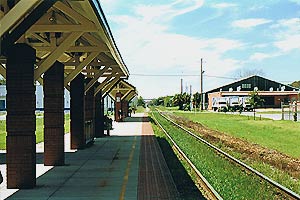
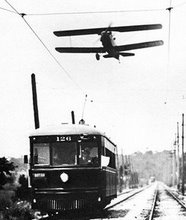
The second major carrier headquartered in Jacksonville. Why has the Florida East Coast not been a player in our ports since the 1960's? Moreover why are we investing in Port highways, putting rail on the back burner, when from 11PM until daybreak, the FEC RY floods the downtown freeways with container trucks making the ferry move from the Northsides Talleyrand Ship Terminals to Bowden Yard on the City's South Side? Wouldn't replacing the former "S" line of the Seaboard - owned by the city, open an all rail route which would greatly lessen the need for the new highways?
23 January, 2009
FLORIDA EAST COAST High And Dry?
Norfolk Southern Locked Out?
Two daily NS locomotives await the connections from the Talleyrand Terminal Railroad in Springfield, North of Downtown Jacksonville. Why are they not players in our major Blount Island or Tri-Pac Terminals?
22 January, 2009
JAXPORT RAIL ACCESS AND A GOLDEN OPPORTUNITY TO FIX IT
Several times people from around the world have tapped into this blog looking for information on the port location and railroad access here in Jacksonville. I thought we'd look at this from both the positives of rapid growth which has earned us the nickname "The Port Of Gold", to the negatives of piecemeal rail services.
First the location of JAXPORT. Consider if you will a major seaport that is located exactly 1/2 way between Miami, Florida and Atlanta, Georgia. This location puts 2/3 Rds of the population of the United States within 24 hours from our docks to your containers destination. One also has to surrender the old thinking of the East Coast as a rather straight line - similar to the west coast of the United States, it's simply not true. In fact the East Coast of the USA reaches so far east that in Maine it is only across a river from the "Atlantic Time Zone". Boston is South of that locale, and New York, Philadelphia, Baltimore and Washington are not only South but quite west of Maines Location. There is a slight buldge just sough of Norfolk, Virginia, in the storm prone Carolina Outter Banks, but then as the coast continues South it also continues West. The Western Most Port on the Atlantic Ocean is Jacksonville, Florida's, JAXPORT.
JAXPORT is so far west that if you drew a line on a globe you might be amazed to find the lat.-long. GPS cordinates for Jacksonville to be N 30.33and W 81.65 compaire this with Boston, Massachucetts 42°. 20' N and 71° .06' W, Jacksonville is a full 10 degrees West. The real shock to most citizens is when they note that Jacksonville is almost directly below, CLEVELAND, OHIO at: 41.46' N and 81.65' W. This means as an East coast port and beach city, we're 128 miles west of Pittsburgh, Pensylvannia - and far enough south that cold winters or large mountain ranges need not play a part in your shipping or travel worries. Just how far west is west? Well you could ship and travel from the West Florida Ports of Key West or Naples, but Jacksonville is just as far west as they are. In fact the whole pensulia of Florida is angled back toward the South and EAST so as one travels south, the East coast of Florida moves farther and farther East of the Panama Canal.
Why not just build in Miami, West Palm Beach, Naples or Tampa? Frankly these are all nice cities blessed with beautiful weather, but their port and transportation space is used up on the east coast, and the prices are in the stratosphere. Tampa and Naples on the other hand have room and decent development prices, but they are locked into a single rail carrier and shallow water with a Interstate Highway bridge restricting the height of all traffic in and out of Tampa Bay.
The fact that Jacksonville is the sole railroad gateway to Florida is quite important to shipping lines, industrial concerns, warehousing complexes and travelers. Being located near the Georgia border at the base of Florida's Crown, Jacksonville is 500 miles from Key West. So unless you are shipping all of your cargo within Florida, that's 500 extra miles more or less, of transportation on every container or every passenger. Going West with that shipment or trip? Pensacola is another 400 miles West from Jacksonville. So locating elsewhere in this state could add as much as 900 miles to your transportation costs just to get out of Florida. Most people are amazed that it's much less distance from New York City to Chicago, then from Key West to Pensacola, Florida. In fact Pensacola is closer to St. Louis, Missouri, then the lower coasts of Florida.
So what is the hangup with JAXPORT and rail transportation? Nothing that couldn't be fixed with some creative investments, either private or public.
Jacksonville Port Authority
JacksonvilleFlorida
JaxPort
international shipping
Port of Gold
JacksonvilleTransportation Authority
CSXT
FloridaEastCoast
NorfolkSouthern
TalleyrandTerminal
JaxPortAccess
Tri Pac Terminal
First the location of JAXPORT. Consider if you will a major seaport that is located exactly 1/2 way between Miami, Florida and Atlanta, Georgia. This location puts 2/3 Rds of the population of the United States within 24 hours from our docks to your containers destination. One also has to surrender the old thinking of the East Coast as a rather straight line - similar to the west coast of the United States, it's simply not true. In fact the East Coast of the USA reaches so far east that in Maine it is only across a river from the "Atlantic Time Zone". Boston is South of that locale, and New York, Philadelphia, Baltimore and Washington are not only South but quite west of Maines Location. There is a slight buldge just sough of Norfolk, Virginia, in the storm prone Carolina Outter Banks, but then as the coast continues South it also continues West. The Western Most Port on the Atlantic Ocean is Jacksonville, Florida's, JAXPORT.
JAXPORT is so far west that if you drew a line on a globe you might be amazed to find the lat.-long. GPS cordinates for Jacksonville to be N 30.33and W 81.65 compaire this with Boston, Massachucetts 42°. 20' N and 71° .06' W, Jacksonville is a full 10 degrees West. The real shock to most citizens is when they note that Jacksonville is almost directly below, CLEVELAND, OHIO at: 41.46' N and 81.65' W. This means as an East coast port and beach city, we're 128 miles west of Pittsburgh, Pensylvannia - and far enough south that cold winters or large mountain ranges need not play a part in your shipping or travel worries. Just how far west is west? Well you could ship and travel from the West Florida Ports of Key West or Naples, but Jacksonville is just as far west as they are. In fact the whole pensulia of Florida is angled back toward the South and EAST so as one travels south, the East coast of Florida moves farther and farther East of the Panama Canal.
Why not just build in Miami, West Palm Beach, Naples or Tampa? Frankly these are all nice cities blessed with beautiful weather, but their port and transportation space is used up on the east coast, and the prices are in the stratosphere. Tampa and Naples on the other hand have room and decent development prices, but they are locked into a single rail carrier and shallow water with a Interstate Highway bridge restricting the height of all traffic in and out of Tampa Bay.
The fact that Jacksonville is the sole railroad gateway to Florida is quite important to shipping lines, industrial concerns, warehousing complexes and travelers. Being located near the Georgia border at the base of Florida's Crown, Jacksonville is 500 miles from Key West. So unless you are shipping all of your cargo within Florida, that's 500 extra miles more or less, of transportation on every container or every passenger. Going West with that shipment or trip? Pensacola is another 400 miles West from Jacksonville. So locating elsewhere in this state could add as much as 900 miles to your transportation costs just to get out of Florida. Most people are amazed that it's much less distance from New York City to Chicago, then from Key West to Pensacola, Florida. In fact Pensacola is closer to St. Louis, Missouri, then the lower coasts of Florida.
So what is the hangup with JAXPORT and rail transportation? Nothing that couldn't be fixed with some creative investments, either private or public.
06 January, 2009
THE FOLLY OF FAUX TROLLEY - sad saga of Cincinnati and Jacksonville
COME ALONG AND RIDE WHILE CINCINNATI AND JACKSONVILLE DRIVE OVER A BUDGET CUTTING CLIFF !
A face only a mother could love - this will really pack 'em in Ohio... NOT!
For years OHIO has produced the most visitors to Florida. It's a little known fact, and I'm sure the number probably rises, falls behind, and rises again, with the economy of time. Cincinnati, not unlike Jacksonville in many ways, is a river port, industrial, and regional market center. Last time I saw a large collection of Cincinnati residents they were in Jacksonville, getting their faces smashed into our football field. I missed this years revenge.
Cincinnati, like Jacksonville has a bright idea. Let's study and build a REAL streetcar system. Development money follows streetcars more then Commuter Rail, BRT, Buses or any other mass transit. But Cincinnati is thinking, maybe a faux trolley which we Jaxson's call PCT TROLLEYS (for: Potato-Chip-Truck-Trolleys).
Why such an insulting name? Well, the final effort of the historic streetcar systems to fight off General Motors was called a PCC Streetcar (for: Presidents Conference Car - designed by a conference of street railway leaders from around the globe in the late 1930's). Our Jacksonville response to Cincinnati would be, "Have you EVER seen or ridden on one of these things?" So lets take it to the Cincinnati article and see what THEY are saying.
Streetcar opponents propose trolley
By Barry M. Horstman • bhorstman@enquirer.com • January 5, 2009
Opponents of Cincinnati’s $185 million proposal to run permanent-track streetcars from downtown to Uptown are urging city leaders to consider a rubber-wheeled trolley system that they contend could provide the same service for a fraction of the cost.
The alternative $9 million trolley plan, to be financed largely with private money, also could begin operating sooner and without the disruption of tearing up streets to lay tracks that would either eliminate parking or traffic lanes along the route, according to former Cincinnati City Councilman Charlie Winburn.
“It’s faster, a lot cheaper, and if it doen’t work out, you can walk away from it without having torn up your streets,” Winburn said. “I don’t see any downside.”
JAX TRANSIT BLOG: People are not fooled by these faux trolleys. They do nothing to promote future streetcar ridership and are seen for what they are, buses with lipstick. We have them in Jacksonville where they serve as downtown shuttles. Frankly we should have saved our money and bought electric buses for this task, at least they wouldn't smell.
However, City Councilman Chris Bortz and other streetcar proponents do.
Cincinnati, like Jacksonville has a bright idea. Let's study and build a REAL streetcar system. Development money follows streetcars more then Commuter Rail, BRT, Buses or any other mass transit. But Cincinnati is thinking, maybe a faux trolley which we Jaxson's call PCT TROLLEYS (for: Potato-Chip-Truck-Trolleys).
Why such an insulting name? Well, the final effort of the historic streetcar systems to fight off General Motors was called a PCC Streetcar (for: Presidents Conference Car - designed by a conference of street railway leaders from around the globe in the late 1930's). Our Jacksonville response to Cincinnati would be, "Have you EVER seen or ridden on one of these things?" So lets take it to the Cincinnati article and see what THEY are saying.
Streetcar opponents propose trolley
By Barry M. Horstman • bhorstman@enquirer.com • January 5, 2009
Opponents of Cincinnati’s $185 million proposal to run permanent-track streetcars from downtown to Uptown are urging city leaders to consider a rubber-wheeled trolley system that they contend could provide the same service for a fraction of the cost.
The alternative $9 million trolley plan, to be financed largely with private money, also could begin operating sooner and without the disruption of tearing up streets to lay tracks that would either eliminate parking or traffic lanes along the route, according to former Cincinnati City Councilman Charlie Winburn.
“It’s faster, a lot cheaper, and if it doen’t work out, you can walk away from it without having torn up your streets,” Winburn said. “I don’t see any downside.”
JAX TRANSIT BLOG: People are not fooled by these faux trolleys. They do nothing to promote future streetcar ridership and are seen for what they are, buses with lipstick. We have them in Jacksonville where they serve as downtown shuttles. Frankly we should have saved our money and bought electric buses for this task, at least they wouldn't smell.
However, City Councilman Chris Bortz and other streetcar proponents do.
San Francisco's 100 year old streetcar, Cincinnati? Jacksonville? Please tell me how much you'll save over this same time period with Faux Trolleys. The proposed four-mile streetcar plan working its way through City Hall could spur hundreds of millions of dollars in economic development along the line and would be more attractive to commuters for whom public transit is a choice, not a necessity, Bortz said.
“You can dress it up however you want, but a bus is still a bus,” Bortz said. “A rubber-wheeled bus is never going to produce the kind of economic activity a streetcar system would.”
JACKSONVILLE TRANSIT BLOG: This is very true, buses of any kind only account for about 7% of all Transit Oriented Development, and a closer examination shows most of that is socialized, state and federal offices.
Winburn’s idea, patterned after a successful downtown trolley in Cleveland – where, in only two years, daily ridership has grown from about 700 to almost 5,500 – comes as the council awaits a report this month from City Manager Milton Dohoney Jr. on potential public and private funds to finance the streetcar proposal.
Even if the city can fully fund the streetcar plan, Winburn argues that the much lower price tag of his trolley proposal makes it a clear preference.
“With the economy as uncertain as it is, this isn’t the time to be investing nearly $200 million in a system that, no matter what the projections say, no one is really certain is going to work,” Winburn said.
A coalition including the NAACP and Citizens Opposed to Additional Spending and Taxes (COAST) has started circulating petitions to place a charter amendment on the November ballot that would prohibit the city from funding the streetcar plan unless voters specifically approved the expense.
JACKSONVILLE TRANSIT BLOG: What about history? How does streetcar stack up against your PCT Bus?
After World War II, the Cincinnati Street Railway modernized its system with new rail cars and infrastructure, as directed by the city. The next City Council reversed the policy by ordering removal of all rail service. The financial losses from the abandonment of nearly new rail facilities forced frequent fare increases on the riders, until it became the first major city to have a 55-cent fare. The ridership decreased 88 percent during 40 yr.
After rail service was eliminated in Oklahoma City and its environs, transit use fell 97 percent on a per capita basis. In St. Louis, with all-bus service, only 13 percent of the riding habit remains. St. Louis has now contracted to restore rail transit on a Metrolink from the airport through downtown to East St. Louis to recover some of the transit market share.
FROM THE APTA Website: Why choose a rail-based system over a rubber-tired system?
A rail-based system provides numerous advantages that help outweigh its higher capital cost:
A sense of government commitment and permanence that reassures potential riders, neighbors, and businesses that service will continue.
People overwhelmingly prefer riding rail vehicles to buses, so rail solutions attract more passengers (see Transportation Research Record 1221 for a detailed treatment of rail vs. bus ridership).
For the above reasons, rail systems typically inspire business development.
Heritage trolley systems provide a sense of historical authenticity that blends very well with an urban environment, especially older, redeveloping neighborhoods.
Heritage trolleys with proper maintenance last essentially indefinitely (New Orleans operates cars built in the mid-1920s in daily, heavy service) while buses seldom have a life of more than 20 years.
MEANWHILE BACK IN CINCINNATI:
Bortz, though, stressed the importance of weighing the system’s long-term economic impact, not simply its construction cost.
“If spending $150 million produces $1 billion in economic activity, that’s a better investment than spending $10 million and getting nothing out of it,” Bortz said.
The permanence of the streetcar’s tracks, Bortz added, would inspire greater confidence among potential investors along the route than a system of rubber-wheeled trolleys that could easily be abandoned or moved.
JACKSONVILLE TRANSIT BLOG: Economics of streetcar -vs- fake PCT trolley buses? Take a look for yourself:

Winburn bills his plan as a relatively inexpensive, low-risk trial of the overarching concept of developing a streetcar line from downtown through Over-the-Rhine to the Uptown area around the University of Cincinnati and nearby hospitals.
Under his proposal, local business leaders would be asked to raise $13 million in private money to buy and operate 12 trolleys for a two-year trial period.
The trolleys – with a nostalgic design featuring wooden rails, brass bells and a distinctive dark green color – could be running by December, while the best-case scenario for the streetcar plan envisions a starting date in early 2011.
“This would give us some real-world experience on whether there’s truly a market for this,” Winburn said.
“If people are riding the trolleys and we’re starting to see investment along the route, great – we’ve saved almost $200 million and didn’t have to destroy our streets to do it. If it’s not working, at least we haven’t wasted a lot of money, didn’t inconvenience businesses with a long construction project and aren’t stuck with tracks we don’t need.”
City Councilman Chris Monzel occupies a middle ground in the debate.
Strongly against the current streetcar proposal, Monzel is yet to be sold on the trolley plan.
JACKSONVILLE TRANSIT BLOG: Are your PCT Trolleys really a solid plan? The Tampa Electric Company operated 100 rail cars in that city until the Tampa Utility Board refused to allow the transit property in the rate base, forcing it out of business. National City Lines, which also operated 37 buses in Tampa, took over the entire operation after the rail system’s demise. Despite rapid population growth, ridership has fallen 60 percent with an all-bus system. Per capita ridership has fallen 81 percent.
“Even if you’re primarily using private funds, that’s still a lot of money to benefit only a couple of neighborhoods,” Monzel said. “I’d like to bring a lot more neighborhoods into the mix. But once you do that, you might say, wait a minute, don’t we already have that with buses?”
JACKSONVILLE TRANSIT BLOG: So what if you DID have buses doing the same job? What would the difference be? Take a look my friends:
Cincinnati and Jacksonville need to realize that the people are not stupid and won't be fooled into investing in your rubber tire trolleys. Note these words from the American Public Transportation Association website:
Does a trolley have rubber tires?
Strictly speaking, No. Trolley cars or streetcars have steel wheels and run on rails, which are often laid directly in street paving.
Today many cities use rubber tired vehicles which are decorated to look somewhat like trolleys, but these vehicles are not real trolleys nor streetcars and are not the subject of this website. Some people may feel they can obtain the benefits of a heritage trolley line by using these inexpensive faux trolleys, but the economic, developmental, and visitor attracting benefits are not generated by these bus trolleys. Authentic rail based systems are required to achieve the benefits.
Whatever happens in Cincinnati, this blog supports CINCINNATI STREETCAR. Oh and Ohio, at least until the streetcars are rolling again in Jacksonville, could you please hold off on sending us anymore of your citizens? 02 January, 2009
THE TRIUMPHANT RETURN OF AMTRAK - IS THE PENSACOLA NEWS-JOURNAL ON CRACK?
Could it be that the once respected Pensacola News-Journal editors and writers are now smoking crack? Probably not, but one might think so with the outrageous editorial commentary from Mr. Mark O'Brien.
Actually the commentary itself was pretty entertaining, even funny at times, but Mark completely fumbled the ball with these words:
Train a vain hope
The city should give up the ghost on AmTrak reviving passenger service here and do something with the empty train station on 14Th Avenue.
First off Mark, you did better then most, you didn't call it Amtrack. But the word is not AmTrak either, it's a registered trademark name, Amtrak.
The remarks also demonstrate a typical complete lack of grasp of the transportation and energy problems facing our nation.
The attitude that the Sunset Limited didn't work out, Katrina killed it, it's gone so lets give up has a sort of odd Yankee ring to it. You might recall in history 101, that our one-time Southern Army was out numbered 10 - 1, yet was able to smack the Federal troops around for nearly 5 years. Why? Well it is said, Southrons NEVER consider the odds before a battle, and brother THIS is a battle.
Amtrak has not failed, in fact it has been one of the most successful things the federal government has ever attempted. Did you know it was designed from the start to fail? Did you know about the Penn Central Official whom on "Amtrak Day" back in 1971, went screaming and dancing through the HQ offices shouting "WE'VE DONE IT! WE'VE SHOT THE PASSENGER TRAIN! WE'VE KILLED IT!" Mark, do you really think Richard Nixon, Conservative, Republican, wanted trains full of happy people riding around on a federal dollar?
Actually the commentary itself was pretty entertaining, even funny at times, but Mark completely fumbled the ball with these words:
Train a vain hope
The city should give up the ghost on AmTrak reviving passenger service here and do something with the empty train station on 14Th Avenue.
First off Mark, you did better then most, you didn't call it Amtrack. But the word is not AmTrak either, it's a registered trademark name, Amtrak.
The remarks also demonstrate a typical complete lack of grasp of the transportation and energy problems facing our nation.
The attitude that the Sunset Limited didn't work out, Katrina killed it, it's gone so lets give up has a sort of odd Yankee ring to it. You might recall in history 101, that our one-time Southern Army was out numbered 10 - 1, yet was able to smack the Federal troops around for nearly 5 years. Why? Well it is said, Southrons NEVER consider the odds before a battle, and brother THIS is a battle.
Amtrak has not failed, in fact it has been one of the most successful things the federal government has ever attempted. Did you know it was designed from the start to fail? Did you know about the Penn Central Official whom on "Amtrak Day" back in 1971, went screaming and dancing through the HQ offices shouting "WE'VE DONE IT! WE'VE SHOT THE PASSENGER TRAIN! WE'VE KILLED IT!" Mark, do you really think Richard Nixon, Conservative, Republican, wanted trains full of happy people riding around on a federal dollar?
Not a chance.
What happened is, that in spite of their best efforts, including 35+ years of starvation portions or financial support, scraps from what ever was left of the billions that we spend on airlines and highways, Amtrak is still with us. Today's Amtrak is stronger then ever, posting gains in ridership as high as 25% per year in some markets, and solid gains in all the rest.
So what about Pensacola? Should we turn the depot into a restaurant? a bus station? a new strippers bar? Maybe a newspaper office?
NO!
Pensacola should be thinking about adding a side track with a switch at each end, and a capacity of a locomotive and perhaps 3 - 10 passenger cars. Something that could hold a lay-over of equipment for frequent day trains between Jacksonville and Pensacola.
PENSACOLA
In case the News-Journal missed it, Amtrak has a new lease on life and it's only going to get better:
A new budget, of some 15 Billion dollars and a steady federal investment stream. This is up from 35+ years of $0 - $900 Million dollar budgets. Notice a difference there Mark?
Didn't the News-Journal read the conditional Amtrak re-authorization passed by both house and senate and signed by President Bush? In order to get the $15 Billion, Amtrak MUST return service between New Orleans and Sanford, Florida. Uh, Mark, the only route runs past that Pensacola station.
What the law doesn't say is how the trains will be scheduled or even it must be the Sunset Limited. Frankly I would doubt the wisdom of sending a long-distance cruise train through the Mobile-Pensacola-Tallahassee-Jacksonville stretch in the dead of night. The Panhandle is just too thinly populated, too rural, for decent passenger boardings at 3 AM. What I expect will happen is we will see an all daylight "Gulf Wind" pocket streamliner running from the Big Easy to Florida's First Coast.
More then one train a day?
Fast frequent daylight trains do well even in freeway adjacent rural corridors, look at the little 2 car San Joaquin trains in California, which started with a single daily run from the Bay area to Bakersfield. BAKERSFIELD! Not exactly the Garden of Eden, nor is it a giant metropolis. Those stops have a real panhandle ring to their names too. Big important sounding towns like Hanford, Denair, Wasco, Corcoran and Madera, on the San Joaquin, could just as easily be Crestview, Madison, Lake City, or Chipley on the new "Gulf Wind". In California, where the worlds most auto centric society is abandoning their cars in droves, that one little train has grown to be a 12 daily corridor trains.
I happen to have some information that The State of Florida has actually received a brain from the great and powerful wizard of Transportation, and is considering a similar corridor between Jacksonville-Tallahassee and Pensacola. Frankly, the cost per seat or per train actually falls with more frequent service. The theory is sort of like opening a store with one product on the shelf or one with many products, which one do you think will succeed?
Mark? Better tell them to build the side track, toss in some extra platforms, and some landscaping, because your train is coming.
29 December, 2008
ATTENTION ALL TRANSIT BLOGGERS - Jacksonville's Impending Disaster Could Reach You!
THE DEVIL WENT DOWN TO FLORIDA
In a city growing fast enough to self fund Light Rail, Monorail or BRT, we are suddenly facing the Transit Devil himself. We may need all the commentary and attention we can get on this subject. I'm asking all blogger's to steal this story, edit, copy or otherwise let it be known that our Jacksonville Devil, needs a national butt kicking or we'll be kissing all mass transit goodbye here on Florida's First Coast. We need NATIONAL ATTENTION PLEASE! When the City Council Google's and reads your words of wisdom from the far corners of this nation, they'll understand, they're being played like fools.
Jacksonville citizens are wary that a financial restructuring Mayor Peyton plans to submit to the City Council will set back plans to extend bus service and could cripple Rapid Transit/Light Rail funding in the long run.
In a bill called, The Better Jacksonville Plan or BJP, resides $2.25 billion in projects, approved by voters in a 2000 referendum. The program thrives on sales taxes.
As The Transportation Authority is in charge of mass transit and highways, road projects are split between the city and JTA, with the city handling local thoroughfares.
Peyton said he'd rather see the local projects completed while state and federal dollars are sought for the highways. Apparently the word "Transit" is not in his vocabulary.
"To me, it's not local versus state. It's Jacksonville," JTA Executive Director Michael Blaylock said. "All of these roads are in Jacksonville and they're for the people, the workers, drivers - everyone."
JTA operates independently of city government, but some of its funding is administered by City Hall. And that's becoming a sore spot.
Last week, Blaylock unveiled projections showing the city likely would be taking control of 70 percent of BJP sales tax money under Peyton's plan, although no numbers are official. The original plan was closer to 50% JTA - 50% CITY.
He said the Peyton plan could lose $174 million in funding for JTA, including $94 set aside and ear marked for A Rapid Transit system.
"They're asking the JTA to forgo our money so they can work on their own projects," JTA spokesman Mike Miller said, referencing an agreement that was promised to the tax payers around two decades ago, when a half-cent sales tax replaced the city's toll plazas.
Now it appears that the Mayor want to violate the trust.
When Better Jacksonville passed, that half-penny became part of the funding stream. The city agreed to collect it while paying a amount equal to the tolls, plus annual interest, to JTA. The problem is, Peyton doesn't believe that the City can afford the luxury of quality Mass Transit. Seeing it as the poor mans ride, Peyton had rather build more freeways.
Peyton's plan would extend a 6-cents-a-gallon gasoline tax through 2039 as a financial baseline for JTA. Better Jacksonville projects, which were set to finish in several years, would extend through 2019.
Blaylock said he's wary of counting on gas taxes as an income source as the agency tries to acquire long-term rapid transit project financing. For one, federal transportation estimates show Americans have driven roughly 100 billion fewer miles in the past year because of gasoline prices.
Also, he said, by 2039 he wonders if cars will even be running on gasoline.
As he announced the Better Jacksonville funding shortfall, Peyton also announced a plan to dip into a city capital fund for $50 million. The money wouldn't be part of Better Jacksonville but would be critical to expanding infrastructure near the city's growing deep water cargo ports.
The council is expected to see legislation next month.
--------------------------------------------
So at the start JTA and the Citizens of Jacksonville had secured:
A dollar amount equal to the toll revenue on 4 bridges (including 2 interstate highways) plus interest as a mass transit baseline, as promised by the City.
A 1/2 cent dedicated gas tax for mass transit
A A 100 Million dollar set-aside to build a Light Rail/BRT Transit System.
We also have IN-HAND, studies on
Streetcar:
http://jtafla.com/pdf/Streetcars/StreetcarRReport090808.pdf
Commuter Rail:
BRT:
http://www.jtaonthemove.com/RTS/showPage.aspx?Sel=37
If the Peyton Plan passes, all JTA will have is:
A 6 cent gas sales tax revenue stream, and the balance of the monies and deals with the City will be canceled.
We'll build a few miles of black top or concrete roads with the former transit money, and won't get a single development or quality investment for our efforts.
Bus service will be cut to the bone with routes appearing and vanishing with the ebb and flow of the tax dollars.
If the Peyton Plan passes, all JTA will have is:
A 6 cent gas sales tax revenue stream, and the balance of the monies and deals with the City will be canceled.
We'll build a few miles of black top or concrete roads with the former transit money, and won't get a single development or quality investment for our efforts.
Bus service will be cut to the bone with routes appearing and vanishing with the ebb and flow of the tax dollars.
Streetcar: O
Commuter Rail: O
BRT: O
The mayors office will stare stupefied out the window, and wonder why "other" Florida cities are booming with development as they chug toward their own rail systems.
I can hear the pathetic strains of the officials as we're passed by, again and again by the big bucks looking for unique and effective transit:
"Say fellas wait, Jacksonville has roads, good ones, ever seen one?
For all of our cities, let's make this thinking stop before it starts to spread. Show the nation how detrimentally zero transit would effect us all. Post this anyway you want, but understand it's a case of Living Neanderthals in Jacksonville.
Subscribe to:
Posts (Atom)
TECHNORATI
TAKE A FREE TOUR OF THE JACKSONVILLE SKYWAY
The arguments rage to this date, "Should have never been built," "waste of taxpayer money," "Doesn't go anywhere," "Nobody rides it..." etc. Bottom line is we have it, and it is finally showing signs of life. Simple extensions to the Stadium, San Marco, and the area of Blue Cross in North Riverside would turn this little train around. Addition of Park and Ride garages and multimodal transit terminals at the end points would bring on the crowds.
The video must have been shot on a Sunday Morning, as downtown is certainly as packed with life as any other major City on weekdays. Jacksonville is a city of Bikes, joggers, walkers, buses and cars, one almost wonders how the photographer managed to find this quiet moment.
Support the Skyway? Join the Monorail Society Today!
WELCOME ABOARD
Sign by Danasoft - For Backgrounds and Layouts