26 July, 2008

6,000 New Jobs Unloaded At Tri-Pack Terminal


JAXPORT welcomes first direct Asian container serviceMOL container chip arrives in Jacksonville six months ahead of schedule July 7, 2008 -- JAXPORT officials, Mayor John Peyton and members of the Jacksonville City Council gathered at Blount Island Marine Terminal on July 7 to greet the first Mitsui O.S.K. Lines (MOL) container vessel to call on Jacksonville.
The event marks the arrival of the first direct cargo service between Jacksonville and Asian markets. The MOL Vision arrived six months ahead of the scheduled opening of the new 158-acre TraPac Container Terminal at JAXPORT’s Dames Point property. The Vision traveled from Ningbo, China through the Panama Canal before reaching Jacksonville, its first U.S. port of call.
“This is truly a momentous occasion,” said JAXPORT Executive Director Rick Ferrin, who was at the dock to meet the MOL vessel. “The arrival of this ship marks the true beginning of all-water service from Asia to Jacksonville through the Panama Canal, which will be a major economic stimulus for our region.”
As the future base of MOL’s U.S. South Atlantic port activities, TraPac will offer state-of-the-art post-Panamax container handling systems with a yearly capacity of 800,000 containers.
MOL noted that increasing development in South Georgia and North Florida is quickly making Jacksonville one of North America’s rising stars of international trade. With nearly 50 major distribution centers within miles of JAXPORT and 17,000 acres of available building and expansion capacity, JAXPORT is fast becoming the premier South Atlantic port for shippers looking to take advantage of its strategic location.
The TraPac Container Terminal at Dames point will double JAXPORT’s container handling capacity. In addition the terminal is expected to create 6,000 new jobs and generate $1 billion in economic activity for the region

BECOMING PRO-ACTIVE, AMTRAKS MISSING MARKET PART ONE


INCREDIBLE MISSING AMTRAK MARKET
By Robert Mann

From Coast to Coast, Amtrak provides fast comfortable trains. After 30+ years of bare bones financial support from the US Government, Amtrak has finally secured a veto proof majority to give the system funds to get things up and running, repair the broken pieces and even look at limited expansion. Included in the expansion are plans to assist States and local transportation authorities to secure matching grants, and funding for new trains. Some rules provide for small starts while others allow entire groups of states to band together in massive corridor-like efforts.

To the railroad historian, one of the more mysterious facts of Amtrak, was it's replacement of the once rich Midwest-Florida market with just one train, "The Southwind". Even up until the time of Amtrak in 1971, the railroads had maintained a fairly rich selection of trains in this area. "The City of Miami" was one such train with a record for being sold out. And yes, the "City" was a sister of the famous "City of New Orleans" as they shared about 50% of their route miles. Another little known route was the (Montgomery) "Champion". A tiny connecting train that clicked off the miles over the old Atlantic Coast Line, nee Seaboard Coast Line, between Jacksonville - Waycross - Valdosta - Dothan - Montgomery. In Montgomery it met the flagship of the Louisville and Nashville Railroad's "Pan American" as it raced south from Louisville - Nashville - Birmingham - Montgomery and headed off for Mobile - Biloxi and New Orleans. Never to be confused with the flagship "East and West Coast Champion" trains of the New York - Tampa and Miami market fame, this tiny little train kept the rails polished. It was a nightmare era, a railroading holocaust, a time when through sleeping car first class trains, became coach only. When names that carried meaning, special dining and lounge cars, special services and extra fares, became nameless, numbered and inept endurance tests. The former through patron from Detroit to Miami, might find him or herself wandering across the Midwest on the Penn Central to get to a station in Louisville for a sprint to Atlanta on the Hummingbird. The 23 hour layover in the wrong part of town brought to you by the crash and burn of the industry.

Upon reaching Atlanta, the Dixie Flyer to Jacksonville had just been discontinued, so one would wander over to catch the Central of Georgia Railroad, "Nancy Hanks" to Savannah. The Nancy was at least well kept, even though stripped of her mail contract, she was down to a couple of express cars and a single coach. Finally hooking up with the Silver Meteor, Star, Palmetto, Champion or Everglades for Jacksonville and points south, the railroads assured the return trip would be via National Airlines.

As Amtrak entered into this unstable sinking business, it is said that government teams combed through every route, every ridership number, track capacity, on-time performance, market potential and some such. When the smoke cleared, they chose the "Southwind" route and twisted Penn Centrals arm into running the Louisville - Chicago segment for their new railroad, after all, as the slogan said, "We're making trains worth traveling again..." Sadly they conveniently left off the part about Louisville to Chicago at a gut rocking 15 miles per hour.

No one it seems turned the pages back just a few years prior to Amtrak's rough founding hours. No one noticed their had been a brisk Florida market at one time, not so long ago. In fact in the early 1960's it was possible to book a Pullman room direct on through trains from Jacksonville to New Orleans, Montgomery, Birmingham, Memphis, Kansas City, St. Louis, Chicago, Detroit, Cincinnati, Atlanta, Cleveland etc. Other railroads, namely The Southern Railway (today's Norfolk Southern) and many other routes had just been cleansed of the passenger train menace just a few years shy of Amtrak. The boys in Washington never heard the words: St. Louis-San Francisco (Frisco), or Kansas City Southern, Central of Georgia, or Georgia Southern and Florida. In that oversight they missed entire families of trains and routes. One of the most promising was that of the old Southern Railway, in conjunction with connections north of Cincinnati, that operated an incredible pair of Midwest - Florida trains, apparently never to be considered again.

I'd like to reverse that trend, wake up the United Rail Alliance, and the National Association of Railroad Passengers, as well as Amtrak, FDOT, GDOT, JTA and the cities involved to push for the return of one or two of these three famous flagship trains. The Royal Palm, Royal Poinciana, and Ponce De Leon, gathered cars from throughout the northern Midwest. Chicago, Detroit, Columbus, Toledo, Buffalo, Dayton, Indianapolis and herded them into Cincinnati Union Terminal. Usually taking all or parts of 3 connector trains and forming one great streamliner at a time, the process was repeated 3 times daily Southbound and likewise, broken into 3 connecting trains, 3 times daily Northbound. South of Cincinnati, all the way through Lexington, Knoxville, Chattanooga, Atlanta, Macon, Valdosta, Jacksonville and all the way to Miami, one great train could cover the schedule. Jacksonville Terminal comes into play if you consider that the train could be broken up again here for both coasts of Florida. One train doing the work of 6, by breaking into, or consolidation from sections en-route. 3 trains doing the work of 18, reaching all across the Midwest, and considering bi-directional operation. That could grow to 3 northbound and 3 southbound trains daily each breaking up or consolidating, equals 6 trains doing the work of 54! Talk about bang for the buck, and this is a route no one has looked back at.

Ponce De Leon, Royal Poinciana or Royal Palm, pick the name you like the best and lets turn up the heat on the "NEW" Amtrak. It's way past time to return the glory to Jacksonville Terminal.


Amtrak took over nearly all rail passenger service in 1971
Illnois Central is part of Canadian National Today
Kansas City Southern remains independent and freight only
St Louis - San Francisco (Frisco lines) is part of Burlington Northern Santa Fe
Georgia Railroad is part of CSX today and freight only
Southern Railway merged with Norfolk and Western to form Norfolk Southern
Atlantic Coast Line is the original parent road of todays CSX
A tale of two cities, by Charles Dickens
Georgia Southern and Florida is part of Norfolk Southern and freight only
Louisville and Nashville was owned by Atlantic Coast Line and is part of CSX today
Pullman was a hotel company on rails broken up by the government in an anti-trust case
National Association of Railroad Passengers is a citizen lobby group which recently proposed a major reshaping of Amtrak route miles, yet completely missed the Southeast.
United Rail Alliance, is a pro passenger train group based in Jacksonville.

25 July, 2008

BICYCLE SKYWAY FOR THE RIVERWALKS?


Photos of the Shweeb System test track, Imagine Berkman, Baptist, Hyatt, Landing, Cummer, Atena, Prudential, MOSH, Maritime Museum, Shipyards, Strand, Peninsular, Ruths Chris, Brewing Company, Marina, Friendship Fountain... IMAGINE - JACKSONVILLE - IMAGINE!

July 23, 2008 The Shweeb is a monorail for human-powered vehicles. It consists of two 200 metre long overhead rail circuits that vary in height between two and four meters above the ground. Under the tracks hang high performance pedal powered vehicles. Between one and five vehicles can be loaded onto each track enabling teams to race each other or race against the clock. Conceived in Tokyo by designer Geoffrey Barnett, the adventure park ride he built in New Zealand is partially a proof-of-concept for an ingenious, high efficiency, no emission urban transport system.

The Shweeb Race thru Space adventure park ride is part of the Agroventures all weather adventure centre within the grounds of the world famous Agrodome near Rotorua in New Zealand. Given the levels of adrenalin involved in that lot, the human-powered Shweeb surprisingly holds its own. As the bikes http://en.wikipedia.org/wiki/Bicycle run on low-resistance tracks and the pods are far more aerodynamically efficient than a bicycle, with less frontal area (the rider is recumbent), most riders can see speeds of 45 kmh and on a longer circuit with a much longer straight, much higher speeds can be expected. Whatsmore, in corners, the pods swing out as much as 60 degrees on tight turns, but unlike a bike or motorcycle, there is no danger of losing traction and crashing. Those who have tried it report exceptional fun.

Recently, fully-faired recumbent bicycles have attained speeds of over 90kph (56mph) on pavement . However, recumbent bicycles are unstable, highly-susceptible to side-winds topple and their low profile makes them a dangerous prposition to use in traffic due to their low visibility.

Barnett has spent six years developing how to efficiently transfer pedal power to drive wheels enclosed within a monorail track while allowing the vehicle to swing freely underneath. The hard wheels on the steel rail mean that there is very little rolling resistance.

Barnett describes his high efficiency, no emission urban transport system thus: “Here’s How It Works . You get up in the morning; descend to the second level of your apartment building where there’s a Shweeb port and empty Shweebs waiting for you. You cruise over the top of the traffic jams. You don’t pay parking. You’ve produced no pollution. You arrive at work fit, healthy and ready to go.

“You don’t own the Shweeb. You use it like a shopping cart. Empty vehicles are restocked to wherever they are needed.

“Shock absorbers between the vehicles ensure that vehicle come together smoothly. When a fit rider comes up behind a slower rider, the impact is cushioned and they act as a single unit. The rider at the rear is sitting in the slipstream of the leading rider and is able to put all their power into pushing the lead vehicle. Two Shweebs acting together will always travel faster than either rider separately. Even if the lead rider were to stop pedalling, the energy required to maintain a vehicle’s momentum on a flat track is minimal.

“Stations are off line. Anyone wanted to get off just merges off the main rail and the platoon continues at top speed.

“The urban Shweebrail network is inexpensive, has a tiny footprint, and each Shweebway requires only a square metre of airspace…It’s safe, silent and sustainable.”

JTA? Want to blow away the competition? Want to be the envy of every system in the nation? Want green? Want attraction? Want community relations? Lets Move!

IS BUS RAPID TRANSIT "JUST LIKE RAIL" ?

MARYLAND TRANSIT PLANNERS BUST BRT MYTH MAKERS
Light Rail Trumps Bus Rapid Transit
Thursday, July 24, 2008;

The June 29 Commuter page [Metro section] featured a status report on Maryland's Purple Line transit project, in which I listed some of the arguments for and against the system, which could be light rail or bus rapid transit.

Dear Dr. Gridlock:
Your report on the Purple Line was very disappointing. Almost everything you said was true, but what you left out was all important for public understanding.

One erroneous statement is that bus rapid transit is just like light rail but on rubber tires. Light rail runs on domestic, low-cost electricity. Bus rapid transit runs on high-cost foreign oil. That is bad and costly.

Buses last only 12 years, while light rail cars last 40 years. In ice and snow, light rail has guidance and braking. Buses do not, unless the roadway is cleared and salted, polluting streams.
On open right-of-way, light rail absorbs water, but busways need extensive water runoff provisions to prevent damage. Light rail cars are larger than buses for comfort, efficiency and safety.

Bus size is limited by highway laws and clearances. The light rail ride is smoother and faster. Rails have no potholes, and electricity provides more power for acceleration.

If we want clean air, less foreign oil, lower long-term costs and more transit use, we must think about those differences.

Critics who say the Purple Line will not relieve congestion are wrong. It's true that one rail transit line will not solve the metro area's traffic problems overall, but it sure will help the local area.

Consider: Estimates suggest the line will have 3,000 riders per peak hour one-way at key points, such as 16th Street and Piney Branch Road. It would take four traffic lanes on streets with traffic signals to move 3,000 people per hour in vehicles with 1.15 people each. Four more lanes of capacity each way will help traffic greatly.

Vienna
Makes sense to me. Like Tennyson, a transportation consultant and former deputy secretary of transportation for Pennsylvania, I hope the Maryland Transit Administration will favor light rail over bus when it issues its findings later this year.

It's difficult to see the decision going any other way. Supporters in and out of Maryland government have been touting the latest ridership figures, which suggest the line would record 68,000 daily trips between Bethesda and New Carrollton. That's for a high-end investment in light rail estimated by planners at up to $1.75 billion for the 16-mile route.

Why No Cross-Town Buses?
Dear Dr. Gridlock:
Why isn't there bus service directly from Maryland to Virginia?

I live in Gaithersburg and work in Tysons Corner, so my public transportation options involve a trip through the District.

Am I the only one of the thousands of people who cross the American Legion Bridge each day who would rather take a bus?

Jon Freilich
Gaithersburg

This is an excellent idea. When he was Montgomery County executive, Douglas M. Duncan felt the same way. Trouble was, not enough commuters did. The SmartMover took commuters from points along the Interstate 270 corridor to Tysons, via the American Legion Bridge. But it failed for lack of ridership, given the high operating costs.

There were plenty of reasons for the failure. Buses got stuck in traffic, schedules became unreliable and once riders got off at the bus station in Tysons, it was difficult to walk to work across those wide, heavily traveled boulevards.

This noble experiment is not an idea that Maryland and Virginia can afford to dismiss. Not today, with construction of new lanes underway on the western side of the Beltway, with the Metrorail project at Tysons and with the planned rebuilding of Tysons itself.

Taking drivers off the road by giving them a new bus option will look smarter and smarter.


HOV - Bus Rapid Transit Highway Enforcement
Over the past two months, enforcement of the rules for High Occupancy Vehicle lanes has been one of the top five topics in the mailbag. There's a lot of anger out there.

I travel the Interstate 66 HOV lanes and notice that although police cars monitor many of the entrances and exits between the Capital Beltway and the District, HOV violators who travel to and from outside the Beltway have relative impunity.

Occasionally, I'll see someone stopped. While that driver is being ticketed, several others go by.
Why is there no way of reporting violators? I know that many people don't understand hybrid rules and that some cars have toddlers tucked where you can't see them. But I think a compilation of reported violators could be used to supply an aggravating factor if they are ever ticketed.

Also, there are predictable times when I-66 comes to a virtual crawl: accident, snow or, most predictably, sunshine (at very specific locations). State police could sit at those spots and stop violators much like shooting fish in a barrel.

Although I very much support enforcement -- especially those conducted on the HOV ramps, where it's safest -- police and commuters understand that enforcement itself creates congestion.
If I want the mailbag to bulge with irate letters, I should urge police to set up an HOV enforcement zone near an accident scene during a snowstorm.

Maura McMahon

JACKSONVILLE STREETCARS GOING TO BE BUILT IN BIRMINGHAM!

Photo: Tram in Milan, Italy, next stop... "Sweet Home Alabama..."

Wednesday, April 30, 2008

Transit authority soliciting streetcar proposals

Birmingham Business Journal

by Jimmy DeButts StaffBlogger Comments:

Who would have thunk it Jacksonville?They ran over us with their football team back in the World Football LeagueDays, then threw themselves onto the alter to snatch the Jaguars from us beforeJacksonville, was announced. Suddenly out of the Mass Transit Shadows of the bigCities, Birmingham, Alabama, comes rolling out with "our" streetcar idea.

Jacksonville? Oh we'd like to do rail... someday. If we don'tmove soon, I suspect their numbers will change in such a positive way that theyjust might get the football team too. Birmingham, the mountain metropolis,good luck - perhaps you can show us the way?

The Birmingham-Jefferson County Transit Authority is seeking proposals for the design and construction of its planned $33 million streetcar system.Birmingham Mayor Larry Langford has promoted a 2.5 mile streetcar line that will run through downtown. The proposed route would begin at the intermodal facility on Morris Avenue and wind through the city, passing cultural hotspots, such as the Birmingham Museum of Art and the Birmingham-Jefferson Convention Complex.The city has indicated the streetcar line will begin construction in early November.

Plans also call for a trip to Milan, Italy, in September to purchase the vintage-looking streetcars that will be run by electricity.Interested parties must attend a May 19 pre-proposal conference to qualify as bidders. Proposals will be accepted by the transit authority until June 30.

22 July, 2008

Whiz Bang Wowzier Monorail Skyway

RADICAL SKYWAY SALVATION SHOW


Photo courtesy of 
Kim Pedersen
The Monorail Society
(Perhaps we should do a story on Kim's highly successful monorail)


How to shock the Skyway back to life? Okay, maybe not this radical, but we need to get to work. Is the Skyway Doomed to the trash heap of Transit has-been's? How to save it, what do we need and how to find that "whiz-bang-wowzier!" of an attraction to this much maligned little train.

First a bit of history. Yes I was the first and LOUDEST critic of the Skyway in the City. I teamed up with then editor of the Jacksonville Journal and we blasted it with both barrels a pre-Skyway editorial. In fact I told George, it would be a "turkey", a really big turkey. That it didn't go anywhere anyone wanted to go, it wouldn't have the speed or capacity, would never get past 2ND rate and die in infamy. 27 years ago he published the editorial "Mann prefers Trolleys to People Mover". When that paper hit the stands, the war was on.

Today, I look back and EVERYTHING I said has happened just as I thought it would. Scary really, I get no satisfaction from it's monumental failure. Now the City has been headlined all around the world in two news articles ABC and CBS, one of which was titled, "What if they built a rapid transit system and nobody came..."

TAKING IT DOWN?

Now for the dollars and sense of the darn thing as it sits. We can't go back and tear it down. The basics, repair shop, technical mechanics, operating and signaling system, fleet and basic core are done. This SHOULD cut way back on the cost of any future expansion. Moreover we have already built it twice, the first time as a "people mover" and then retro-built the whole project as a true "monorail."

PICKING UP THE PIECES:

Several unfinished pieces of the Skyway need to be addressed for any chance of success.

1. Parking downtown, the devil in the details. The City makes money on Parking enforcement, yet the City shouldn't be in this business at all. To have a truly modern urban core, on street parking should be time limited but free.

2. Cheap parking garages, The Skyway was planned to reach INTO the parking garages around the downtown and bring in the customers to the core. Somehow we lost track, demanded new office and hotels build massive downtown garages, glutted the market and drove the price down.
tn one miss-step we caused the parking market to crash, potential transit riders to by-pass transit, and drove the small retailers from the core. Had parking been rolled into JTA, some control and common sense might have come from a master plan.
savior of the historic building complex, and write the book on how to re-spin an image.


3. UN-Connections, The Skyway was to empty the downtown streets of buses. Now really this probably wasn't a very likely goal, but at least some of the buses COULD have and SHOULD have turned back after a quick Skyway connection. Somehow the planners at JTA never got that message and the little empty trains kept right on rolling along with those 1/4 full buses right below them.

4. Transfers, we never bothered to institute a system of transfers or day passes. A transfer is simply a form issued by one bus route good on another (punched out) on the form itself. This allows the passenger to pay one fare and ride two buses, or move from bus to Skyway. A simple one day bus/Skyway pass for say $3.00 available in vending machines all over town should do the job. A multi-Mode pass good for JTA BUS - SKYWAY - RIVER TAXI - EXPRESS BUS - (perhaps even Greyhound and Trailways to local stations) would cost $5.00. Not only do the passes and transfers wipe out the need for fare collection, they relieve the drivers of being cashiers, or tending a vending unit. SAFETY. Moreover, transfers collected all us to track which routes connect with which, so better plan the future expansions.

UN MENTIONABLE TRANSIT

We have been so burned by the Skyway experience that today's City Hall laughs it off with bad nerves. Don't bring it up. Don't talk about it. Leave it alone. Not on my watch...etc. No one is willing to step up to the plate and make a diamond from this lump of coal.

Almost everyone agrees that our city should "finish what it started" with the Skyway. So do I. However those who are calling for it to reach out as a regional mass transit system, don't understand it's mode or purpose. A small monorail like the Skyway was NEVER intended to be more then a very short haul passenger shuttle. A downtown "dolly trolley" in the air.
Union Terminal as a "whiz-bang-wowzier" venue, fizzled and died. Too small and in the middle of the moonscape of LaVilla. Nobody is going there unless there is some scheduled event, and being far too small for many events, locked in by roads and rails, it's time to return this place to it's "God intended purpose....TRANSPORTATION".

1. Leave the line to Union Terminal and build a transportation center around it. I would encourage the City to not only reopen the old tunnels to the railroad concourses but extend them across and under the station concourse, under Bay Street and bring the passengers up in the new Skyway - Bus Terminal. Link it all underground - AMTRAK - SKYWAY - JTA BUS - TRAIN STATION - BUS STATION - GREYHOUND/TRAILWAYS, with a simple cut and cover underground walk system.

Pursue development like BAY STREET STATION with the Skyway being incorporated INSIDE part of the buildings, a balcony or landing.

Relieve any future downtown business of parking fees, space requirements and the parking Nazi's. For every XXX new offices, condos or restaurant seats open in the core, build XXXX new parking garage facilities at the end of the SKYWAY routes. Downtown garages already build could be sold with a land swap that includes, building a SKYWAY friendly, or streetcar friendly garage on the edges of town in exchange for removal of the former downtown garage, and returning said property to the tax rolls as new development. Even paying JTA a parking credit for each space required but un-built, money that could be funneled into a series of downtown parking shuttle improvements.


2. The line to Rosa Parks is missing a few pedestrian elements that would make it sing, a Skywalk to First Baptist Church and to City Hall. Rosa Parks itself falls short of FCCJ on a very busy street. A short extension to the North Gate of FccJ with covered walks, or a skywalk over highways would be light years ahead of the current arrangement.


3. Slowly improve the Bay Street EAST extension, pushing it toward Newnan Street and a multi-modal link, then to Berkman Towers, on to the Shipyards project and finally to the stadiums and Randolph entertainment district. With two major bridges coming into the Randolph area, It would make sense to route all buses, streetcars, water taxis, shuttles and automobile garage efforts in this same area. Care should be given to making the parking facilities much more then just another garage. These end-of-the-line garages must have spaces that will not be displaced by stadium crowds, they need to fill or empty as fast as the best of the airport garages, complete with their own ramps and entries and exits from the Freeways. Retail, restaurants and clubs rented out around the ground floor of these anchor garages might attract hotels and more development.


4. Riverside/Brooklyn have current plans for a station, but like much of today's Skyway, it's too little - too late. We need to get bold and go with the system plan for a single beam, double track monorail system here. We had a booming office district around Everbank-Bluecross-DuPont of the type that could be rolled into a special transit tax district. The Skyway on Riverside and the streetcar on Park would go a long way toward touching off a development race. The option of using the old Francis Lytle PS4 school as a transit center would not only draw the development inland from the riverfront, it would pull historic 5-points into the downtown transit core, JTA would earn public good will as the chance to write the book on how to re-spin an agency's image.

5. Southside, last but certainly not least of the extensions is on the Southbank. Again this Skyway was never intended as regional rapid transit, but as a downtown distributor it must reach all of downtown. Currently it does neither! Since the early 1920's the subject of getting over the Florida East Coast Railroad tracks has been the major bone of contention for locals and businessmen. Nearly 100 years later, and we still haven't addressed this problem even though we have a Skyway, perched at the King Street Station, and for an effort of less then a mile, it could enter the new Hilton Complex and garage, sail OVER the FEC RR and come gliding into a station South and West of the railroad at the corner of the Florida East Coast railroad and Atlantic Avenue. Bus transfer platforms and a commuter rail platform, with room for streetcar, would make this compact stop, one with a lot of bang for our buck. It also would poise the system to jump on Jackson Square as that development comes on-line.

THE NIMBYS (Not In My Back Yard) Certainly this family has deep roots in Jacksonville. We will hear the "nobody rides it..." argument over and over, harder to deal with is the "you never finished it in the first place" argument. The former is easily shot down mention of the later, frankly finishing it without a careful rebuilding of shuttles, streetcars, buses and commuter rail feeding into the system would be futile. But these improvements don't have to happen overnight, or even in the same time-window as the Skyway compliments, they do however have to be done. Meanwhile we should institute immediate extension of each Skyway line with a branded ELECTRIC shuttle bus system. FARE FREE. Different then our "PCT Dolly Trolleys" these electrics are real transit buses in a 30 foot body. They use the newest cool running AC motors, high tech batterys and Induction charging plates hidden in the street pavement. While the little Skyway extension buses pause at the Skyway station, stadiums or Riverside, for 5 minutes, they get a recharge... no wires, no contacts, no visible mechanical toys. As we extend the Skyway station by station, we simply redeploy the new electrics in other downtown, town center, Beaches shuttle work.

So what is missing? We need a resolve, courage to stand up and do the right thing here, creative financing and leadership can make up for foot dragging on every ones favorite political football.It's time to pick up the ball and score big, we need a whiz-bang wowzier.

16 July, 2008

BRT STILL GROWLING DOWN THE ROAD ASLEEP AT THE WHEEL


A LINE BY LINE CRITIQUE OF AN ARTICLE ON
BUS RAPID TRANSIT
IN THE CITY OF JACKSONVILLE AS PUBLISHED IN
THE FLORIDA TIMES-UNION

JTA's fast bus program still in the planning stage

The Federal Transit Administration will provide some funding.
JacBy LARRY HANNAN, The Times-Union
and commentary by "The Jacksonville Transit Blogger"


Richard Ervin believes the bus system in Jacksonville could run better than it does now.

This is true, and almost any citizen of the city that has ever used our transit system would agree.

While waiting for a ride at the Florida Community College at Jacksonville Station, Ervin said people can't always rely on the buses operating on time.

Rely on a system that is held captive to the wild fluctuations in Florida's traffic and eternal construction zones. We all know someone who is getting up at 4 o:clock AM in order to make a simple bus trip to a 8 - 5 office job.

There are often delays in traffic, and they can't always be relied upon to get to work on time, he said.

In response to complaints from people like Ervin, the Jacksonville Transportation Authority is starting an effort to improve the public bus system in downtown and suburbs . The effort involves putting more buses downtown, with new bus routes that would be more efficient than the existing routes.

Remember the promises that the Skyway would replace the bus downtown? Thou shalt NOT build BRT under thy Skyway! While the hearings would have one believe that the new rapid bus will become the "be all" and "save all" of Jacksonville Transportation, I couldn't disagree more on the point of the plan itself. Running new highways for buses and the sudden flood of buses predicted is due to fail for many of the same reasons the Skyway has lapsed into premature rigermortis. High start-up costs, soaring diesel fuel pricing, and lack of training. For over 100 years Jacksonville has had some form of "bus" that ambles along the roads every 40 minutes, with 5-10 passengers aboard. Just because we brand it, and run some new buses every 5 minutes doesn't mean all of those passengers will suddenly show up and fill our seats. They must be trained and that will start with the CURRENT system cutting the headway's from 40 minutes, to 20, then to 10, then to 5. At that point passenger loads and demand will drive the construction of betterment's such as BRT. With few exceptions, Jacksonville is getting the cart before the horse.

JTA will hold two public hearings at Jacksonville City Hall on Thursday to discuss this effort. The agency is billing the new effort as Bus Rapid Transit.

The agency isn't billing this as Bus Rapid Transit, the Federal Government is. BRT is a planned system of building dedicated busways which try very hard to look just like Light Rail Transit. Rather then train tracks, there are mini-Freeways. Mr. Ervin, is right, the system could operate better then it currently does. But a bus system needn't cost a Billion dollars with nothing more to show for it then a few new buses and a few miles of mini-freeway.

Transportation officials will discuss their plans to improve the bus system at these hearings and seek comments.

Another dog and pony show in order to fulfill the requirements of federal funding applications. This is NOT some suddenly benevolent JTA program reaching out to touch your heart and mind for the good of the City and our fellow citizens.

JTA does not yet have specific routes, costs or a timetable to institute Bus Rapid Transit. The plan calls for a restructured bus route system focused on key downtown streets, dedicated bus lanes during peak hours of operation and traffic signal priority.

This describes the Light-Rail-Lite model of Bus Rapid Transit. Certainly this makes more economical sense then the massive Quickway or "Mini-Freeway" model. The worst part of our own local plan is the relocation of the downtown routes North-South or East-West all onto just 2 to 4 streets. Oddly the new "superbus" would roll along right underneath our seldom used Skyway.

Traffic signal priority would be achieved by having devices on the buses that keep the traffic lights green when a bus is approaching that light. This would be done when a bus is running behind schedule, said JTA spokesman Mike Miller.

In other words, any driver that rolls up to a stoplight, is not likely to stop his bus. The idea seems great for bus riders and many of the public will think how quickly it will move the traffic, but they'd be wrong. If the lights are on a timed system, and a great deal of Jacksonville IS, then some yahoo in a bus would throw off the sequence for the rest of the day.

JTA is preparing to institute Bus Rapid Transit in conjunction with the Federal Transit Administration, which will kick in some money for the new system.

Under the Federal "New Starts" and other programs "BRT" is labeled as a system or product just as streetcars or subways are. By jumping through every hoop, the City can indeed obtain funding to lock us into a BRT system on some of the trunk lines.

The current bus system has 48 routes that are centered in downtown Jacksonville. Most of the routes connect at the FCCJ Station.

Apparently our newspaper doesn't know the FCCJ station has a name, "ROSA PARKS TRANSIT CENTER"

JTA is planning to build a new regional transportation center along Bay and Forsyth streets that will become the hub of the new public bus system.

Building this new Transportation Center next to the current Jacksonville Terminal, which is being used as a much-too-small convention center, borders on madness. The City of Jacksonville needs to address it's convention shortcomings and get the facility empty so buses from JTA, Greyhound, Trailways, and trains from AMTRAK could all mix with the Skyway. There is even a partial tunnel system that could tie it all together.

After looking at the downtown area, JTA plans to focus on improving bus service in other parts of the city in future phases of the project, Miller said.

We can hope that the system adjusts it's efforts to direct this new money toward Commuter Rail, rather then BRT. The trouble here is that 3 out of 4 of the proposed busways follow right alongside the railroads. Only Arlington has a stand-alone shot at success. Meanwhile just adjust the other 3 trunk lines a few degrees and the badly duplicate system suddenly becomes a balanced ballet of buses-trains-and monorail. For example the North route planned for I-95, where nobody lives, could swing slightly Northwest and open a whole new Transit dependent neighborhood to faster, safer, better service. Rather then I-95 Gateway as a route, we end up with even more BRT using Moncrief, Norwood and Lem Turner, tying into rail Shands or Union Terminal.

The agency sees Bus Rapid Transit as part of a future regional transportation system that includes the existing Skyway, commuter rail and possibly boats that can transport people throughout Southwest Florida.

Someone was asleep at the wheel here, we live in "NorthEAST Florida". Also note that in spite of the claims to be deep n a streetcar or Light Rail Study, the reporter completely missed that point. But then again, he might believe he's in Naples.It's all good though, someone give him the phone so he can ask JTA, I'm sure there is a plan... Somewhere.

Bus Rapid Transit has been criticized by rail proponents who want to see JTA focus on building a commuter rail system. JTA officials claim the solution to Jacksonville transportation problems include both rail and buses.

In this JTA is correct. It WILL require layers of mass transit, overlaid into a tapestry of layers. Not just downtown, but in Town Center, Beaches, Regency, Orange Park and other locales. But it is impossible to make a fine garment if every stitch follows the same path.

14 July, 2008

CHANGING DOWNTOWN TO UPTOWN


Getting On the Right Track
We can learn from New Orleans, Little Rock and other cities and develop the right transit system for our city without the obstacles and negative side effects being incorporated into the massive BRT fiasco.
By Robert Mann, Based on a original report
By Jason Leach Mar. 19, 2007

A recent piece in the Toronto Star discusses the ongoing battle in Toronto over dedicated streetcar lanes and their impact on neighbourhoods.

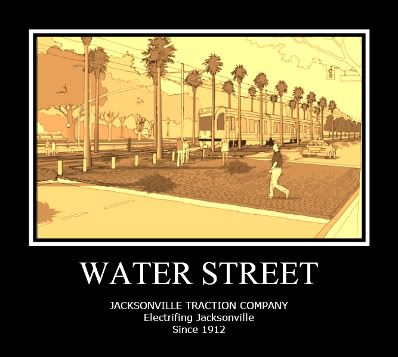
Recent issues of Folio, The Florida Times-Union and Metro Blogs/Forums have seen many writers and bloggers come forward with plans for heritage trolleys, modern streetcars or light rail on Jacksonville's main east west corridor – Water Street, Newnan, Beaver or Duval from the Transportation Center to the Stadiums or Phillip Randolph.

I believe that the plans we've presented for JACKSONVILLE TRACTION COMPANY, INC. are affordable, efficient and most of all, will have a great impact on surrounding neighbourhoods. Here's why:

1. Cost.
A 'rapid streetcar' using heritage trolleys or a mix of heritage and modern streetcar vehicles is much cheaper to build than a full LRT system. JTA studied an LRT system, which, of course, is much cheaper than a subway.

The rapid streetcar concept takes the same features of light rail – speed, attractiveness, permanent tracks which draw large private investment and dedicated lanes – but uses slightly smaller vehicles and doesn't require massive relocation of underground services due to the lighter vehicles.

2. Dedicated lanes, but not walls, curbs and obstacles.
A streetcar plan such as the one proposed to run both ways Water Street would see streetcars in their own lane, but would still allow cars to make left turns at most streets and cross the tracks easily and safely. The raised curbs that are a feature of some streetcar lines are rather clumsy obstacles for pedestrians, cyclists and vehicles.

In Portland or most European cities with streetcars it is common to see street parking on the "other side" of the tracks against the curb as well as pedestrians crossing the tracks with their groceries or cyclists crossing the tracks as necessary.

Obviously the train has the right of way, but we aren't talking about a bullet train speeding along killing people. Streetcars are designed to fit perfectly in the urban environment, not act as obstacles.

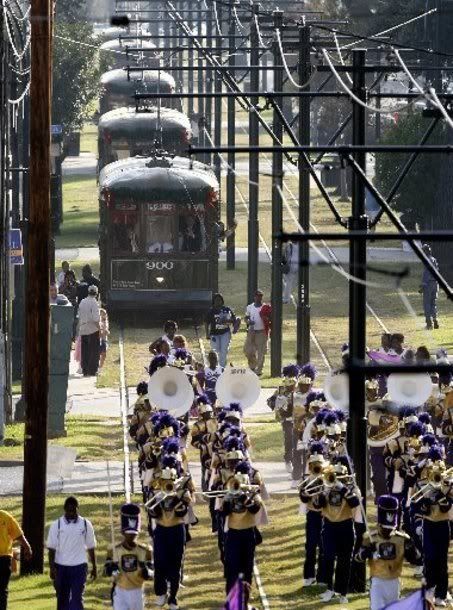
Streetcars blend into the cityscape. Feel like jaywalking, crossing the tracks on your bike or dropping someone off? Make sure no train is coming and go for it. In fact Jacksonville Traction's own unique heritage is very similar to that of New Orleans. Streetcars operate in center medians and the track is sodded over. The addition of plantings, trees and shrubs once gained us fame as "The most beautiful streetcar line in the world."

More photos here:http://www.urbanplanet.org/forums/lofiversion/index.php/t103.html
Note – the above photos from Portland show a streetcar that uses the same lanes as cars. Regardless, a double solid yellow line and signage would allow the same design to be used with a system using dedicated lanes. So traffic lane or historic style median, No curbs required.

3. Neighbourhood/retail impact
Let's be brutally honest here. Downtown is a shell of what it used to be and what it could be. In Jacksonville, some shopkeepers feel that the senseless demolition of historic buildings, parking meters with a Gestapo-like control, and endless moonscapes of blank walls, or empty lots packed with the homeless have resulted in bad news for business in the area that always seemed to bustle with activity.

In Jacksonville, six and eight-lane freeways, sprawl, parking meters, broken or inconsistent sidewalks, one way streets and timed lights have killed once-booming retail streets. We have parking coming out of our backsides, but few customers and many less shops, restaurants, hotel rooms or clubs than there should be.

Streetcars-in-lane might slow down the vehicle traffic on Water. Parking would be retained as-is on the edge of the business core and folks could easily turn onto and off of side streets to find curbside parking.

More importantly, people and businesses would begin to show up in large numbers as a result of the streetcar line. The line shown in Portland in the photos above has seen $1.5 billion in private investment within a five minute walk of the tracks since opening.

Another or central corridor down Duval Street has many underused lots and buildings and plans for a massive courthouse complex. A streetcar along with a more pedestrian-friendly environment (think trees and benches along the entire corridor) would revitalize the uptown neighbourhoods that have been ignored for too long. In effect pulling the City both along the river and moving it inland.

LRT which JTA once studied, spaces stops apart quite far. A rapid streetcar would take a medium approach, having stops spaced out further than a typical bus route, but not as great a distance as with LRT.

4. Transportation options
Even though walking or cycling aren't directly mentioned as a benefit of a streetcar, they are natural byproducts of this project. Right now people have one realistic option for traversing our Streets – their car. Streetcars still allow for vehicle lanes, but having lights controlled for the streetcars instead of autos would make it quicker to get from downtown to Union Station-Transportation Center to the core or stadiums in the streetcar. Streetcars can discharge or pick up passengers in the median, since they have doors on both sides. The operator simply makes certain there is no oncoming car or traffic and can open doors left or right, thus there is no need to eat up curb space such as JTA'S proposed downtown transit mall.

Furthermore, balancing the transportation modes on our city streets will automatically result in more cyclists and pedestrians. Cyclists would feel safer to ride their bikes on a normal city street whereas right now downtown streets are not much different than I-95. More shops, condos, restaurants, clubs and hotels and streetcar users means more people getting on and off trains, running errands, going out for coffee or just walking the dog.

Jacksonville would start to look like a proper, urban downtown once again. Public art, benches, trees, flowers, patios and sidewalk displays would turn an empty, concrete canyon into a wonderful blend for local residents and visitors.

BUS OR AUTO - THIS IS NOT THE ANSWER


11 July, 2008

"ALL ABOARD JACKSONVILLE," THE CALL OF THE TRANSIT CONDUCTOR


Top Photo: Streetcar Conductor, Bottom Photo: Commuter Rail Conductor
Same job, Same Uniform, Different Address

Among weary commuters, conductor keeps smiling
Originally published July 10, 2008
By Adam Behsusi News-Post Staff

Conductor Russell M. Bly checks tickets as passengers board the train for Frederick in Rockville, Maryland.

If you choose to doze off on Russell M. Bly's train, let him know and he'll come wake you when you arrive at your stop.

The long-time conductor's enthusiasm and care for passengers may seem misplaced on a train full of bleary-eyed commuters making the daily haul between Frederick and Washington's Union Station.

But that's the way Bly likes it, and he's not ashamed to admit he can turn the grind of the daily commute into a pleasant experience for most of his passengers, making even the most stone-faced crack a smile.

"If somebody sees me coming, they're glad to see me," he said.

A third-generation railroad man and the third to carry his grandfather's name, Bly has been working the rails for 40 years in freight and passenger service.

He started his career at NASA repairing computers but got laid off the night astronauts landed on the moon. The loss of his job made him eligible for the draft.

After a stint in the Navy, which included five tours in Vietnam, a cruise of the world on a nuclear warship, exotic ports of call throughout Asia, the retrieval of two astronauts from capsules that landed in the ocean, and afternoon tea and crumpets with the Queen of England during a stop in Australia, Bly decided to return home to Mount Airy and take a job with the railroad.

He married during his second tour in Vietnam. Regrets were few when he came back and began a career with the B&O Railroad, hauling freight.

"There wasn't anything better out there that I already didn't have," he said.

Four decades later and Bly seems to have never lost any of his youthful bounce.

On a recent ride from Washington to Frederick, the 60-year-old conductor exchanged conversation with his regular passengers, asking about their grandchildren or what local fishing hole yielded the most bites.

"Most of them have my cell phone," he said.

Sometimes he'll get a call to hold the train for a minute as a late passenger pulls up to the station. If they're ahead of schedule he'll do it but said it doesn't always happen.

What makes Bly even more of a fixture during the morning and afternoon commute is his unique "all aboard" call he bellows at each stop.

The end, an adamant "yeehaw!", makes the call his own. Giggles grew louder from a group of children riding the train Tuesday afternoon with each call and stop.

"When I came out here on passenger service, nobody did it," Bly said.

Riding his grandfather's train to Virginia gave Bly the inspiration to revive the ear-piercing yell.
Radios, intercoms and other technology have eliminated the call from a bygone era, he said. Surely a wake-up call for drowsy commuters in the morning, Bly said he is the only MARC conductor to holler out a final boarding notice.

"My wife doesn't even know him and she loves him," said a suit-and-tie clad passenger boarding in Washington.

Having worked MARC trains for 15 years, including the first one to leave from Frederick eight years ago, Bly said he's seen changes and his share of danger.

He earned a nickname, The Bouncing Ball, when he fell from a train moving 55 mph. He was spotted as he bounced to the level of the train car windows.

Despite a bruised lung, Bly showed up to work the next day to save a $5,000 bonus promised for the crews having gone so long without an accident. Reporting the injury would have eliminated the reward, he said.

In the next few years, Bly said he plans to retire and spend more time with his nine grandchildren. For now, he said he will continue working the line and trying to make passengers smile at the end of a long day.

"I can't tell you how generous they are to me," he said.
BLOGGER COMMENT:
This is a program who's time has come again. Jacksonville, JTA, Buses, Skyway and future Streetcars need to seriously consider the quality's of the old style Conductor. Understand if you will, that the Conductor NEVER operates the train, bus, monorail, or streetcar, but in a transportation world he can move mountains. He is the absolute authority on his vehicle, even to the point of having Federal, and State Law authority. It is he, and he alone, that says when the vehicle moves, or when it stops. He decides who rides and who doesn't. He or she receives the orders from on high and passes them down to the train engineer or streetcar motorman.
But he or she is much, much, more then some stoic authority figure, the Conductor is the friend to the vehicle, and it's passengers. A friendly face, a helping hand. Never too busy to see to a passengers comfort or convenience. He spends his days split between doing many transportation chores and making sure that everyone who steps off his grand conveyance will yearn to come back. To engage him or her in conversation, he is pastor, confident, day labor, friend, authority, tour guide, helping hand, and most of all, family, to all who know him. A program of roving REAL Conductorson Jacksonville's growing Transportation System, married to the City Ambassador program, and the Jacksonville Historical Society, would provide dozens, perhaps hundreds of volunteers to add a touch of Victorian era service, to a 21St century transit network. Add to that an apprentice program for youth - (always under the guidance of adult operators), and we create an entire generation that respect their fellow man, cherish their city's roots, and will never have to be asked, "What do you want to be when you grow up..." You see, handled properly, such a program could qualify and licence them in time for High School graduation. What greater gift could we give our youth, and our transit riding community?

10 July, 2008

THE STATE OF JACKSONVILLE BUS RAPID TRANSIT

Miami-Dade South Busway BRT system


For 30 years, I have played the attack dog for lame transit schemes that have rolled out of city hall in Jacksonville. The latest of these attacks have been directed at JTA's BRT system. Perhaps it's time to explain my stand on BUS RAPID TRANSIT and how it would and wouldn't work in Jacksonville.

First understand, no one can quite explain what Bus Rapid Transit, or BRT, really is. To make it elementary, let's just say it is a cafe or smorgasbord of bus transit toys, laid out to pick and choose from. Depending on the extent of investment and the number of additions and betterment's, a regular bus provider can become a magic BRT magnet.

BRT comes in two forms, the very expensive, first proposed for Jacksonville, rivals Light Rail in Costs, with few extra benefits and at least an equal number of faults. This system is known as "QUICKWAY". Usually it involves completely grade separated bus ways, without a single cross street, pedestrian cross walk, or railroad crossing. In effect a freeway for buses. Stations are grand affairs, some with shopping and other services built in. Buses run fast and frequent. Other features might include railroad like signals for traffic control, real time digital information signs, ground level boarding, GPS bus locating service. In short, it's a great concept for a medium to high density route with very frequent "headways" (times between buses). A decent example of the QUICKWAY system is the Miami-Dade Kendall Busway, where a perfectly good railroad was torn out, graded flat and paved over.

The second form of BRT is what JTA claims, it is now pursuing. Known as LIGHT-RAIL-LITE-BRT, It would include only some of the above. In fact the buses might operate in an HOV or commuter lane in the local freeway or arterial road. There might be a few pull-offs, some digital signs, traffic light priority, even que jumping bus lanes, for the ever long lines at the traffic signals. In short it is a discount way to still build a system of BRT without the hundreds of Millions involved in building bus only freeways or "Quickways." Los Angeles, is chock full of examples of the LIGHT-RAIL-LITE-BRT model.

Your JACKSONVILLE TRANSIT BLOGGER is neither for nor against either type of system. As they would apply to a City with few other options, South Florida for example, BRT often makes the most sense. However, whenever highway lobbyist push for replacement of existing railways for a two or three lane quickway, my hair stands on end.

Why scrap a perfectly good railroad for a new concept, that even in it's most expensive form is still being sold as "Like rail only cheaper."

Facts are facts and frankly, while select rail projects, Light Rail and Modern or Heritage Streetcars can be found that cost $30 - $50 Million a mile, this in and of itself shouldn't qualify BRT as superior.

BRT doesn't have a track record in this country of attracting developers, the reasons stated by Mr. Mike Miller of JTA, in the BRT meetings. "If a route turns out that it doesn't work, we can just move it..." THAT is EXACTLY why nobody is going to plunk down $200 Million dollars on a new downtown high rise, because it's close to a BRT line. Here today, gone tomorrow.

A few other reasons why BRT in Quickway form is useless in most of Jacksonville. It will cost more then a simple Light Rail System. Starting with Heritage vehicles, streetcar lines have been recently built for as low as $3 Million dollars a mile, with many deluxe projects coming in at $10 or $15 Million a mile. Streetcars are not oil dependent, electric current, a simple 600 volt DC system can be provided by tidal action in the river, by wave action at the beach, by wind generators at the jetties, by any form of fuel, including solar power. The entire system in Edmonton, Canada, is wind powered in a branded marketing campaign called "RIDE THE WIND..."

So rail doesn't pollute, or at least doesn't need to. Rail can be placed in the street, curb, sidewalk, on private land, down an old unused freight branchline, up a Greenway, in a median, on a bridge or some combination of all of the above.

But it's not the end of the world for BRT advocates in Jacksonville. We citizens deserve the best of the best in Transit, and the World is our shopping mart. BRT in a semi-Quickway to the beaches could even be designed for someday conversion to Light Rail. The new Matthews Bridge could share BRT and SKYWAY or LRT as it brings mass transit into Arlington.

A properly laid out core of rail trunk lines could replace the current BRT plans for Southwest Jacksonville, (commuter trains), Southbank and Southeast Jacksonville, (commuter trains - Skyway - Streetcars) , North Jacksonville is a natural for an easy combo of Commuter Rail (The old "S" line-Greenway, Rapid Streetcars Gateway Mall - Downtown) . Note that we didn't wipe out the BRT plans for Arlington, nor did we take them out of the other areas. We just move them to the ends of the rail lines. For example, step off the train at Airport Station and a BRT bus meets you across the platform to whisk you to the Airport or River City Marketplace. Step off in Yukon, and the NAS bus takes you to work on the base. At Union Station other Light-Rail-Lite-BRT systems take you west to US 90 or I-10, Normandy.

I don't see the future of JTA as a ONE SIZE FITS ALL transit system. It won't work and never has. By layering non-competitive-complimentary layers over the city, we offer Choice, Speed, Comfort and Safety.

Now don't get me started on Comfort, do a blog search for the "SILVER EAGLE MODEL 15 Coach" Add bathroom and Starbucks bar and we'd have to beat the passengers off the longer run s. Let's work together to built our broken stepchild JTA system into a World Leader. Mr. Mayor? Mr. Blaylock? Pick up the phone.

09 July, 2008

JACKSONVILLE DEVELOPERS POLITICIANS GET 920% RETURN ON INVESTMENT!

WHAT IS IT ABOUT HERITAGE STREETCARS THAT MAKE DEVELOPERS AND POLITICIANS WANT TO DANCE?


COULD HAVE BEEN

WOULD HAVE BEEN

SHOULD HAVE BEEN


READ IT AND WEEP JACKSONVILLE


Augusta Trolley Study is Mostly Praised

By Sylvia Cooper, staff writer
The Augusta Chronicle

The Downtown Development Authority's plan to spend $37,000 in special-purpose sales-tax money for a trolley study received mostly positive reviews from Augusta commissioners Monday.


"I think if we do something like this it will put us on the cutting edge," said Mayor Pro Tem Betty Beard. "This would be a tremendous beginning."

Commissioner Calvin Holland said it is what he calls "thinking outside the box."

But Commissioner Jerry Brigham had questions about long-term costs.

"We know the city of Atlanta has the MARTA tax to underwrite public transit," he said. "Augusta doesn't have a MARTA tax. How are we going to fund the long-term costs of operations? That's the real question."

The Augusta transit system already loses about $4 million a year, and that loss is covered by transfers from the general fund that come mainly from property taxes.

The authority's executive director, Margaret Woodard, said a trolley could help revitalize downtown Augusta by promoting economic development on its route.

"Twenty to 30 times what you invest in a trolley is going to come back in re-development," she said. "Little Rock's return on investment was 920 percent. Developers want to develop along the line for two reasons. No. 1, it shows a real commitment by the city to invest in some type of transportation that's energy-efficient, and No. 2, they don't have to build parking as much as they would."

The 4.5-mile light rail track would run on Broad Street, along part of the Augusta Canal and up 15Th Street to the Medical College of Georgia complex, with the expectation that people would ride it downtown for lunch.

Commissioner Don Grantham proposed a 60- to 90-day trial of that concept using a bus, but transit planner Uriah Lewis said that had been tried before and didn't work due to traffic in the area around Harper Street.

Fifty percent of the money to build the track, estimated to cost between $50 million and $175 million, could be paid for with money from the federal Small Starts programs and the private sector, Ms. Woodard said.

In addition, it could possibly be powered by the Augusta Canal, making it the first such trolley system in the country, she said.

BLOGGER COMMENTS:
Shame on Jacksonville, for backwoods thinking, small town planning, and good old boy transit deals. We created the TPC and took the home of the PGA TOUR and yet Augusta still wows the international golf community with the "Masters" and those stupid green jackets.

For 30 years, since the days of Jake Godbold, I have been pounding the bricks with these development numbers, often in a friendless one man war to shake some sense into our city.
When I started this, San Diego was the first City in 40 years to construct (then under construction on an old rail line) a new Streetcar or LRT line. Portland, Oregon was "Talking about it but nothing looked promising..." I presented Jacksonville Downtown Development Authority with a plan to use some of our old and original streetcars, REBUILT. Oddly enough about 4.5 miles to the inch in length. To revive the dead, to bring back something of a specter, to the streets of Jacksonville. Unique to our city. Once the greatest Traction system in Florida, I reasoned it would be as big an East Coast attraction as San Francisco's cable cars are out west. Well, sadly I was wrong. Jacksonville quietly asked me to shut up and go away, and we never built the first HERITAGE TROLLEY SYSTEM. We ignored it even as one or two other towns and Cities tried it. We cut up 5 perfectly good Jacksonville Trolleys during the next 30 years. Today, 68+ Cities have this concept. The amazing thing is even the newest ones are still bringing in returns of 30 - *920% on every dollar invested. You'd think some Jacksonville developers, hotels or the Landing would call me, you'd think the politicians would want me as their best friend, you'd think I'd be leading a think tank over at JTA... You'd be wrong. This is Jacksonville, a place where our own streetcars once wore a jacket of Augusta green.

Amazing.


*(Little Rock, Arkansas has a similar length line, and has hit a 920% return on investment)

08 July, 2008

RASPUTIN ROCKS BRT IN EAST BAY


Amazing JTA-Like photos of Telegraph Avenue in the East Bay. The top photo is the real avenue, and the bottom photo is computer enhanced to show the same road with BRT. Note that parking is gone, and as if by magic, so is the traffic.


Opponents Hope Bus Rapid Transit Plan Will Come to Stop on Berkeley Ballot

Carolyn Jones, staff writer
The San Francisco Chronicle


Berkeley may be among the greenest cities in the nation, but it's also home to a budding backlash against public transit.


Opponents of AC Transit's plan for dedicated bus lanes on busy Telegraph Avenue south of the UC campus have gathered enough signatures to qualify the issue for the Nov. 4 ballot. The initiative, if approved by voters, would require voter approval to create any high-occupancy-vehicle lanes in the city, except on Interstate 80.


On Tuesday, the City Council could decide to adopt the measure outright but probably will put it before voters. Meanwhile, supporters and opponents of bus rapid transit are gearing up for a fight.


"Spending all this money to save one or two minutes on a bus trip is completely insane," said Ken Sarachan, owner of Rasputin's record shop on Telegraph. "It'll be the final nail in the coffin for Telegraph Avenue."


Merchants and residents along the famed avenue say dedicated bus lanes would force traffic onto side streets and make parking even more scarce. They say the $400 million AC Transit plans to spend on bus rapid transit would be better spent on cleaner buses, express buses that don't use dedicated lanes, or a bus rapid transit route that is not so close to BART.


AC Transit's plan calls for an 18-mile bus rapid transit route from San Leandro through downtown Oakland and on Telegraph Avenue to Berkeley.


The route would feature dedicated bus lanes and elevated passenger stops in the middle of the street. Buses would run every few minutes and have the technology to turn traffic signals green, creating a system the transit agency describes as light rail without tracks. (*1)


Proponents of bus rapid transit say it would encourage bus ridership and therefore improve parking and traffic along Telegraph.


"Berkeley was just proclaimed the second-greenest city in the state, and it would be ridiculous if we turned down a public transit project in favor of the automobile," said Alan Tobey, a member of Friends of BRT. A UCLA study recently named Berkeley as the second-greenest city in California, behind Albany, based on voting records, number of hybrid cars and other data.


Proponents add that taking every decision on high-occupancy-vehicle lanes to voters is an expensive, time-consuming process, Tobey said. "In a representative form of government, it's sabotage," he said. "Second-guessing the city council on ordinary land-use issues is simply bad government. In Berkeley, everything already gets talked about to death."(*2)


But merchants on Telegraph say eliminating parking would be a death knell for their businesses.


"If customers can't park, it's yet another incentive for them to buy online or at a big-box store," said Bruce Kaplan, former owner of Looking Glass Photo on Telegraph. "We're not against bus ridership, but we think they should look at alternatives. This whole thing is a bad piece of land use."


Bus rapid transit has been successful in Europe, South America and Australia and is gaining support in the United States, AC Transit spokesman Clarence Johnson said. "It's clearly the wave of the future," he said. "It's faster and much less expensive to build than light rail (*3), and the most practical way to move large groups of people in an urban setting."


The bus rapid transit plan for the East Bay is still being studied, but it could face serious hurdles if Berkeley's initiative passes.


"It's clearly their right to put this on the ballot. It's democracy at work," Johnson said. "Although we obviously want people to weigh the issue carefully when they vote."

BLOGGER COMMENTS:

(*1) At $20 Million a mile BRT is reaching the cost of Modern Streetcars, Heritage Trolleys which operate much the same way, with at least equal benefits, have been built for as little as $3 Million a mile. So depending on the source, who says BRT is Just like rail only cheaper? Locally only JTA believes a bus is a train.


(*2.) Studied to death? Just like Jacksonville. The difference here is the people care enough to put a stop to BRT's multi-million dollar - 2 minute time savings. For that they are as much as called "Bad citizens". PLEASE label me as Jacksonville's Number ONE BAD CITIZEN!


(*3) Faster and more practical? Hardly. What they leave out is BRT comes in two forms, "QUICKWAY" and "LIGHT RAIL LITE". In QW form, it is built just as high speed rail or subway. No crossings, no pedestrians, no crosswalks, overpasses and massive station centers. This is the international model, and has results similar to Light Rail in costs, but in practice, would cost even more in the USA then the Light Rail. The LRL form, which is what JTA has shifted to, is a "cheap" copy with a minute saved here and there with Que jumping, signal priority and a bit of private lane usage. The end result is Millions spent, a couple of minutes saved, and when all is said and done, we have a few more miles of road, and a few more buses.


As a postscript, you blogger must point out that either model to really operate up to expectations, must be a mature transit corridor, with bus services headway's of every 5-10 minutes. Can you think of a single place in Jacksonville's system where JTA offers that type of service? They haven't even tested the usage with express buses on 10 minute headway's on routes such as Gateway, Regency, 103Rd, or Baymeadows. Let's take it to the ballot. "50,000 passengers a day will ride the Skyway," they told us. Same JTA, different day.


Yeah, bad citizen, NUMBER ONE.

DEVELOPMENT ORIENTED TRANSIT


'Christian Science Monitor" Touts Streetcars as "Development-Oriented Transit"


Urged by mayors and advocacy groups, US cities and towns are examining the possibility of returning the forgotten vehicles to their streets.


By Cristian Lupsa


Correspondent of "The Christian Science Monitor"


POSTED ONLINE at http://www.csmonitor.com on February 5, 2007


FEBRUARY 5, 2007 -- Columbus, Ohio, might not be your image of booming America, but Mayor Michael Coleman says an explosion of jobs and immigration have made it the second-fastest-growing city in the Midwest from 2000 to 2005 (after Indianapolis). Now in his second term, Mayor Coleman is determined to shape Ohio's largest urban area – once No. 3 behind Cleveland and Cincinnati – into a 21st-century city.


His plan includes a streetcar system that would connect Columbus's spread-out downtown attractions, and bring an estimated 6 to 1 return on the initial investment, according to a city-commissioned study. They are riding streetcars into the 21st century? Is this "Back to the Future"? Well, yes.


After Portland, Ore., launched the first modern streetcar system in 2001, cities and towns from coast to coast – impressed by the financial success of Portland's venture – have followed suit or examined the possibility of returning the forgotten vehicles to their streets. While not a solution to traffic congestion or pollution, streetcars have proved to be an attractive amenity to revitalized downtowns, encouraging street life and community, boosting development, and promoting energy-efficient transportation.


"Streetcars aren't going to change the world, but they'll do their part," says Jim Graebner, a Denver-based consultant and chairman of the streetcar subcommittee for the American Public Transportation Association in Washington.


Mr. Graebner was involved in plans for more than 30 streetcar systems in the past couple of decades – half a dozen of which came to be. He says the vehicles are sure to return as cities themselves come back. Streetcars, he adds, don't need dedicated tracks – the tracks are integrated into street traffic. And they're pedestrian friendly.


But this is not a retro-transit fashion fad; it's nostalgia with a grass-roots twist. Most projects are championed not by transit authorities, but by mayors and advocacy groups. They are paid for by public/private partnerships, with little money from the Federal Transit Administration. The FTA continues to fund mostly larger people-moving enterprises, such as commuter rails. Streetcars, advocates say, are for people in growing downtowns, not commuters.


"The streetcar is not a toy or a gimmick," says Charles Hales, a senior vice president of HDR Engineering, a consulting firm in Omaha, Neb. "It's a necessary response to people's return to the cities."


Mr. Hales, who was instrumental in developing Portland's system, says the city wanted to create "development-oriented transit" as opposed to the traditional "transit-oriented development." The former aims to encourage developers to build high-density areas, where driving a car becomes an inconvenience. Couldn't buses, which are cheaper, do the same? They might, advocates say, but "have you seen developers write checks for buses?" Tracks, Hales says, show the city's commitment.


Streetcars fueled urban growth in the late 19th and early 20th centuries, but as cars took over after World War II and fueled urban sprawl, most cities uprooted tracks.


Columbus is not a mass-transit city – it's car territory, but Coleman says he is persuaded a streetcar will make a difference to jobs, connectivity, and development. Still, he'll take it one step at a time – having most recently appointed a committee to examine how to pay for an initial two-mile route without raising taxes.


The average price for a mile of track ranges from $8 million to $25 million, one-third to one-fifth the cost of commuter rails and subways, Graebner says. The reason more than 40 cities are exploring streetcars today, he says, is that all systems opened recently have produced handsome returns. According to figures from local officials and data advocacy groups:


Tampa, Fla., spent more than $55 million on its system and attracted more than $1 billion in investments.


More than 100 projects, worth around $2.5 billion, were built along the $100-million Portland line.


The $20-million line in Little Rock, Ark., attracted about $200 million in development.


Kenosha, Wis., with a population just shy of 100,000, built the cheapest system ($5.2 million for two miles of track). It brought in about $150 million in development.


Advocates don't argue that streetcars are synonymous with development, but that's missing the point, according to "Street Smart," a recent report by Reconnecting America, a nonprofit that promotes urban development that integrates public transportation. "You want development to happen next to a streetcar so people won't get into a car and drive," says Gloria Ohland, a vice president of communications for Reconnecting America.


In other words, the streetcar helps build denser urban areas. Michael English, vice president of the board running the Tampa system, says the city planned its routes not to take cars off the Interstate, but to provide alternatives to driving short routes. The lines connect Tampa's historic district to a burgeoning downtown.


"We need to rethink sprawl," says Len Brandrup, director of transportation in Kenosha. "We believe in capitalism, but we have few tools to get people out of cars and into public transportation."


And that's the big question: Can streetcars be efficient means of transit? Robert Dunphy, an expert on transportation and infrastructure at the Urban Land Institute in Washington, is not entirely convinced. Mr. Dunphy likes streetcars, but views them as amenities. Most of those operating today – with the exception of those in larger cities such as Portland or San Francisco – fall into that category.


Lisa Gray, director of the nonprofit Charlotte Trolley, calls the local streetcar (currently closed while the city connects it to a new light rail line) an "attraction." It's not transit, she says, but a "moving museum" that happens to serve as transit. Ms. Gray says the vehicles are a great gathering point, and a way for local citizens to connect with the past. "When the trolley was the only mode of transportation, people met their neighbors on it, she says. "This notion of traveling is connected to community."


Streetcar advocates often talk about the trolley's power to create "place." That's exactly why they'll work in downtowns, Hales says. Graebner adds that they are more intimate transportation than buses.


Dunphy says streetcars have a hipper appeal. "People who are users of public transport are fine with buses," he says. "Streetcars are for people who don't use public transportation." Dunphy isn't arguing that streetcars should remain museum pieces, but wonders whether their resurgence can address the American transportation conundrum: "it's a lot easier to get people to support public transit than to get them on it."

TAKE A FREE TOUR OF THE JACKSONVILLE SKYWAY

The arguments rage to this date, "Should have never been built," "waste of taxpayer money," "Doesn't go anywhere," "Nobody rides it..." etc. Bottom line is we have it, and it is finally showing signs of life. Simple extensions to the Stadium, San Marco, and the area of Blue Cross in North Riverside would turn this little train around. Addition of Park and Ride garages and multimodal transit terminals at the end points would bring on the crowds. The video must have been shot on a Sunday Morning, as downtown is certainly as packed with life as any other major City on weekdays. Jacksonville is a city of Bikes, joggers, walkers, buses and cars, one almost wonders how the photographer managed to find this quiet moment.


Support the Skyway? Join the Monorail Society Today!

Subscribe to monorailsociety
Powered by groups.yahoo.com

WELCOME ABOARD

Sign by Danasoft - For Backgrounds and Layouts